

Crowded markets create a strange problem. Brands have access to more customer data than ever, yet many still end up launching similar products, repeating familiar campaigns, and competing around the same features.
The opportunity is often not the one that is “in the game”. White space opportunities are unfilled needs, underserved audiences, underutilized topics, or poorly defined market positions.
There are places where demand is, but no action has been taken to compete. These gaps cannot always be identified by sizing up competitors’ websites or by comparing features of their products.
Businesses should know what customers are saying, where they are unhappy, and what they’re hearing about the marketplace.
That’s where media monitoring for competitive analysis becomes valuable. By monitoring news, social media, reviews, forums, podcasts, and other public channels, businesses can identify indicators of where the market might be heading next.
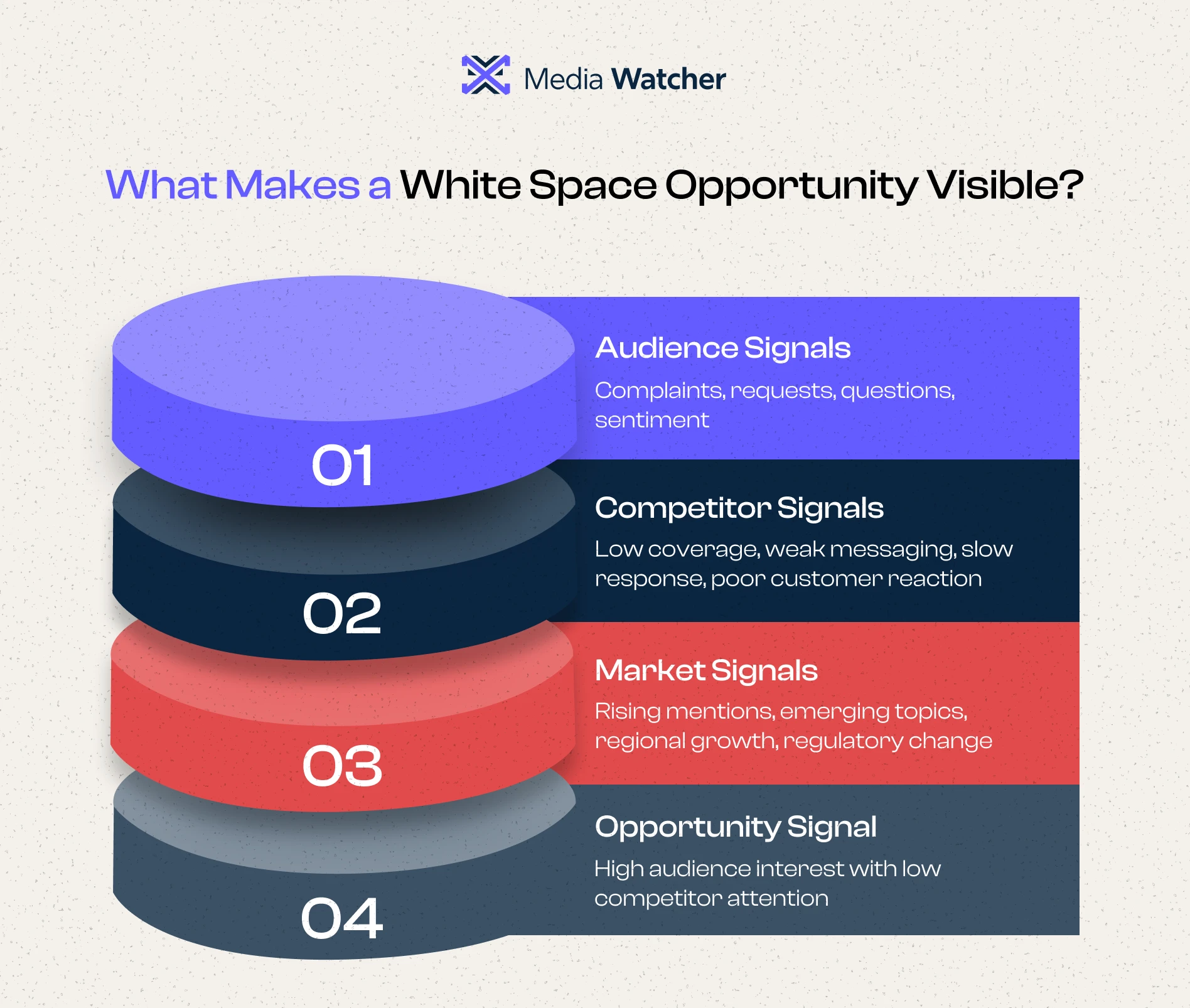
Here are nine ways media monitoring helps brands uncover white space opportunities.
1. It Reveals Recurring Customer Pain Points
Customers keep talking about the features they want in goods and services they buy. They have complaints regarding confusing interfaces, costly plans, substandard customer support, reduced functionality, and poor experience.
These discussions can be found on review platforms, social media updates, online forums, and industry forums.
One complaint is not necessarily a lot of trouble. If the same issue keeps appearing across platforms, it’s a market signal.
Media monitoring helps companies group these scattered conversations into visible patterns. A software brand may notice that small businesses repeatedly describe existing platforms as too complex. A financial service may find that customers want faster support during specific stages of their journey.
These frustrations can reveal product, service, or positioning opportunities that competitors have failed to address.
The strongest white space often begins with a sentence that customers keep repeating while the market keeps ignoring it.
2. It Exposes Gaps in Competitor Offerings
Typically, competitor analysis is a traditional approach that focuses on other companies’ offerings. Media monitoring takes it one step further by presenting the response customers have to those offerings.
Businesses can monitor their brand competitors to keep track of their product introductions, feature announcements, pricing changes, campaign messages, and customer responses using brand competitor monitoring.
It will help you determine what is missing between your competitors’ offerings and your audience’s experience.
A competitor may promote excellent customer service while online discussions tell a different story. Another may offer advanced features that customers find hard to use. The market leader can have very good coverage but low sentiment regarding price or access.
These spaces offer an opportunity for another brand to enter with a more focused, relevant offer. It’s not always a new product that’s required to create the opportunity. It may be developed as a solution that is simpler, clearer, or more reliable to a recognized problem.
3. It Identifies Underserved Audience Segments
The white space can also be found among the audience as well. Overall, it may seem like a crowded market, but certain customer groups remain poorly served.
They can be freelancers, small businesses, regional companies, younger consumers or professionals in niche industries.
Brands can use media monitoring to track conversations across location, language, sector and topic. This can help identify communities where a concern is discussed often but there is not much attention paid to it by existing providers.
For example, a business platform may discover that most competitors target large organizations while independent consultants are actively searching for a simpler alternative. A healthcare technology company may identify a strong interest in a specialty that current solutions barely address.
Using media monitoring for market research allows businesses to understand these smaller but meaningful demand pockets before committing resources to a new segment.
4. It Detects Emerging Trends Before the Market Becomes Crowded
By the time a trend appears in a major industry report, early movers may already be building products and campaigns around it.
Public conversations often reveal changing behavior sooner. Market trend monitoring helps businesses track increases in mention volume, shifts in language, new concerns, and growing interest around specific topics.
These signals may relate to technology, regulation, consumer behavior, workplace culture, or changing social expectations.
A gradual rise in discussion around data privacy, ethical sourcing, or flexible pricing may indicate that customer priorities are changing.
The key is not simply noticing a trending topic. Brands must understand why the conversation is growing, who is driving it, and whether competitors are responding.
When audience interest rises while competitor attention remains low, white space may be forming.
5. It Reveals Weakly Occupied Brand Positions
Many competitive markets suffer from messaging repetition. Every brand claims to be faster, smarter, easier, or more innovative. Over time, these promises lose their ability to create distinction.
Competitive media monitoring helps brands compare the messages competitors promote with the values customers actually discuss.
Suppose every company in a category competes around speed while customers increasingly care about trust, privacy, and transparency. A brand that owns those concerns may create a much stronger position than one that simply claims to be slightly faster.
Media monitoring can reveal which benefits dominate competitor communication and which important customer priorities remain unclaimed.
This creates positioning white space. It gives a brand an opportunity to become strongly associated with an idea that matters but lacks a clear owner.
6. It Uncovers Regional and Language Based Opportunities
Customer priorities can change dramatically across markets.
A message that performs well in one country may feel irrelevant in another. Product concerns, buying behavior, and cultural expectations also vary between regions.
Media monitoring allows companies to study local conversations rather than relying only on global averages. This can reveal regional demand, emerging issues, and differences in customer sentiment.
A product category may be highly competitive in one market but underdeveloped elsewhere. Customers in a specific region may discuss affordability, localization, or regulatory requirements more frequently than customers in other locations.
These patterns can guide geographic expansion and help brands adapt their positioning before entering a new market.
White space is not always a new idea. Sometimes it is an existing solution brought to the right market with the right message.
7. It Finds Content and Narrative Gaps
White space also exists in communication. Customers frequently ask questions that no brand answers clearly. Industry publications may focus on major developments while ignoring practical concerns.
Competitors may publish large volumes of content around the same familiar keywords. Media monitoring can identify these unanswered questions and overlooked narratives. Useful signals include:
- Repeated customer questions
- Topics gaining engagement but receiving limited expert coverage
- Common misconceptions
- Emerging search language
- Industry concerns competitors avoid discussing
These gaps can become opportunities for thought leadership, educational content and campaign development.
By using media monitoring insights, brands can create content around what audiences are already trying to understand. This improves relevance and helps the business build authority before a topic becomes saturated.
8. It Helps Validate Whether White Space Represents Real Demand
Not every complaint or emerging conversation represents a viable business opportunity.
A topic may generate attention for a few days and then disappear. A small number of vocal users may create the appearance of widespread demand. A competitor’s weakness may be real but unrelated to the brand’s capabilities.
Media monitoring for market research helps companies validate potential white space by examining:
- Conversation volume
- Growth over time
- Sentiment intensity
- Audience relevance
- Geographic distribution
- Source credibility
- Competitor response
- Engagement patterns
A promising opportunity usually appears across multiple signals. Customers discuss the issue repeatedly, the conversation grows over time, and competitors remain slow to respond.
Validation prevents brands from building strategies around temporary noise. It helps decision makers focus on gaps that show genuine momentum and commercial relevance.
9. It Turns Market Conversations Into Action With Media Watcher
Finding white space manually can be difficult. Relevant conversations can be heard on news media, social media, podcasts, radio, television, and online forums. Media Watcher aggregates these data signals to help teams understand the evolution of industry, competitor, and public narratives.
Additionally, Media Watcher allows brands to track competitor mentions, follow key topics, interpret sentiment in mentions, track share of voice, and detect sudden shifts in conversation volume. Teams can even follow entities and hashtags throughout several channels, languages, and regions.
It provides brand managers, marketing teams, researchers, and product strategists with insight into the extent to which marketplace attention is expanding and where it still lags.
Instead of relying on disconnected searches and periodic reports, businesses can continually assess customer needs, competitor activity, and new narratives.
Media Watcher helps transform competitive media monitoring from a reporting exercise into a source of opportunity intelligence.
Find the Gap Before Everyone Else Sees It
Opportunities in competitive markets are ample. They just make those opportunities less obvious.
Competitive analysis through media monitoring enables businesses to be outside the comfort zone of products and known competitors. It shows common frustrations, unmet audiences, changing expectations, and new conversations.
The goal isn’t to be trendy or to respond to every mention, but to detect meaningful patterns of customers’ demand growing faster than the market response.
Media Watcher enables brands to monitor those trends across channels and make sense of public dialogue.
The next market opportunity may already be taking shape. The right media monitoring platform helps you see it before the space becomes crowded. Book a demo or contact Media Watcher’s team today!