


A major news story rarely stays in one place. A breaking announcement may first appear on a wire service. Within minutes, dozens of publishers can republish it. Other outlets may shorten the story, rewrite the headline, add a paragraph of commentary, or combine it with previous reporting.
For a reader, this looks like widespread coverage, and for a media monitoring system, it creates a much harder question: “Are these 100 different stories or 100 versions of the same story?”
This is where news deduplication becomes an important part of modern media monitoring.
Without an effective way to identify duplicate news content, monitoring platforms can overwhelm users with repeated alerts, inflate mention counts, and create a misleading picture of how much original coverage a topic has actually received.
At the same time, simply removing every repeated article would create another problem. Syndication is itself meaningful. If one original report is republished across 70 news outlets, that distribution tells PR teams something important about the reach and momentum of the story.
Effective media intelligence therefore has to do two things at once:
Reduce repetition without losing the signal created by amplification.
Modern approaches combine content comparison, metadata, clustering, and increasingly sophisticated AI news analysis to understand not only whether two articles look similar but whether they are actually telling the same story.
Research into near-duplicate detection has long used techniques such as document shingling and similarity measurement, while newer news clustering approaches increasingly use semantic embeddings to identify articles covering the same substantive event even when the wording differs.
What Is Duplicate News Content?
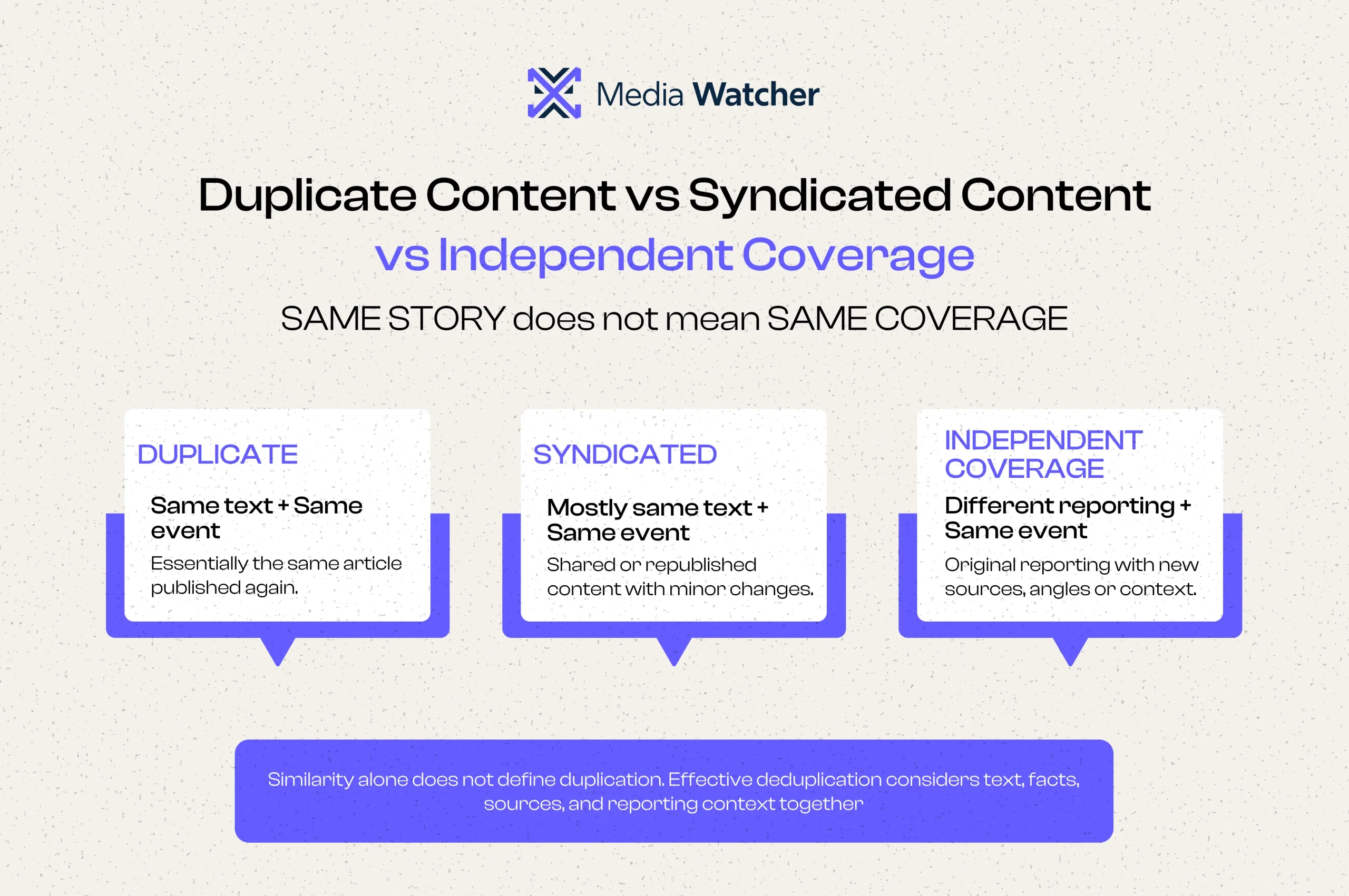
Duplicate news content is broader than two webpages containing exactly the same text. In media monitoring, repetition usually falls into several categories.
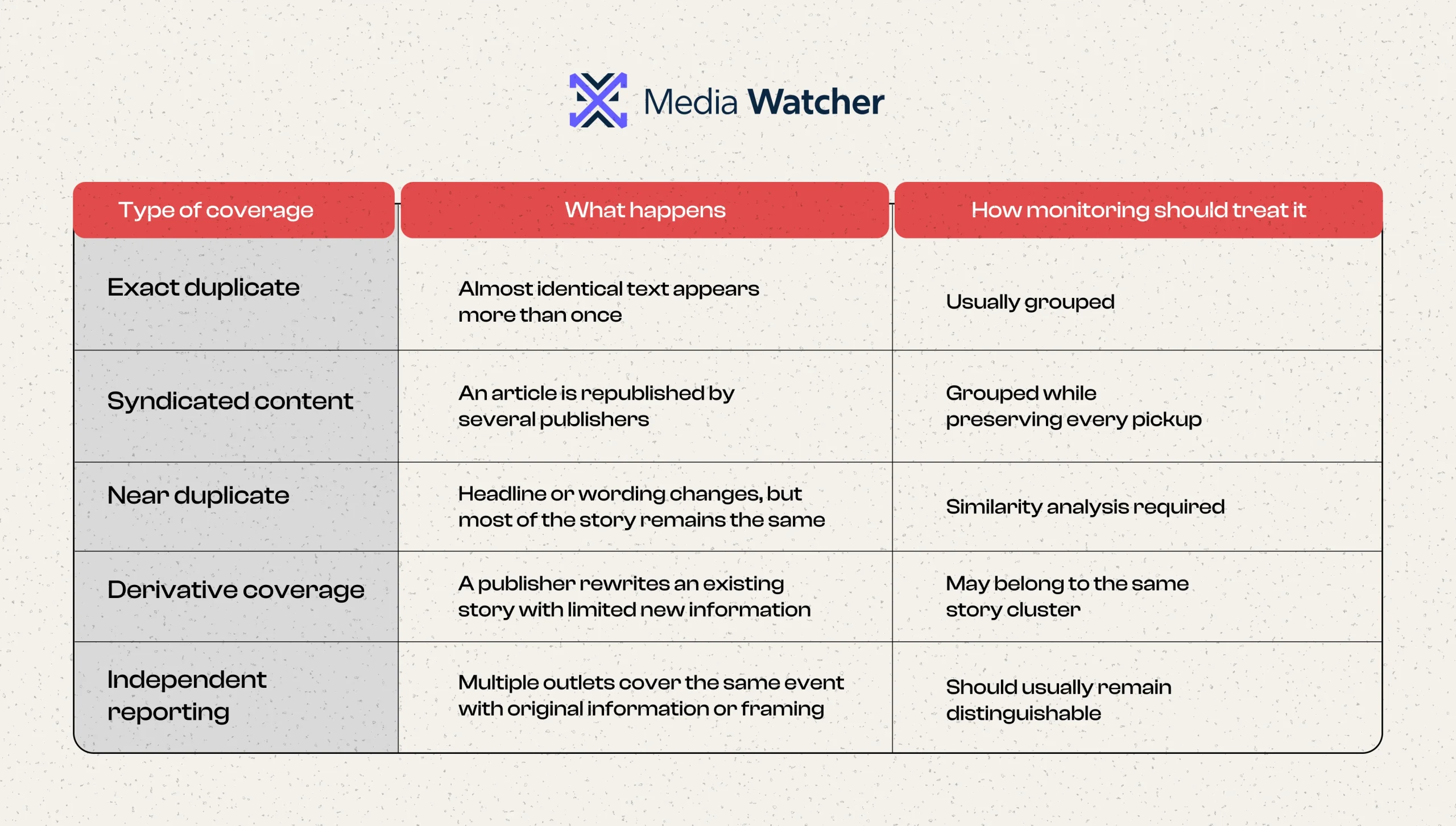
This distinction matters because content syndication is not the same thing as accidental duplication.
A publisher may legitimately distribute an article to partner websites. A wire story may appear across regional outlets. A corporate announcement can also trigger dozens of stories based heavily on the same source material.
The articles are separate media mentions, but they may not represent separate pieces of journalism.
This is why sophisticated media monitoring focuses on identifying relationships between articles rather than blindly deleting repeated URLs.
Why News Content Aggregation Creates a Deduplication Problem
Modern news content aggregation brings information from a very large number of sources into one environment.
That is exactly what makes monitoring useful. A PR team should not have to open hundreds of news websites every morning to determine whether a brand has been mentioned.
But broader coverage also increases repetition.
Imagine a company announces an acquisition at 9:00 AM. A financial news service publishes the announcement at 9:03. Then a national publisher republishes the story at 9:07. Moving further, the regional outlets begin carrying versions of it at 9:15. Industry publications rewrite the announcement throughout the morning.
Commentary pieces appear later in the afternoon. A traditional keyword search might treat every matching page as an individual result. A media intelligence platform needs to understand the structure underneath those results.
Thus, some may be direct copies. Some may be lightly edited. Some may be genuinely new reporting.
The objective of news deduplication is therefore not simply to reduce a number. It is to organise coverage according to how much genuinely new information each article contributes.
Why News Deduplication Matters for Media Intelligence
Poor deduplication affects much more than the appearance of a monitoring feed. It can affect the conclusions teams draw from their data.
Inflated Media Mention Counts
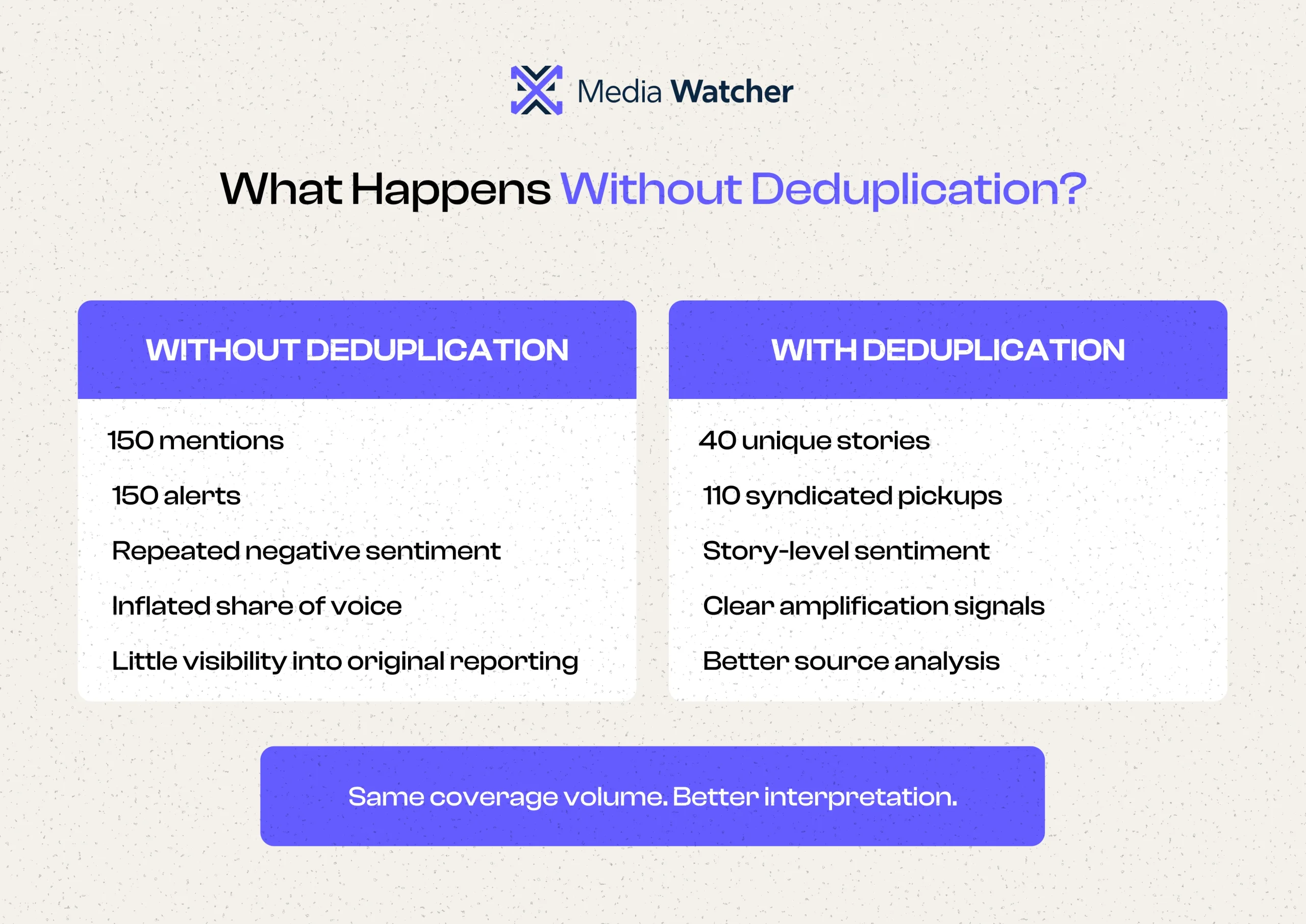
Suppose an announcement produces 150 online articles. If 110 are syndicated versions of the same original report, saying the organisation received 150 independent pieces of coverage would be misleading.
A useful media intelligence report should allow analysts to distinguish between:
Unique stories that are 40 and total published mentions that are 150. Thus, both numbers matter, but they simply answer different questions.
Alert Fatigue
If every syndicated copy produces another alert, an important breaking story can fill an inbox with dozens of notifications that contain almost identical information.
The team may technically be receiving more data while gaining almost no additional intelligence.
Distorted Sentiment Analysis
Repeated content can also magnify sentiment. If one strongly negative article is syndicated across 50 outlets and every copy is analysed independently, an unadjusted sentiment dashboard could make that single narrative appear far more diverse than it really is.
The distribution is still important. But analysts need to know that the negative coverage originated from one story family rather than 50 unrelated editorial decisions.
Misleading Share of Voice
Duplicate coverage can influence competitive comparisons too. One competitor may receive 200 mentions because a single announcement was widely syndicated. Another may receive 120 mentions from dozens of independently written articles.
Raw volume alone does not explain which company generated broader original editorial attention. Deduplication gives media intelligence the context required to interpret these numbers properly.
How Media Monitoring Handles Duplicate Coverage
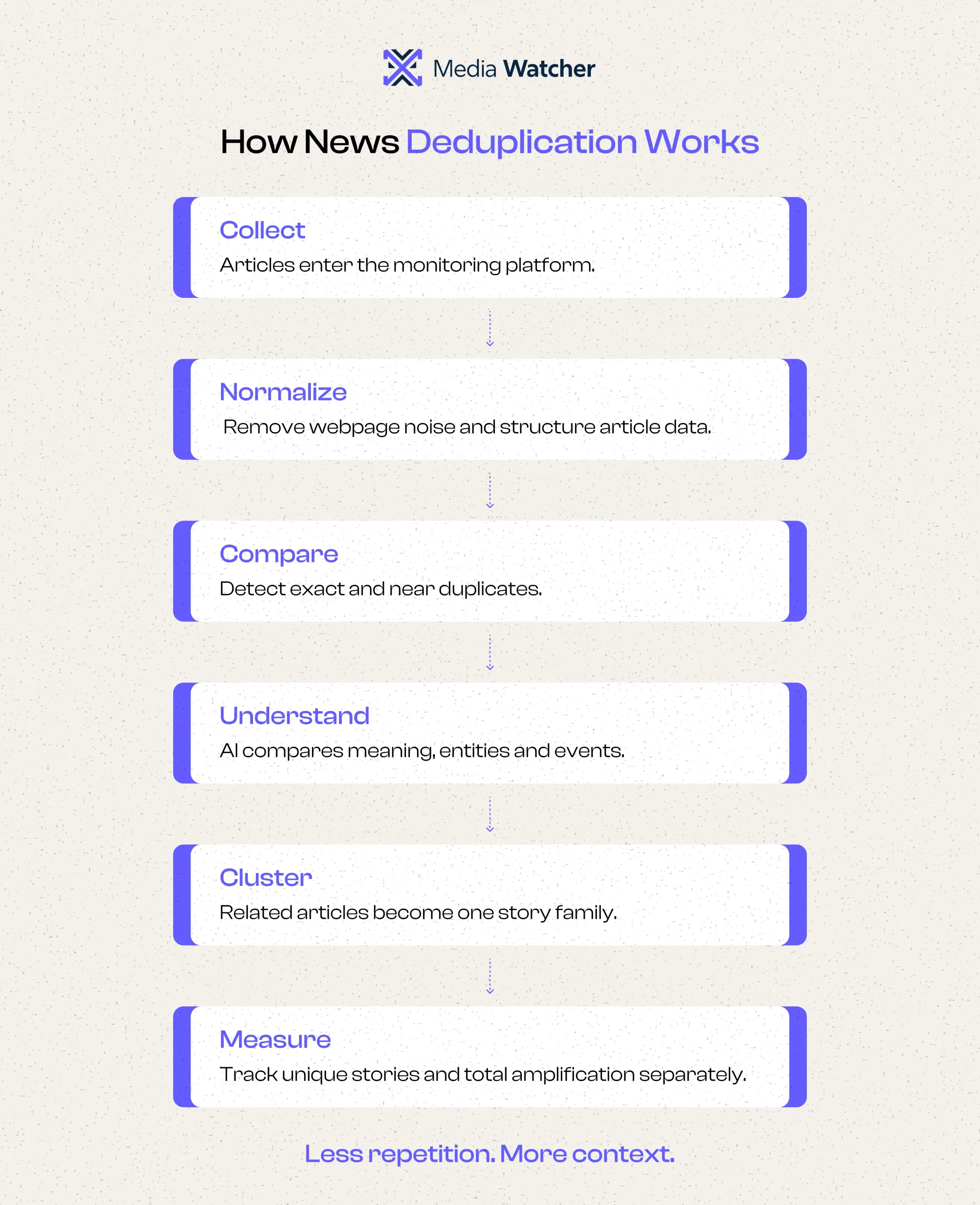
So, how does media monitoring handle duplicate coverage when thousands of articles are entering a system continuously? There is no single universal algorithm. Modern systems can combine several stages of analysis.
The Content is Collected and Normalised
The process begins when articles are ingested from publishers, news feeds, and other online sources.
Before meaningful comparisons can happen, the system may normalise the content.
This can include separating the main article from navigation elements, promotional blocks, and other repeated webpage material. Headlines, publication times, author information, source details, and URLs can also become part of the structured record.
URL information can help identify duplicate pages, particularly when publishers expose canonical information. Google itself uses canonicalization to group substantially similar URLs and select a representative version. In broader media monitoring, however, URL signals alone are not enough because syndicated articles frequently appear on entirely different domains.
Exact Duplicates Can Be Identified Quickly
If two articles contain essentially identical normalised text, the easiest form of news deduplication is a direct comparison.
Systems can create compact fingerprints of content and compare them rather than repeatedly comparing entire documents. This works well when the text has not materially changed.
But online news is rarely that tidy. A publisher may change a title, add a local introduction, remove several paragraphs or insert its own formatting. The system therefore needs a way to recognise near duplicates as well.
Lexical Similarity Detects Near Duplicate Articles
One established technique is to divide text into overlapping sequences of words known as shingles. The resulting sets can then be compared to estimate how much textual material two documents share.
Techniques such as MinHash can make these comparisons more efficient when working with large document collections. Stanford’s information retrieval material describes shingling and MinHash based approaches for identifying near duplicate webpages, while recent research evaluating news monitoring pipelines has also found LSH with MinHash useful for near-duplicate news detection.
This can identify articles whose wording is overwhelmingly similar, even if a few sections have changed. However, lexical similarity still has limits.
Consider these headlines: ‘Company X acquires fintech startup Y for $500 million’ and ‘Fintech Y bought by Company X in major expansion deal’
The words differ significantly. The event does not. That is where semantic analysis becomes valuable.
AI News Analysis Compares Meaning, Not Only Words
Modern AI news analysis can represent an article according to its semantic meaning. Instead of asking only: “How many words do these articles share?”
The system can ask: “Are these articles describing the same event?” Semantic representations can account for entities, topics, relationships, locations, and other contextual signals.
Recent research on multilingual news clustering demonstrates how contextual embeddings can be used to organise articles into themes, topics, and individual news stories based on substantive similarity.
This is especially useful when publishers paraphrase a syndicated report or when different outlets cover the same development using very different wording.
Articles Are Organised into Story Clusters
Once similarities have been calculated, related articles can be grouped into a story cluster. Instead of a dashboard showing:
- Article 1
- Article 2
- Article 3
- Article 4
- Article 5
- Article 6
The interface can conceptually show: Story: Company X acquires Company Y, along with 42 related articles. The user can then expand the story to inspect individual sources.
News clustering has been studied specifically for streaming environments where articles arrive continuously, and story structures change over time. Google research, for example, has explored methods that group incoming news into focused storylines while identifying topics, entities, and the temporal evolution of those stories.
That temporal element matters. A story is not static.
New reporting may introduce a regulatory response, executive comment, market reaction or previously unknown detail. The cluster must therefore evolve as the news develops.
A Representative Article Can Be Selected
After related articles are grouped, the system can determine which version should represent the cluster.
The representative article could be selected using signals such as publication timing, completeness, similarity to other members of the cluster, or source characteristics.
This does not necessarily mean declaring one publisher the true original source.
Publication timestamps can be unreliable. Stories can also move between wires, partners and publishers extremely quickly.
The purpose is to give the user a clear entry point into the story while preserving access to the wider coverage.
Syndicated Copies Remain Valuable Data
This is one of the most important parts of how media monitoring handles duplicate coverage. Deduplication should not make syndication disappear.
Imagine one report originates from Publisher A and is subsequently carried by 75 other outlets. From a reading perspective, the user probably does not need to open all 76 copies. From a media intelligence perspective, those 75 pickups can be highly significant.
They reveal how far the story travelled. A strong monitoring model therefore separates content uniqueness from distribution volume.
The system can collapse the repeated reading experience while retaining information about every publisher that carried the story. In other words, content syndication becomes a propagation signal rather than dashboard clutter.
Monitoring Results Become More Usable
The final stage is presentation. Instead of forcing analysts to understand hundreds of repeated headlines individually, the platform can organise the information around stories, sources, sentiment, reach, timing and other signals.
This turns news content aggregation into actual analysis. The value is not merely collecting more news. It is understanding what the collected news represents.
The Role of AI in News Deduplication
Traditional matching remains valuable, particularly for exact and near exact copies. AI becomes more useful as the differences between articles become more subtle. An AI news analysis workflow can examine several dimensions at once.
- It can identify whether articles mention the same people and organisations.
- It can compare the events being described.
- It can recognise whether different words express similar meaning.
- It can distinguish a story announcing an event from another story analysing its consequences.
It can also support multilingual clustering where the same event is reported in different languages. Research in multilingual news analysis increasingly uses cross language or multilingual embedding techniques to identify semantically related stories across linguistic boundaries.
This moves deduplication beyond simple copy detection. The real question becomes: How much new information does this article add to what is already known?
That is a much more useful question for PR teams, researchers, and analysts.
Why Syndication Should Be Measured, Not Ignored
If repeated content were completely removed, PR teams would lose valuable insight into amplification.
Consider a hypothetical crisis. A national outlet publishes one critical investigation. Within two hours, 60 regional and industry publications pick up the report. Only one original investigation exists.
But the reputational situation has clearly changed. The correct interpretation is not 61 independent negative investigations. Nor is it only one media mention.
A better interpretation is: One originating story generated 60 additional pickups, creating widespread negative amplification. That distinction is exactly what media intelligence should make visible. Teams need to understand both the source of a narrative and its distribution.
Common Challenges in News Deduplication
Even advanced systems face difficult cases.
Headlines Designed for Different Audiences
Publishers can dramatically rewrite headlines while retaining almost identical article bodies.
Partial Syndication
One outlet may reproduce only the first half of an article and add original commentary beneath it.
Press Releases
Dozens of publishers may reproduce information from the same press release without directly copying one another.
Developing Stories
An article published at 10:00 AM may be updated repeatedly throughout the day. A later version could contain important new information.
Multilingual Coverage
Two articles can describe exactly the same event in different languages while sharing almost no surface-level vocabulary.
Similar Events
Two lawsuits, earnings announcements, or regulatory actions involving the same company can occur close together. Overly aggressive clustering could incorrectly merge separate developments.
- For this reason, deduplication always involves a balance.
- If similarity thresholds are too strict, duplicates remain separate.
- If they are too loose, genuinely different reporting gets collapsed.
- The goal is not maximum deduplication.
- It is accurate story organisation.
What PR and Communications Teams Should Measure
Once duplicate and syndicated content are handled properly, reporting becomes far more useful. PR teams should avoid relying on one headline number. Instead, consider analysing:
- Total mentions to understand overall visibility.
- Unique stories to understand the amount of distinct coverage.
- Syndicated pickups to understand amplification.
- Source diversity to see how widely coverage moved across publisher types or markets.
- Story-level sentiment to understand the tone of distinct narratives.
- Article-level sentiment to identify how tone changes as a story spreads.
- Reach and influence to understand which publishers or voices had the greatest potential impact.
This prevents one heavily syndicated article from being mistaken for dozens of independent editorial signals.
Turning News Noise Into Media Intelligence With Media Watcher
The biggest challenge in media monitoring is no longer access to information. It is turning enormous volumes of information into something people can actually interpret.
Media Watcher is built around that broader media intelligence challenge. Its platform monitors more than 100,000 media sources across 80+ languages and 235+ regions, bringing news and other media signals into a unified environment. It also provides contextual filtering, article summaries, sentiment analysis, influence signals, reach metrics, and historical analysis.
These capabilities matter because media teams rarely need another endless stream of links.
They need to understand what is changing.
- Which story started the conversation?
- How widely did it spread?
- Is the apparent surge in coverage coming from independent reporting or syndication?
- Which sources are shaping the narrative?
- Has sentiment shifted as the story moved?
- And which developments actually deserve attention?
That is the difference between monitoring media and understanding it.
Effective news deduplication, intelligent news content aggregation, contextual AI news analysis, and visibility into content syndication all contribute to the same outcome:
A clearer picture of the story behind the volume. When hundreds of headlines can originate from only a handful of underlying narratives, media intelligence should help teams see both sides of the equation.
Not just how much coverage exists. But how much of it is actually new.