

Consider a scenario in which a stock drops 4% on Wednesday, and by Friday, nobody remembers the headline that sparked it. What they missed wasn’t the news itself. It was three days of coverage accumulating toward a move that technicals never flagged.
That gap lies between when a story starts building on multiple, distinct sources and when it finally hits the price. Market trend monitoring either closes that gap or it doesn’t. Most tools only arrive after the price has already moved.
What Market Trend Monitoring Means for Traders
The terminology refers to two different things; it is important to note the distinction. When it comes to business, market trend monitoring involves the surveillance of consumer patterns or industry data on a quarterly basis.
That applies to product teams, not to Prop Traders that are keeping tabs on intraday positions. Market trend analysis is one of the essentials for equity traders to keep an eye on the type of information that piles up around a stock before it enters a price.
The price provides information about market history, while a narrative building across outlets and a tone change indicate how sentiment is likely to continue.
Most Prop Traders are very active in monitoring price and volume data daily. Even fewer trace the story that builds as those numbers go up. It is right there that the very first signals traded reside.
How a News Narrative Builds Into a Tradeable Trend
A narrative evolves through four stages, each with a different level of confidence. Knowing which stage a story is in determines whether it is worth acting on at all.
- Stage 1, first mention: one or two outlets cover the story early. Volume is low, tone is mixed, and price ignores it entirely. Most monitoring tools register this stage as background noise.
- Stage 2, coverage growth: the story spreads across 10 to 30 independent sources. Source diversity separates genuine news from aggregator recycling. Thirty newsrooms reaching the same conclusion independently is a different signal entirely.
- Stage 3, tone convergence: language across coverage starts moving in one clear direction. Sentiment shifts from neutral to directional, and price typically lags this stage by hours to days at a minimum.
- Stage 4, price reaction: the market finally prices in the narrative fully. The entry or exit window that mattered for most active traders has already closed well before this point.
On June 3, 2026, XRP dropped more than 5% to a 15-week low. Exchange balances were shrinking, and Binance inflows were at their lowest level in a year. ETF capital was still flowing in at a pace. Every technical indicator available to chart readers pointed toward accumulation.
CoinDesk documented the divergence on June 3, 2026: a cautious tone had built across coverage well before $1.25 broke. The narrative had already reached Stage 3 before most charts showed anything wrong.
The Difference Between a Signal and Noise in Financial Stock News
Day trading news coverage spikes every single day. Most of it is recycled wire copy that changes nothing about a position’s risk profile. Three filters separate a real narrative signal from that noise.
Source diversity asks whether the story is appearing across independent editorial outlets. A genuine narrative trend emerges across separate newsrooms, each reaching the same conclusion independently. One wire republished by fifty aggregators is not the same thing.
Persistence checks whether the story has attracted new coverage after 48 to 72 hours. Reactions to short-lived spikes are typically event reactions. Narratives that continue to get coverage move the price.
The question of tone consistency is whether sentiment towards coverage is moving in a common direction. When the tone is mixed at high volume, it means that the market is uncertain, not the direction. The signal that can be traded is the consistency of tone across various sources.
The Robinhood week of May 22-28, 2026, illustrates this working against headline numbers. Tearsheet PRO (June 2, 2026) tracked the story. Crypto trading revenue had fallen roughly 47% year-over-year, which is a figure that would typically signal negative price pressure.
The media narrative framed Robinhood’s moves as structural repositioning instead. The tone of coverage was generally positive, focusing on the new crypto rails and diversified revenue models. HOOD closed the week at $84.84, which surprised analysts watching only the revenue figure for direction.
Why Most Market Trend Monitoring Software Misses the Narrative Layer
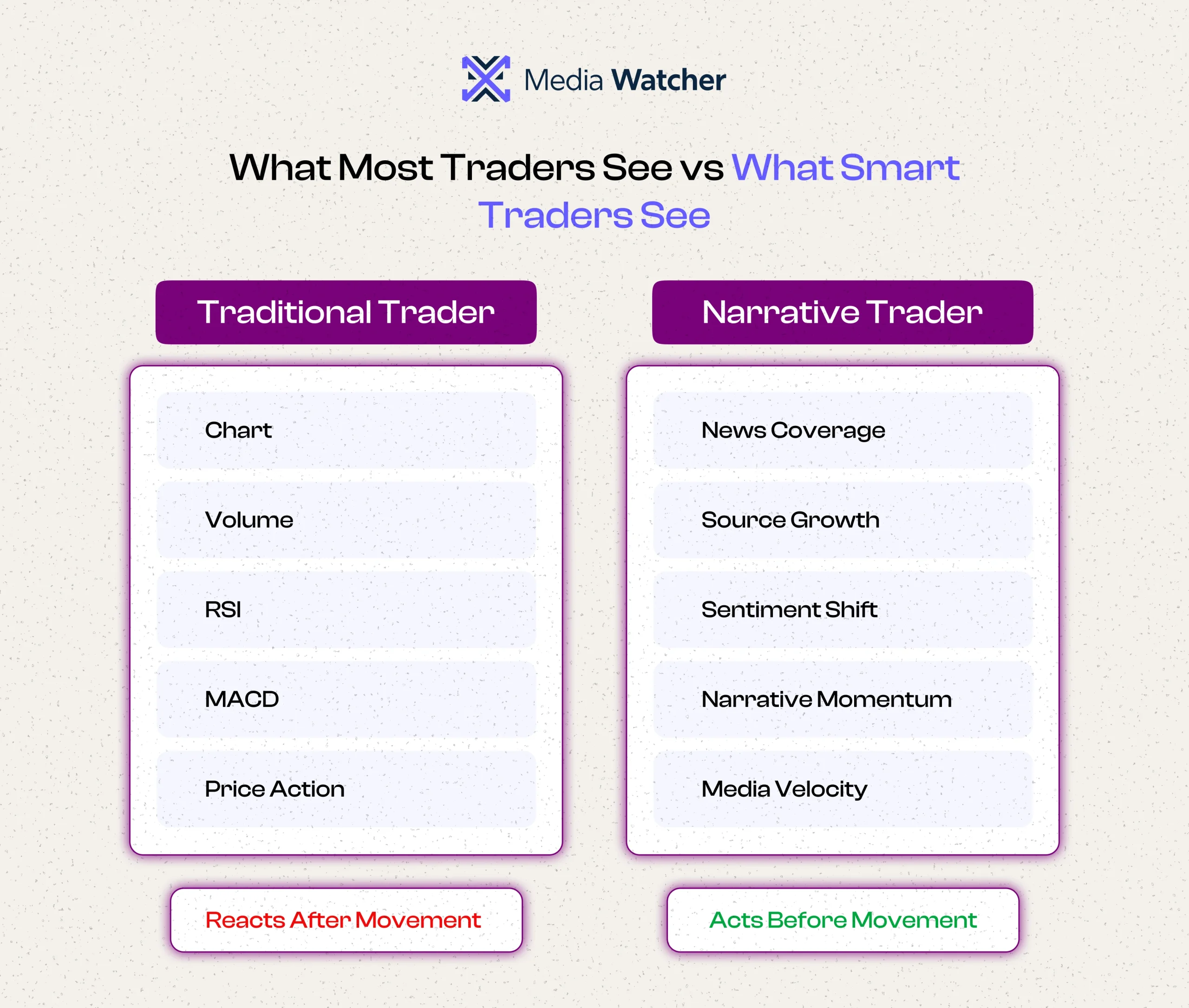
Standard market trend monitoring software is built around price action. Moving averages, RSI, MACD, and volume patterns answer what a stock has already done. None of them answers what the market is starting to believe a stock will do next.
This is not a flaw in technical analysis, but a scope problem. Chart-based tools track price history and do it well. What they cannot do is track language shifting across thousands of financial news sources on a specific ticker.
Financial stock news alerts built on keyword triggers carry the same blind spot. A keyword alert fires when a term appears. It cannot distinguish a tier-3 blog mention from the same story breaking across Bloomberg, Reuters, and the Financial Times within six hours.
The narrative layer is where sentiment analysis closes that gap most effectively. Source authority weighting combined with tone direction reveals the patterns that raw keyword volume alone never surfaces reliably.
How Investment Watcher Turns News Sentiment Into Stock Sentiment Alerts
Investment Watcher runs on Media Watcher’s infrastructure, monitoring 100,000+ sources across 235+ regions in 80+ languages. For Prop Traders, the workflow starts with a personal portfolio of up to 15 tickers.
Investment Watcher continuously tracks the media framing and headlines around each holding. It monitors tone shifts in coverage, not just unfiltered ticker mentions. When tone shifts direction, sentiment change alerts arrive within 200ms of publication.
That latency is the practical edge for day trading news workflows. A narrative shift reaching a trader 90 seconds late is already priced by fast-money desks. The 200ms threshold means the alert arrives before a story reaches a second outlet.
The market is broad and calm, and there’s a single-ticker story going down, which is a signal. Investment Watcher features a Fear & Greed Index in addition to ticker-level tracking. This combination provides Prop Traders with context that no chart can provide alone.
One internet-based hedge fund feeds Media Watcher’s trading signals and real-time sentiment scores directly into their algo system. 6-month returns up 15%. The edge was acting on narrative shifts before competitors noticed anything in the price data.
Price data is what has already occurred with a stock, and it tells Prop Traders what has happened. They hear what the market is beginning to believe in through the narrative that builds over the years, which they accumulate from financial news. By the time that belief shows up in price, the window that mattered is already closed.
Watched tickers are having narrative shifts that are being compounded across sources, with no manual workflow to catch up in time. Schedule a Demo to discover how Investment Watcher reveals them before price does.