

Breaking news moves quickly. A claim can travel from one social post to several headlines before a journalist has time to identify where it started.
For newsrooms, finding a developing story is only half the challenge. Reporters must also verify quotes, confirm claims, and separate original reporting from repeated speculation. They often need to complete this work within minutes while competing outlets are already publishing.
This is where breaking news monitoring becomes valuable. It gives journalists an earlier view of emerging stories and more time to investigate them before the deadline closes.
But receiving an alert does not necessarily indicate a claim is correct. Between 2024 and 2025, Apple used its own AI to generate news alerts, underscoring the importance of verifying them before using the information they provide.
Apple’s False AI News Alerts Exposed a New Risk
Apple Intelligence added notification summaries to quickly give users an overview of message and app notifications. Instead of showing every headline separately, the system used generative AI to create a short summary.
A fake notification claiming that Luigi Mangione had shot himself was the technology’s latest blunder in December 2024, when it appeared on the BBC website. The BBC hadn’t reported that Mangione had died, but he was arrested for the murder of the chief executive of UnitedHealthcare, Brian Thompson.
Apple Intelligence had generated the false statement as part of a summary of the BBC News app’s actual notifications. However, the summary was accompanied by a BBC logo, so the user may reasonably have assumed that it was written or reported by the BBC.
Further inaccurate summaries of the situation were made. Apple’s technology was prematurely revealing the result of the PDC World Darts Championship to darts player Luke Littler before the final. Another summary falsely stated that Rafael Nadal is a tennis player.
In January 2025, Apple briefly paused headlines summarization in the news/entertainment app notifications while it works on improvements. Later software changes also made summaries visually clear and provided additional options to turn them off.
The case raised an important question pertinent to journalism today. Whereas information could previously be adapted only from the publisher to the recipient, it can now be adapted in both directions.
If an article is used as the basis for an AI tool, aggregator, repost, or summary, the meaning might change even though the facts are reported correctly. For journalists who are accustomed to live alerts, seeing the original source will be crucial.
Why Breaking News Alerts Still Require Verification
Breaking news alerts are intended to shorten the time from the event to when the newsroom becomes aware of it. That’s helpful, but it can also put pressure on to publish before all the facts.
During a developing story, reporters may encounter:
- A quotation without its full transcript
- A screenshot without a visible date
- A company statement repeated without context
- A translated claim with different wording
- Several articles relying on the same unnamed source
- AI-generated summaries that omit important qualifications
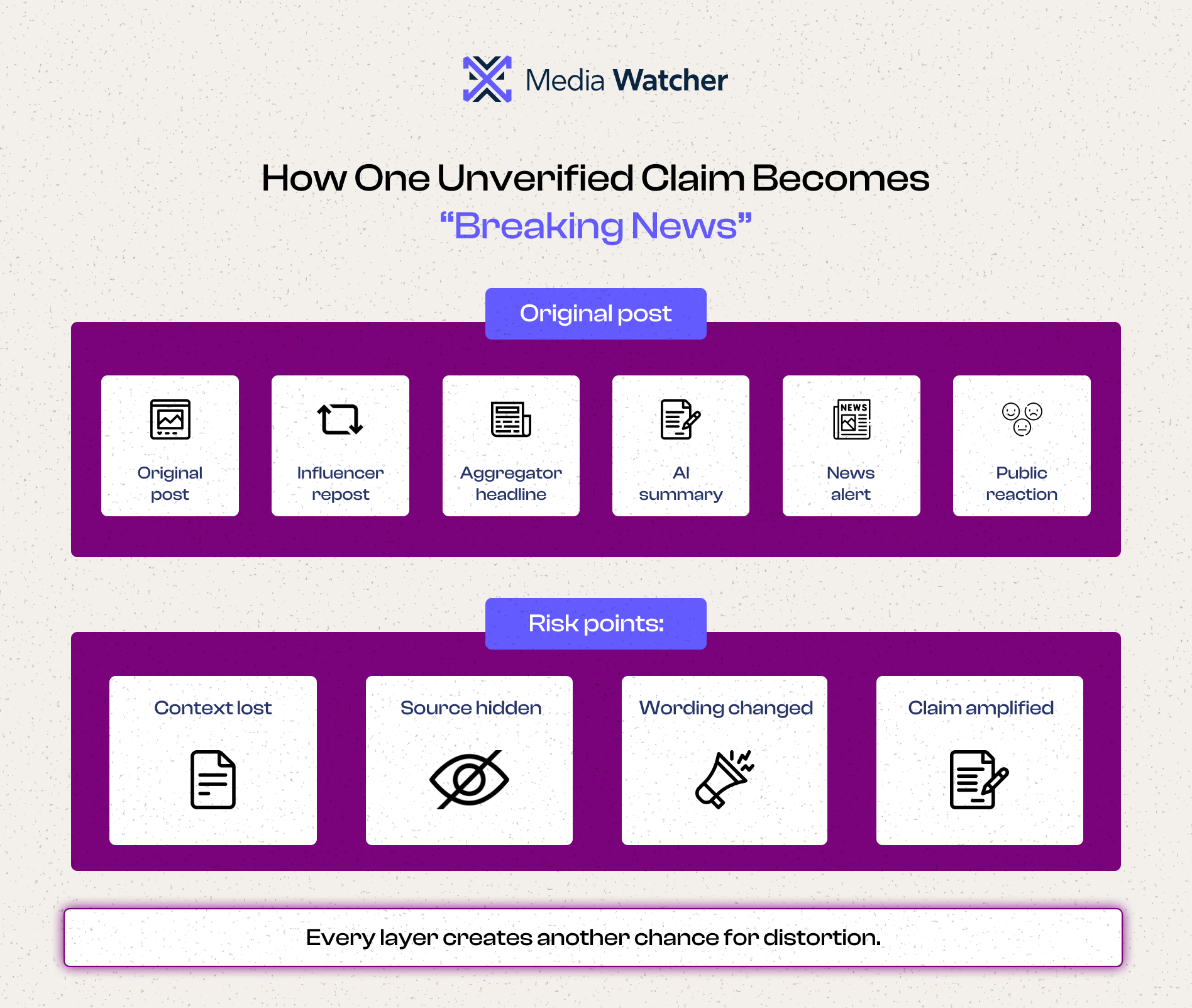
Repetition can easily be mistaken for confirmation. Five publications may carry the same claim, but all five could be relying on a single social post.
A credible breaking news monitoring process is supposed to show journalists how a claim is developing, where it first appeared, and if the independent sources are confirming it.
The goal is not simply to receive more alerts. It is to receive useful signals that lead reporters back to reliable evidence.
How Real-Time News Alerts Support Faster Verification
1. They Reveal Emerging Claims Earlier
Real-time news alerts may appear as an abnormal mention before it turns out to be major news. This allows reporters to investigate the claim before they find out about it after the story has picked up momentum.
For example, a journalist receives an alert that contains a quote that is not accepted, and they need to look for the interview, speech, or press release. The journalist can then check whether the original has been passed down word-for-word or reworded.
Early awareness creates a verification advantage. It does not provide automatic proof.
2. They Help Trace the Original Source
The first task after receiving an alert should be to identify where the information came from.
Journalists may conduct a “find all” search for exact matches of the quote, the interviewee’s name, the organization’s name, and the event location. The earliest reference can result in an official account, a local report, a witness post, or unnamed screenshots.
The first source is not necessarily reliable. It is just the beginning and the point for more investigation.
Effective news monitoring alerts should make it easier to follow this trail across publications and platforms rather than presenting every mention as equal.
3. They Make Independent Comparison Faster
A claim appearing in several places can look credible even when every article is copying the same report.
Journalists must determine whether different outlets have obtained separate confirmation. This may involve comparing named sources, official documents, direct quotations, and reporting from local correspondents.
News alerts for journalists are most valuable when they provide access to varied sources, regions, and languages. This broader view helps reporters identify whether the story is being independently verified or merely repeated at scale.
In Apple’s case, opening the original BBC article would have immediately shown that the AI summary did not reflect the broadcaster’s reporting.
4. They Surface Corrections and Denials
Breaking stories rarely remain unchanged.
Authorities revise figures. Companies clarify statements. News organizations update headlines. Sources deny quotations that were attributed to them.
Journalists can continue to monitor for the central claim and add in terms like “denied,” “correction,” “retraction,” “clarification,” and “confirmed.”
This way, the newsroom can catch any changes after the article is published and correct them so that they do not reach other readers with inaccurate information.
A good news alert software should not be used to complete the monitoring process, and should be applied continuously.
5. They Help Preserve Proper Attribution
Under deadline pressure, a small wording change can create a major accuracy problem.
Think about how it would be different to say: “A data breach exposed 10 million customers,” and: “A hacking group claims a data breach exposed 10 million customers.”
The first presents the figure as fact. The second makes it clear that the number has not yet been independently confirmed.
Real-time news alerts for journalists should help reporters see who is making each claim and how other credible sources are describing it. This enables newsrooms to publish developing information without removing necessary uncertainty.
A Practical Alert-to-Publication Workflow
Journalists can use the following process whenever an alert contains an important quote or claim.
Capture the Signal
Record the alert’s wording, source, timestamp, and platform. A screenshot may help document what appeared, but it should not be treated as confirmation
Note the wording of the alert, source, time, and platform. One may be able to help by showing a screenshot that captures what happened, but it is not proof.
Open the Original Source
Don’t depend on the notification, it is not enough. Read the entire article, statement, filing, or social post.
This step is particularly crucial when AI or another automated system provides a summary of the original material.
Identify the Claim
Separate what is confirmed from what is alleged. Determine whether the information is a direct quote, official figure, eyewitness account, leaked document or third-party allegation.
Trace Its Origin
Search for exact wording, names, and related terms. Check whether the quote appears in an official transcript, recording, or statement.
Find Independent Confirmation
Look for another credible source that has verified the information separately. Several reports based on the same initial source do not count as independent evidence.
Publish With Accurate Attribution
If there are missing facts, show that. The use of phrases like “according to,” “the company said,” or “has not been independently verified” helps safeguard the accuracy of the report.
Continue Monitoring
Keep the query active after publication. Corrections and new evidence can appear minutes or hours later.
What Journalists Should Include in Monitoring Queries
Broad searches create too much noise. A query such as “Apple news” may produce thousands of unrelated results.
More focused breaking news monitoring can include:
- Exact phrases from disputed quotations
- Names of people and organizations
- Locations connected to the event
- Official agencies and public bodies
- Terms such as “confirmed,” “denied,” and “correction”
- Relevant languages and geographic filters
- Exclusion terms that remove unrelated coverage
Queries should also change as the story develops. A broad query may help discover the event, while a more precise one can track a particular statement or source.
The best alerts reduce noise while keeping the newsroom informed about meaningful developments.
Turn Breaking News Monitoring Into Better Reporting With Media Watcher
Journalists should not have to choose between publishing quickly and reporting carefully.
Media Watcher helps newsrooms track international media and social conversations through tailored keyword searches, media alerts, and ongoing monitoring. Teams can filter relevant coverage, analyze how conversations differ across regions, and follow changes in public sentiment as a story develops.
A journalist can therefore use Media Watcher to identify a developing claim, locate other reporting on it, and then monitor corrections or reactions after the article has been published, rather than having to search through scattered sources.
The media intelligence features of the platform enable reporters to gain insight into the content and not just what people are saying, but where people are saying it and how people are reacting to it.
The first alert should never be the final answer. With Media Watcher, newsrooms can spot the signal earlier, investigate the source faster, and publish with stronger context before the deadline closes.
Know when the story starts. Verify before it spreads. Book a Media Watcher demo today.