

Viral moments are rarely big, as they never begin with a million views. They usually start quietly: a phrase repeated by some creators, an unusual jump in the comments, a complaint that gets reposted, or a niche conversation or discussion shifted from one platform to another.
When a trend finally shows up on all the marketing dashboards, it is often too late. People have already joined in. The audience has seen it many times. It is no longer interesting then. If a brand tries to join in, it may look like they are doing it late or trying too hard.
Viral trend monitoring helps managers handling social media forums spot these signals in time, understand the trend’s root, and decide whether to act, observe, or stay away.
It’s not about catching all the popular posts. It’s about recognizing opportunities where there is momentum, intended audiences, and a credible role for the brand.
What is Viral Trend Monitoring?
Viral trend monitoring is the practice of identifying and evaluating online chatter before it becomes a trend. It includes social media trend tracking, sentiment analysis, creator activity, engagement velocity, and cross-platform movement.
Traditional monitoring focuses on watching for mentions of brands and campaign phrases, while viral trend monitoring tracks changes. It checks whether a topic is becoming popular, who is making it popular, how they feel about it, and whether it’s growing outside the community it started in.
A brief, fast conversation can be more essential and crucial than a long, slow one. Volume is not the only key signal. It is momentum.
Why Social Teams Spot Viral Trends Too Late
Most teams have plenty of data. They can access information as well. However, the problem is that they do not have a way to filter out the important stuff from the daily chatter.
Conversations are all over the place, on different platforms. Many social media alerts use keywords that do not give much context. As a result, key signals get lost amid many mentions and irrelevant search results.
Approval processes create another delay. A social manager may catch the right moment but lose it while waiting for several departments to approve a short caption. Speed matters, but only with context and clear ownership.
Signals That Suggest a Trend is Building
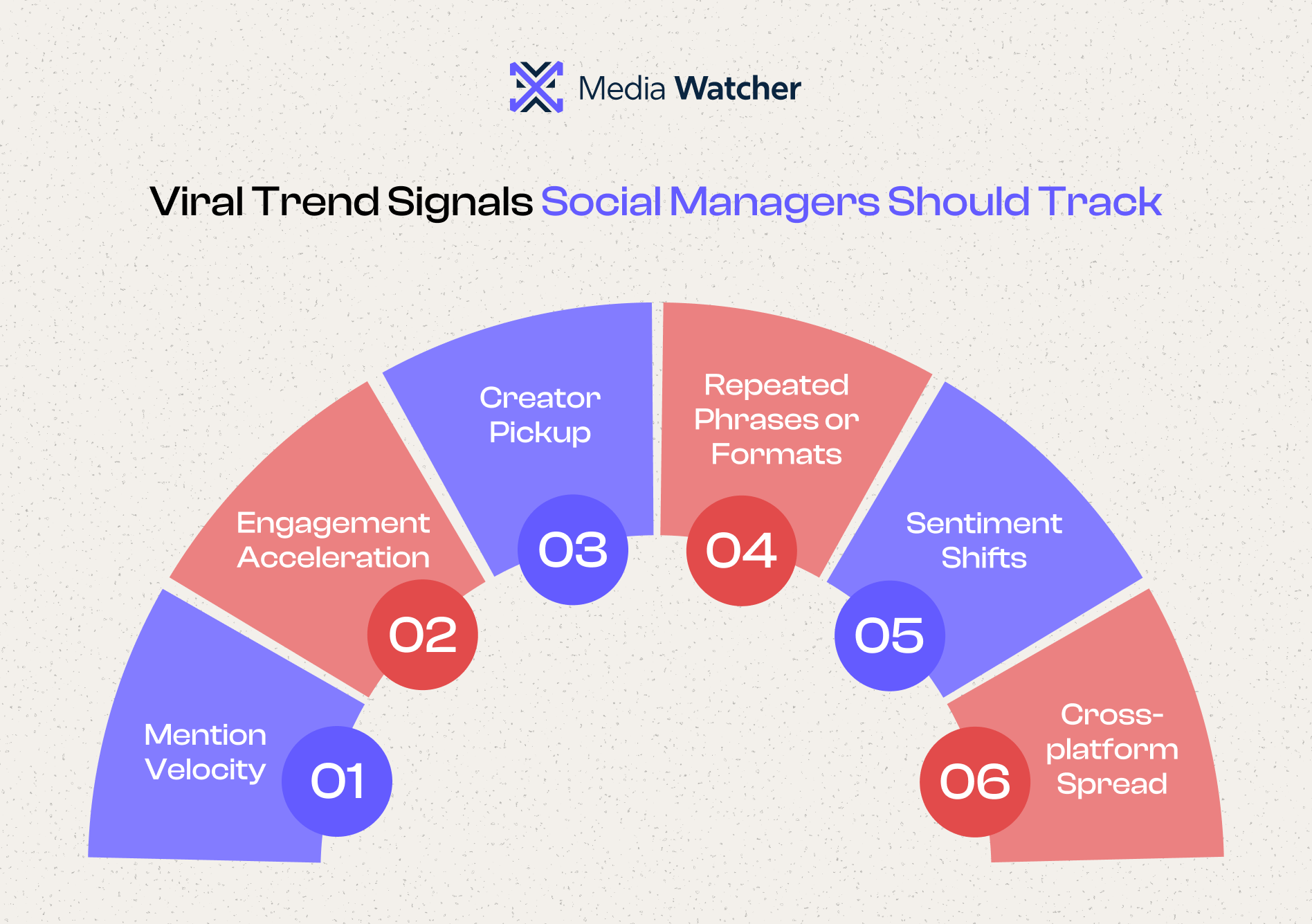
No single metric can validate that a conversation is going viral. Effective social media trend tracking pulls together several indicators at once.
Mention Velocity
Track how quickly conversation volume rises compared with its normal baseline. A sharp increase over two hours may be more meaningful than a high number of mentions accumulated over several days.
Engagement Acceleration
Look at the rate at which posts are getting shares, saves, comments, stitches, and reactions. People are helping distribute the content, not just watching it, as seen by the speed of engagement.
Creator and Community Pickup
As more creators and communities pick up a trend, its credibility increases. Niche creators are particularly useful indicators, as they can popularize ideas among wider audiences before major accounts take notice.
Recurrent Format and Language
Recurring phrases, sounds, jokes, questions, or visual structures show that an idea is becoming easy to recognize and recreate.
Sentiment and Cross-Platform Movement
High engagement can represent excitement, criticism, confusion, or outrage. Social listening alerts should identify emotional direction, while cross-platform spread shows that the topic is traveling beyond one community.
A Five-Stage Viral Trend Monitoring Framework
A practical framework should move the social manager from detection to action without treating every spike as an emergency.
1. Detect the Signal
Make real-time viral trend alerts for changes in mentions, engagement, sentiment, related phrases, creator activity, and competitor conversations.
Alerts should be based on the behavior, not on the occurrence of a single keyword. It is better to see a few more mentions or negative sentiment or creator pickups than just one mention with a brand name.
Teams should also establish normal activity levels for the topics they monitor. Without a baseline, it is challenging to tell whether a sudden increase is genuinely unusual.
2. Confirm the Momentum
One should know that before preparing content, it is important to confirm that the trend is genuinely developing.
Ask:
- Is activity still rising?
- Are people creating original responses?
- Has the topic reached more than one community?
- Is a single large account driving the conversation?
- Is the activity organic, paid, or coordinated?
- Is the conversation moving between platforms?
This stage prevents the team from mistaking a temporary spike for a wider cultural moment.
3. Assess Brand Relevance
Not all viral conversations are marketing opportunities. The trend should flow into the audience, product, campaign, or brand personality.
It might be better to generate a smaller industry conversation than a global meme with no real connection to the brand. Relevance protects the team from earning impressions while weakening credibility.
Before joining, social managers should ask what the brand can contribute. If the answer is only “visibility,” participation may not be worthwhile.
4. Evaluate Associated Risk and Sentiment
Review the most frequent feelings, common criticisms, sensitive topics, misinformation, and any potential reputation issues.
Brand mention alerts are also helpful here, as they can signal to the company when the trend starts to directly affect it. A non-threatening conversation can suddenly turn sour when tied to a product, a campaign, an executive, or a controversy.
The same topic can also have different connotations in different social communities. What may be seen as ‘funny’ on one site can be perceived as insensitive or misleading on another.
5. Choose the Response
Once the trend has been cross-verified, the team can:
- Add useful information or expertise
- Participate with timely content
- Amplify relevant community content
- Continue observing
- Escalate the issue internally
- Ignore the trend
Strategic silence is not a missed opportunity. Sometimes it is the clearest sign that a social team understands the room.
When Viral Attention Becomes Brand Risk
Nike offered a useful 2026 example. Ahead of the Boston Marathon, a sign at its Newbury Street store read, “Runners welcome. Walkers tolerated.” The message attracted criticism online for appearing exclusionary toward slower runners and people who use walking as part of their race strategy. Nike removed the sign and said it had missed the mark.
The lesson is that campaign meaning is shaped by the community receiving it. A basic dashboard might have shown rising mentions. A stronger viral trend monitoring process would have identified negative sentiment, repeated criticism, and the movement from a local display to a wider online debate.
It also shows why opportunity and risk alerts need different workflows. A light cultural trend may go to the content team. A fast-moving inclusion concern should reach communications and leadership.
High engagement is not automatically positive engagement. Without sentiment and context, a brand may mistake growing criticism for campaign success.
Create Clear Social Media Trend Alert Levels
Not every notification deserves the same urgency. Social media trend alerts can be organized into five levels.
- Watch: An unusual increase appears, but evidence is limited.
- Validate: Multiple signals suggest the conversation is developing.
- Prepare: The trend is relevant, and the team begins drafting a response.
- Act: Momentum is accelerating, and the response window remains open.
- Escalate: The conversation could affect reputation, customers, operations, or legal risk.
Each alert level should have an owner and a response time. Without ownership, even excellent social media alerts become interesting notifications that nobody acts on.
The way to escalate a problem should be really clear. Social media managers need to know when a problem is still about the content and when it should go to public relations, customer support, the legal team, or the senior leadership team.
How to Reduce Alert Noise
A good alert system should make decisions easier, not create another crowded inbox. Establish normal conversation levels for each brand, competitor, campaign, and topic. Alerts should be triggered by meaningful changes from those baselines rather than every individual mention.
Use contextual keyword groups. Combine the brand name with product terms, campaign phrases, complaint language, or emerging themes. Add exclusions to remove irrelevant meanings and spam.
Separate social listening alerts by purpose. Opportunity alerts can monitor creator pick up, audience questions, and cultural themes. Negative sentiment, boycott language, misinformation, and a sudden spike in complaints can all be tracked with risk alerts.
Lastly, review false alarms and adjust thresholds for signals that lead to sustained conversations. The team should enhance its alert framework as it learns.
Build a Faster Alert-to-Response Workflow
Early detection is only valuable if the organization is able to respond. Define who receives the alert, who validates the trend for risk review, who develops the response, and who publishes it.
If there is a harmless trend, it can be pre-approved, and thus, the social team does not have to start the whole procedure over again.
A watch alert may be reviewed later that day. A validated opportunity may need action within hours. A reputation threat may require immediate escalation.
Teams should also document their decisions after major trends. Reviewing why the brand participated, waited, or remained silent can help them make better future judgments.
How Media Watcher Supports Earlier Detection
Media Watcher’s platform focuses on real-time monitoring, custom alerts, sentiment analysis, and hashtag tracking, as well as mentions, reach, engagement, and sentiment. It provides sentiment change alerts that will alert teams when public sentiment starts to change.
This will help in the connected tracking of social media trends. Teams can track related topics, set brand mention alerts, monitor sentiment trends, and explore unusual activity without just manual monitoring.
Media Watcher can help marketing teams transition from reactive to proactive monitoring. Signals are on-platform, and it’s the social manager’s job to determine whether they’re an opportunity, a threat, or noise.
Catch the Right Moment, Not Every Moment
Efficient social teams are not those that answer every query. Instead, they are the ones who can identify when to pay attention, when to escalate, and when to let go of the matter.
Viral trend monitoring provides marketers with a systematic approach to making that decision. Real-time viral trend alerts, sentiment, creator activity, cross-platform viral spread, and brand relevance provide teams the ability to shift earlier, but without acting blindly.
Virality is not automatically an opportunity. It is a signal. The advantage comes from understanding what that signal means before everyone else does.