

Real estate markets rarely change without warning. Before a shift appears in transaction reports, rental yields, or property prices, people start talking about it.
News outlets cover mortgage rates. Residents react to new developments. Investors discuss infrastructure plans. Local businesses announce openings or closures. Together, these conversations begin shaping confidence in a location.
Real estate news monitoring helps property firms understand how buyers, renters, investors, and communities feel while those opinions are still forming.
Research has found that housing news sentiment can be linked with future property price movements, although the strength of that relationship varies by market.
A recent study using Dubai property data also found that news sentiment became particularly useful for longer term, neighborhood level forecasting when combined with other market information. Here are seven methods real estate news monitoring uses to track market sentiment.
What Is Real Estate Market Sentiment?
Real Estate Market Sentiment is a gauge of confidence, concerns, and expectations about the real estate market. It can be country-wide, city-wide, neighborhood, development, or a specific property type.
It is possible for positive sentiment to develop around regeneration projects, reduced borrowing costs, improved employment prospects, or new transport connections. There can be reasons for negative sentiment, such as affordability issues, construction problems, skyrocketing taxes, safety concerns, and poor economic conditions.
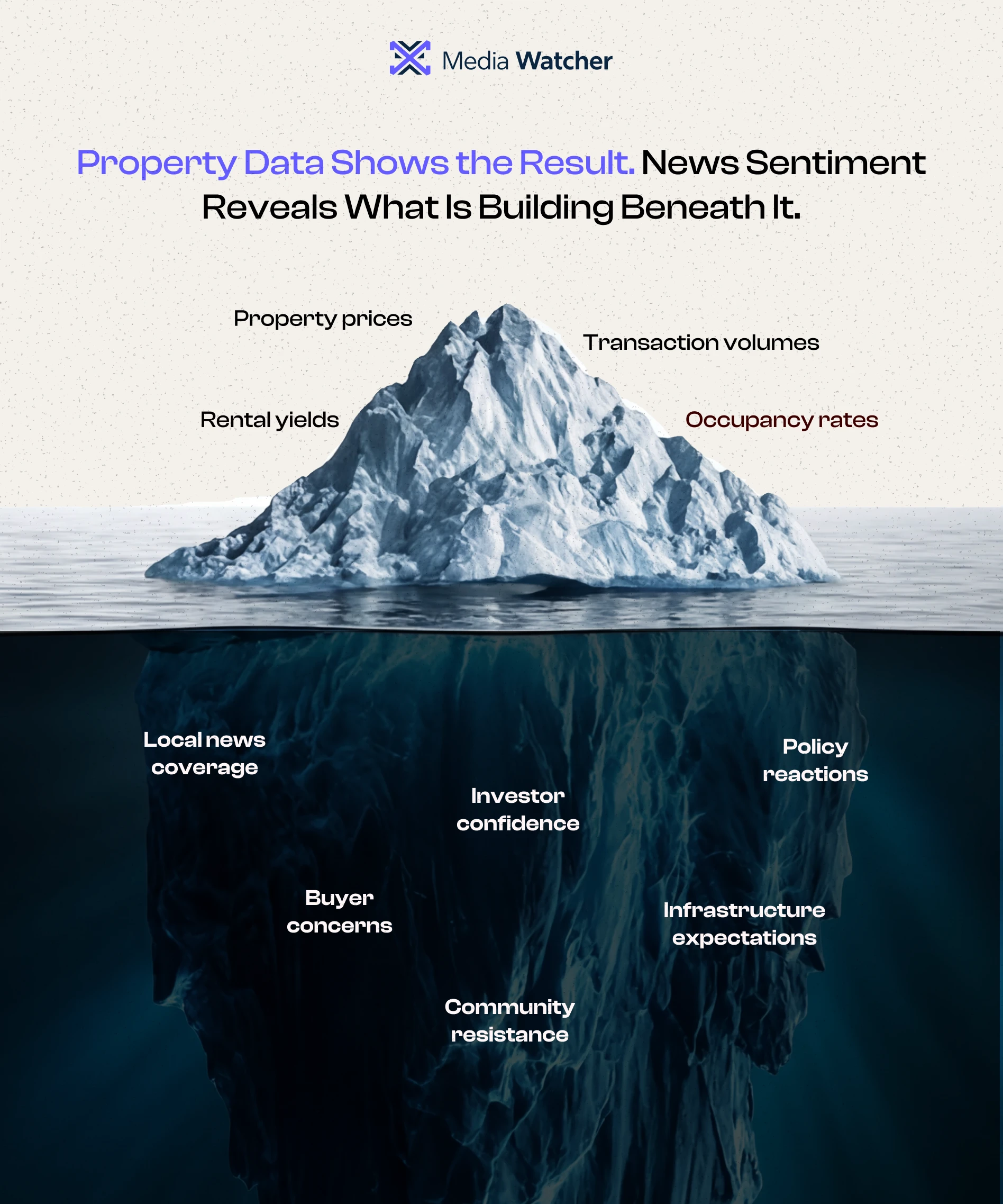
Since these elements tend to be part of the news before they affect the official market data, monitoring coverage gives a real estate company an earlier view of changing expectations.
1. Tracking the Language Used in Property News
How any market is being framed is revealed by the language of journalists, analysts, and industry experts.
The words “housing shortage,” “buyer hesitation,” “investment hotspot” and “market correction” mean different things. If certain phrases become more common, people may react differently to the current situation.
Real estate news monitoring collects relevant articles and analyzes their tone over time. Firms can then see whether coverage of a location or property category is becoming more optimistic, cautious or negative.
The real value comes from tracking direction. One critical article may have little impact. A steady increase in negative reporting around affordability, weak demand, or oversupply may indicate that confidence is beginning to decline.
Instead of reacting to individual headlines, property firms can examine the larger narrative taking shape around the market.
2. Monitoring Sentiment by City and Neighborhood
Property markets are highly local. National headlines may describe a slowdown, while particular neighborhoods continue attracting buyers and investment.
Real estate firms can monitor news by location to understand how sentiment differs across cities, districts, and communities. This may include coverage of schools, business districts, public transport, crime, planning decisions, and local amenities.
Research examining real estate news in major Canadian and Australian cities found that the relationship between media sentiment and future house prices differed between the two countries.
This shows why sentiment should be interpreted within its local market rather than treated as a universal indicator.
Location-based monitoring helps firms identify areas gaining positive attention. It can also reveal markets where confidence may be deteriorating before the change becomes obvious in property sales or pricing data.
For developers and investors, this offers a clearer view of where market momentum may be building next.
3. Watching Government and Economic Announcements
Housing markets are heavily influenced by decisions made outside the property industry.
Market expectations can change due to shifts in interest rates, lending standards, property taxes, zoning reforms, rent controls, and construction regulations. News monitoring enables companies to monitor such announcements and the reactions that follow.
The following news report will give you the details. The wider conversation reveals how the buyer, developer, landlord, and investor see it.
A new Housing Policy can seem like a positive development. In the future, there may be concerns about implementation costs, financing, or limited supply. By tracking the story as it develops, real estate companies can gauge market reaction beyond the initial announcement.
Teams can also compare reactions across different sites. A policy that is favorable in one area could face opposition elsewhere due to affordability, infrastructure, or environmental issues.
4. Measuring Reactions to Infrastructure and Development Projects
The development of new transport links, commercial areas, hospitals, universities, and regeneration plans can change the perception of a location.
Real estate news monitoring helps companies track announcements and public reaction. Positive coverage can lead to greater interest in neighboring properties. Resistance may arise due to congestion, displacement, environmental impacts, or construction disruptions.
Sentiment around these projects is tracked for site selection, investment planning, and campaign timing. It also provides developers with guidance on which benefits to highlight and which concerns to communicate more effectively.
The purpose is not just to look at volumes of mentions. It is important for firms to be aware if the project is being mentioned as an opportunity, disruption, or uncertainty.
The tone of the discussion can also be a good indicator if the initial excitement is sustained or slowly replaced by a feeling of doubt.
5. Identifying Changes in Buyer and Renter Priorities
Market sentiment is shaped by what people currently value.
For some, the commute time is an issue at some point. Later, the discussion might focus more on cost, energy efficiency, space flexibility, or access to local services. Tenants might start to worry about the safety, the terms and conditions, or their monthly expenses.
By tracking property-related content in the media, social conversations, and online comments, firms can gain insights into these evolving priorities. Marketing teams can then adapt their messaging around the issues receiving genuine attention.
A residential project may need to emphasize transport connections in one market and lower running costs in another. A commercial property campaign may perform better by discussing workforce access, sustainability, or neighborhood development.
This also strengthens market research. Firms gain access to natural conversations that show how people describe their needs, frustrations, and expectations rather than depending entirely on formal surveys.
6. Tracking Developer and Competitor Reputation
Sentiment surrounding a property is often connected to the company behind it.
Coverage of construction quality, handover delays, tenant disputes, regulatory action or customer complaints can quickly affect confidence in a developer. Positive reporting about successful projects, sustainable design or strong partnerships can strengthen trust.
Real estate news monitoring allows firms to track their own reputation alongside competitors. It shows which companies are receiving positive attention, what issues are causing criticism and how narratives change after an announcement.
These insights help communication teams respond earlier. They also show leadership where competitors are gaining credibility or becoming vulnerable.
Competitor monitoring can reveal more than reputation risks. It may uncover new project announcements, geographic expansion, funding activity, partnerships, and changes in market positioning.
This gives real estate firms valuable context for their own communication, investment, and development strategies.
7. Detecting Sudden Mention and Sentiment Spikes
A sudden rise in coverage often signals that something important has happened. The trigger may be a planning approval, major investment, legal dispute, viral complaint or unexpected economic announcement.
Without real time monitoring, the issue may spread across news and social channels before the firm understands its scale.
Sentiment alerts help teams identify unusual changes in mention volume and emotional tone. They can investigate the source, assess which locations or projects are affected, and decide whether a response is needed.
This is especially helpful when it comes to reputation management. The quick notice allows companies more time to check facts, craft messaging, and avoid speculation from taking over the narrative.
Mention spikes can also indicate positive opportunities. When there’s a lot of interest in a neighborhood, infrastructure project, or property trend, it may be time to start a campaign, conduct a market analysis, or reach out to prospective investors.
Turn Real Estate News Into Market Intelligence With Media Watcher
Tracking real estate sentiment manually is difficult. Relevant signals are scattered across local publications, national news, social platforms, blogs, podcasts, and industry sources. By the time teams collect and review everything, the conversation may already have moved.
Media Watcher brings these signals into one monitoring environment.
It tracks news and online conversations from over 100,000 sources in over 80 languages and 235 regions. The AI powered sentiment analysis captures positive, negative, and neutral coverage, while tailored alerts surface important changes as they happen.
Real estate firms can use Media Watcher to monitor:
- Property markets and categories
- Cities and neighborhoods
- Residential and commercial developments
- Competitors and developers
- Housing policies and regulations
- Infrastructure projects
- Buyer and renter concerns
- Reputation risks
Teams can compare sentiment across locations, identify emerging narratives, and investigate the events driving changes in confidence.
Media Watcher also alerts users when mention volumes rise, or sentiment begins to shift, helping teams investigate developing stories before negative momentum grows.
This allows marketing, investment, research, and communication teams to have a common understanding of the market. They can follow the progression of a story rather than reading headlines and think about what this could mean for demand, reputation, and future decisions.
With Media Watcher, real estate news becomes more than a collection of headlines. It becomes a practical source of market sentiment intelligence.