

A banking crisis does not always begin with a breaking news headline. In some cases, it begins with a customer reporting some sort of account limit violation, unexpected denial or mobile banking disruption. Experiences like this can spread within hours on social media and gain greater visibility.
According to the American Bankers Association (ABA), 89% of surveyed banks consider social media important to their institutions, while 88% report being very or somewhat active on social media. The findings, published in September 2023, reflect how deeply digital communication has become embedded in banking.
However, keeping a social presence is just one aspect of things. Even banks have to grasp the sentiment behind public speaking outside their official channels.
Banking social media monitoring helps financial institutions track public discourse, detect signals and make informed decisions in anticipation of problems before they escalate.
What Is Banking Social Media Monitoring?
Banking social media monitoring refers to the process of monitoring and analyzing the public comments made about a financial institution on social media, online forums, news sites and other related digital platforms.
It’s more than just reading comments posted on a bank’s official pages. Users can talk about payment delays on X, post about watching for suspicious banking messages on Reddit or share their experience using financial products on online forums.
There may be a lot of discussions that involve the bank without the bank being explicitly referenced.
Social media monitoring services are used to track conversations, shifts in sentiment, and what topics are being discussed.
The aim is not merely to collect mentions. Banks need to distinguish routine feedback from developments that may indicate operational concerns, customer dissatisfaction or reputational risk.
Why Does Social Media Monitoring Matter for Banks?
Confidence is the key to banking relationships. When it comes to banking, customers expect financial institutions to keep their information secure, process transactions with ease, and communicate effectively when issues arise.
When that confidence is questioned publicly, the influence can be stretched beyond the customer who originally raised the complaint.
Consider a temporary interruption in a bank’s mobile application. Some customers report login failures while others complain about delayed transfers. As these conversations spread, people who have not experienced the issue may begin questioning the service’s reliability.
Without effective monitoring, the bank may find it challenging to understand how widely the issue is being discussed.
The importance of identifying public concerns also extends to financial regulation.
The Federal Financial Institutions Examination Council (FFIEC) has provided guidance for financial institutions to address social media risks with suitable policies, governance and monitoring controls.
Although the guidance does not require banks to track every conversation, it reinforces the need for a risk-based approach to social media activities.
Five Ways Banking Social Media Monitoring Helps Financial Institutions
Explained below are the five key ways banking social media monitoring delivers value to financial institutions.
1. Identify Reputational Risks Before They Escalate
Not all negative comments need to be addressed immediately. However, repeated complaints about the same service can indicate a problem worth investigating.
Imagine several customers reporting unexplained transaction failures within a short period. Individually, these posts may appear routine. Together, they could indicate a broader operational issue.
Social listening tools can help banks recognise recurring complaints, unusual increases in mentions and changes in conversation themes.
This visibility enables communications and customer service (CS) teams to be able to research developments earlier in the day and plan for proper responses.
Monitoring does not ensure that a reputational crisis can be avoided. It does, however, decrease the chances that key public conversations go unnoticed.
2. Understand How Customers Perceive Banking Services
A sudden increase in online mentions may initially seem positive. But higher visibility doesn’t always guarantee customer satisfaction.
Users like the convenience of a new digital banking feature, and that could be enough to draw in a lot of attention. Or that same attention could reflect confusion about the feature’s functionality.
That’s where sentiment analysis becomes valuable. Positive, negative and neutral conversations can be reviewed to gain an understanding of customers’ perceptions of products, announcements and service changes.
News sentiment analysis will provide an extra layer for institutions to see if the financial reporting reflects a positive, negative or neutral sentiment towards their organisation.
For instance, when a new bank charges account fees, they can keep track of customer response as well as media coverage.
In addition, because automated sentiment classification systems can miss sarcasm, cultural expressions, and financial jargon, sensitive results should be followed up with human review.
3. Recognise Fraud Narratives and Brand Impersonation
Financial institutions are attractive targets for impersonation because customers often trust messages that appear to come from their banks.
Fraudsters may create fake customer support profiles, distribute misleading financial promotions or direct users towards fraudulent websites.
According to the Federal Trade Commission, consumers reported $3.5 billion in losses from impersonation scams in 2025.
These losses include various forms of government and business impersonation across multiple communication channels. They are not limited to banking or social media.
For banks, this broader fraud landscape highlights the importance of recognising suspicious references to their brands.
Monitoring public discussions may reveal complaints about fake banking accounts, suspicious advertisements or fraudulent messages claiming to represent an institution.
These signals can support investigation and customer warnings, but monitoring should operate alongside dedicated fraud prevention and cybersecurity controls.
4. Strengthen Competitive Intelligence
Customer expectations are influenced by experiences with competing banks and financial service providers.
A competitor introducing faster international transfers may attract positive attention. Still, another financial institution with recurring complaints from customers could offer insights into the areas banks are beginning to see they need to fix.
Using relevant news coverage and public discussion, Competitive Intelligence can be used to help institutions identify these developments.
To gain insight into the expectations of the industry, banking teams can monitor competitor announcements, customer feedback and new financial products.
For banks with a corporate business presence, B2B social listening can provide additional clues about B2B conversations on commercial lending, transaction banking, payment infrastructure, and treasury management.
These results can be used to assist product development, strategic communication and market research, based on customer feedback, not only internal feedback.
5. Enhance Crisis Communication
When a banking incident becomes public, customers need accurate information rather than conflicting updates.
Social media monitoring helps communication teams understand which concerns are spreading and whether official statements are addressing them.
During a digital banking outage, for example, customers may repeatedly ask whether transactions are safe, when services will resume or whether payments need to be initiated again.
Monitoring these discussions can help banks identify unanswered questions and communicate more clearly.
It also helps teams evaluate how public conversations change following an announcement. The effectiveness of this process depends on coordination between customer service, communications, risk management and operational teams.
How Does Banking Social Media Monitoring Work?
Effective monitoring begins with defining the information a bank needs to track. This may include the institution’s name, banking products, executive mentions, service complaints, competitor references and common terms associated with fraudulent activity.
Relevant content is then collected from supported social networks and public information sources.
Monitoring systems can organise the findings by topic, source, sentiment and changes in conversation volume.
For instance, an unusual increase in negative mentions concerning mobile banking may trigger an alert for further investigation.
Teams can then review the underlying conversations, establish whether a genuine operational issue exists and determine the appropriate response.
The value comes from combining relevant information with a clear escalation process. Monitoring software can identify potential concerns, but people remain responsible for interpreting the findings and making decisions.
Why Financial News Monitoring Matters Alongside Social Listening
Social media conversations often develop alongside financial reporting.
A regulatory announcement may receive initial coverage from financial publications before customers start discussing its implications. Other times, online rumours may get picked up by financial commentators or a journalist.
Monitoring one source without the other can leave banks with an incomplete picture.
Financial news monitoring software helps institutions track relevant financial reporting on banking regulations, market developments, competitors, and reputation issues.
In addition to social media monitoring, these insights offer a more comprehensive understanding of how narratives develop and spread.
For instance, a bank facing criticism for a policy change can gauge customer responses and financial news coverage to understand the general reaction.
This can help communications teams distinguish isolated complaints from larger issues in the spotlight.
What Should Banks Look for in Social Listening Tools?
Choosing a monitoring solution requires more than comparing dashboards. Financial institutions should evaluate whether the platform provides the coverage and analytical capabilities needed for their specific operations.
Important considerations include:
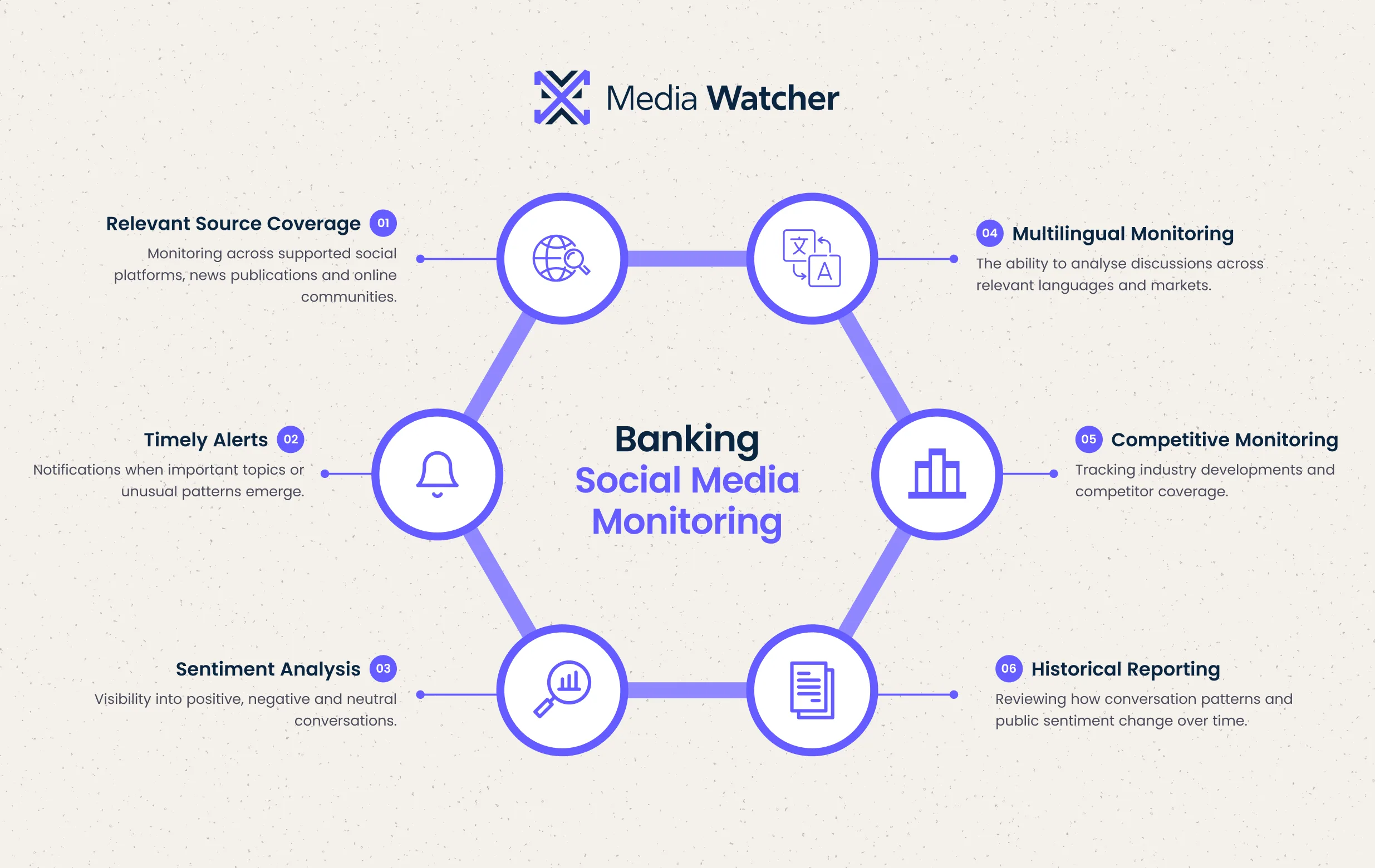
Banks should also consider security controls, data privacy, reporting requirements and the availability of integrations.
The right platform should make relevant information easier to understand rather than overwhelm teams with more notifications.
How Media Watcher Supports Banking Reputation Monitoring
For banks operating across several markets, manually tracking relevant news and online discussions can quickly become difficult.
Media Watcher provides media monitoring, sentiment analysis, competitor tracking and configurable alerts through a centralised platform.
Its monitoring capabilities help organisations follow relevant coverage, identify emerging narratives and understand changes in public perception.
For banking teams, this can support reputation management, market intelligence and greater visibility into financial news developments.
Custom monitoring topics and alerts also help teams focus on information relevant to their institution.
When evaluating Media Watcher for banking social media monitoring, institutions should confirm which social platforms and data sources are supported for their specific requirements.
Explore Media Watcher to learn how real-time media intelligence can strengthen banking reputation monitoring and decision-making.