

A business can spend years building its reputation and still face a crisis it never saw coming. A supplier gets linked to fraud, an executive faces misconduct allegations, or a negative news story spreads across diverse markets before the organization even notices.
According to PwC’s 2023 Global Crisis and Resilience Survey, 91% of organisations experienced at least one disruption other than the COVID-19 pandemic during the preceding two years. While not every disruption involved negative publicity, the finding highlights why businesses need better visibility into emerging threats.
That’s where adverse media monitoring can help. By monitoring negative news, organisations can identify emerging issues and analyse media attention, gaining a clearer and earlier grasp of risks and responding with the right information.
What Is Adverse Media Monitoring?
Adverse media monitoring tracks publicly available information that could reveal financial, operational, regulatory, or reputational risks for an individual, company, or organisation.
Also referred to as negative news monitoring, it is the process of combing through news articles, investigative reports, regulatory announcements, and other sources to uncover potentially negative material.
An example of that would be a financial institution that is able to keep track of allegations of fraud from their business customers or a multinational corporation that keeps track of allegations of corruption, regulatory violations or unethical practices from their suppliers.
Unlike occasional online searches, continuous adverse monitoring helps businesses identify new information as it emerges, making it easier to reassess risks throughout an ongoing relationship.
Why Is Adverse Media Monitoring Important?
Risk events in the business do not just randomly occur. They are often reported on news sites, in regulatory reports, and on public forums before their full impact is known, and they can leave a permanent record.
Effective adverse media monitoring helps organisations recognise those signals and decide when further investigation is necessary.
1. Identify Potential Risks Earlier
According to the Association of Certified Fraud Examiners’ 2026 Report to the Nations, the median occupational fraud scheme remained undetected for 12 months.
While media monitoring cannot ensure detection of fraud, it can offer further clues as to suspicious activity, investigations or misconduct in business relationships.
Recognizing these changes in advance allows risk management teams time to address any concerns before they get more serious.
2. Protect Corporate Reputation
Organizations can be influenced by negative publicity in terms of how customers, investors and business partners view them.
Reputation risk monitoring enables businesses to understand the stories making the news, track shifts in media sentiment, and identify whether negative stories are starting to resonate in other areas.
This enables communications teams to have a more informed response to issues which might affect their reputation rather than being caught on the back foot once they have already gained widespread attention.
3. Strengthen Due Diligence
A company may pass its initial verification checks and later become associated with an investigation or misconduct allegation.
Continuous negative news monitoring helps organisations identify developments that may warrant renewed customer or third-party due diligence.
The Wolfsberg Group’s Negative News Screening FAQs recognise negative news screening as a valuable way for financial institutions to better understand potential financial crime risks.
How Does Adverse Media Monitoring Work?
Adverse media monitoring combines information collection, entity identification, content analysis and ongoing risk assessment. The process typically involves five stages.
Step 1: Collect Relevant Media Information
Monitoring begins by gathering information from news websites, industry publications, regulatory announcements, investigative journalism and other relevant public sources.
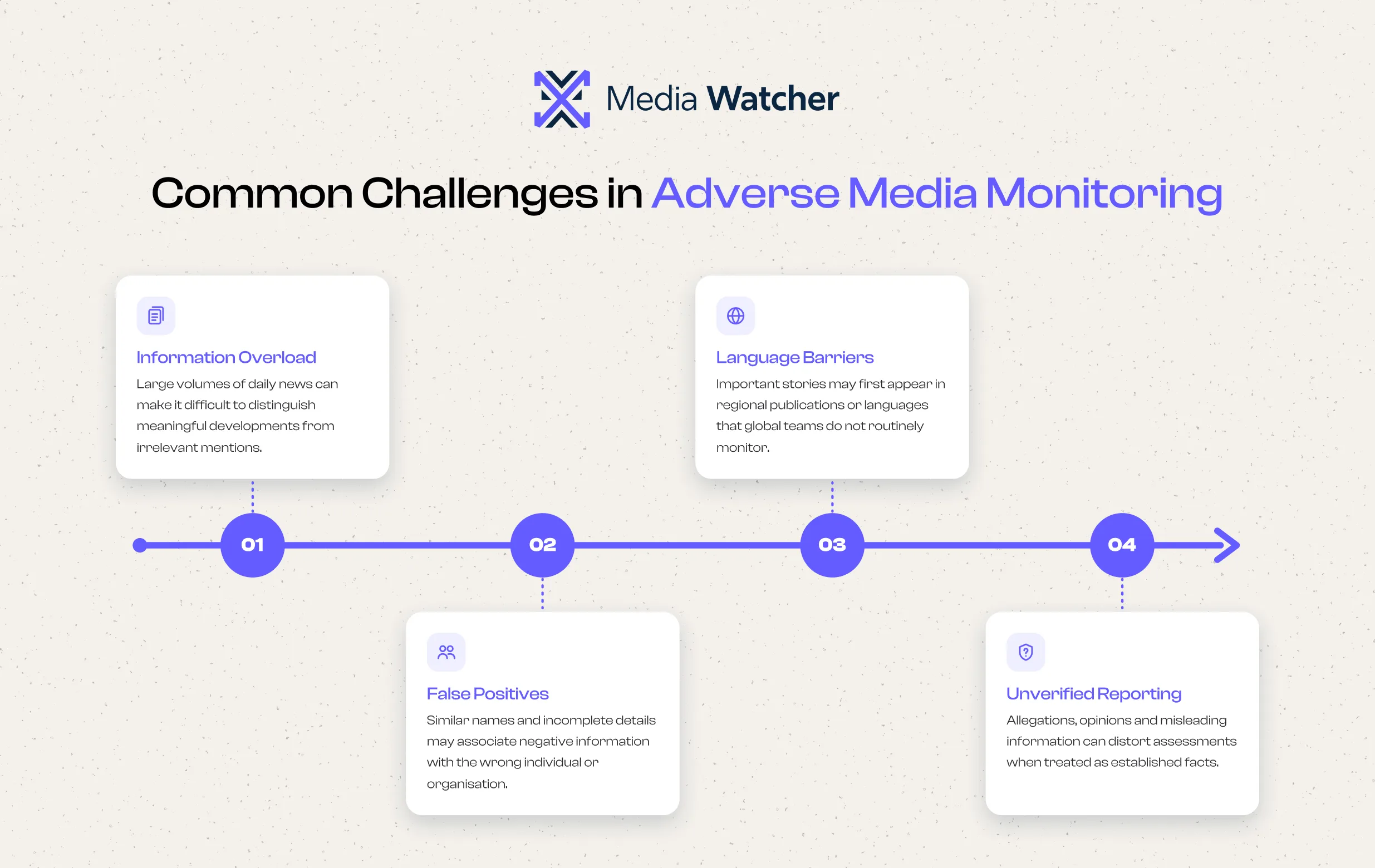
Broad geographical and language coverage is important because local publications may report significant developments before international news organisations.
Step 2: Identify Relevant Entities
Monitoring systems search for references to specified companies, executives, customers, suppliers or other entities.
Search criteria may include organisation names, alternative spellings, locations and risk-related keywords to identify potentially relevant coverage.
Step 3: Analyse the Information
Not every negative mention represents a genuine risk.
Media intelligence tools help organisations organise information, identify recurring topics and understand changes in sentiment. Analysts must then consider source credibility, factual accuracy and the seriousness of reported events.
Step 4: Generate Alerts
When relevant developments are identified, automated alerts notify responsible teams.
Alerts can help organisations investigate breaking stories and determine whether an incident requires a reputational response, further due diligence or escalation.
Step 5: Continue Monitoring
Risks change over time. An allegation may develop into an investigation, enforcement action or legal decision.
Continuous media risk monitoring helps organisations follow these developments and update their understanding as new information becomes available.
Adverse Media Monitoring vs. Negative News Monitoring
Adverse media monitoring and negative news monitoring are closely related and are often used interchangeably.
However, their emphasis can differ depending on the organisation’s objectives.
- Negative news monitoring generally focuses on identifying unfavourable reporting about specific individuals, companies or activities.
- Adverse media monitoring often applies that information to a broader risk assessment process involving financial crime, regulatory exposure, business relationships and reputational concerns.
For example, discovering a news article about a supplier facing bribery allegations represents a negative news finding. Evaluating its credibility, tracking subsequent developments and reassessing the supplier relationship are part of a wider adverse media monitoring process.
Both approaches contribute to a more informed understanding of emerging risks.
What Risks Can Adverse Media Monitoring Identify?
Adverse media monitoring provides visibility into several categories of potential business risk.
Financial Crime and Fraud
Reports involving fraud, money laundering, bribery, corruption and financial misconduct may reveal concerns requiring investigation.
The ACFE’s 2026 research estimates that organisations lose approximately 5% of annual revenue to occupational fraud, based on assessments by Certified Fraud Examiners.
While this estimate does not measure media-related losses, it demonstrates the financial significance of identifying misconduct and maintaining effective risk controls.
Regulatory and Compliance Risks
News about investigations, enforcement actions or regulatory violations can influence how organisations assess customers and commercial relationships.
The FFIEC’s Customer Due Diligence guidance identifies negative media searches as one possible source of additional customer information, depending on risk.
Reputational and Brand Risks
Brand risk monitoring enables businesses to capture negative media coverage related to product controversy, executive misconduct, unethical practices, and more, all of which have an impact on public trust in a brand.
The US Federal Trade Commission reported that consumers lost $2.1 billion to scams originating on social media in 2025.
While this statistic is based on consumer fraud and not on reputational damage, it does show the need to monitor digital threats and fraud related to audiences online.
How Media Intelligence Strengthens Reputation Risk Monitoring
Traditional media searches provide individual results. Media intelligence helps organisations understand the wider context behind those results.
By analysing coverage across multiple sources, businesses can identify emerging narratives, measure changes in sentiment and determine whether an issue is attracting greater attention.
For example, one negative article about a company may receive limited coverage. However, if several regional publications begin reporting similar concerns, the developing pattern may warrant closer investigation.
Combining risk intelligence with media monitoring allows organisations to connect individual stories with broader developments, supporting more informed reputational and operational decisions.
Best Practices for Effective Adverse Media Monitoring
A reliable monitoring strategy requires clearly defined objectives and consistent assessment procedures.
- Establish monitoring priorities: Identify high-risk entities, industries, regions and business relationships.
- Monitor credible sources: Prioritise reliable publications and corroborate significant claims.
- Use automated alerts: Reduce the delay between relevant news publication and internal awareness.
- Review findings carefully: Verify identities, evaluate context and distinguish allegations from confirmed misconduct.
- Maintain ongoing oversight: Reassess risk when new information or significant developments emerge.
Combining automated discovery with human judgement helps organisations avoid treating every negative mention as an equally serious threat.
How Media Watcher Supports Adverse Media Monitoring
It’s tedious to manually monitor thousands of information sources, especially for companies with many markets.
Media Watcher provides AI-driven media monitoring, sentiment analysis, and timely notifications to keep organizations informed. The platform offers access to:
- 100,000+ media sources for monitoring relevant news coverage.
- 235+ countries and regions for broader geographical visibility.
- 80+ languages to help identify developments across international markets.
- Sub-200ms advertised alert latency to support timely awareness of monitored developments.
Configurable media monitoring and sentiment analysis let businesses track negative coverage, follow developing stories, and watch for potential threats to company reputation.
Media Watcher can support the media discovery and reputational intelligence components of adverse monitoring. Formal financial crime screening, entity verification, and compliance decisions should remain part of the organisation’s wider risk management framework.
Explore Media Watcher to discover how real-time media intelligence can strengthen your organisation’s risk visibility.