

Have you ever thought of a product launch that earns positive headlines? And only 2 days later, the customers started questioning the very feature. Then a specialist publication comes in and picks up those concerns.
And within a week, the coverage that has celebrated innovation started asking whether the company rushed its product to market or actually spent some time in testing. No matter, the brand is still getting attention as it anticipated. But what that attention means has changed now.
This creates a challenge for the communications teams. Tracking mentions can reveal growing interest, but deciding how to respond requires understanding the story that develops around those mentions.
Thus, in this case, narrative intelligence becomes extremely useful. It helps organizations understand what deserves attention and which business decisions should follow by connecting coverage, as well as recurring claims and shifts in interpretation.
What Is Narrative Intelligence?
Narrative intelligence is the practice of examining how stories about an organization, industry or issue develop and circulate. It considers the interpretations attached to events, the sources promoting those interpretations and their potential significance.
A topic identifies the subject being discussed. A narrative expresses a particular understanding of that subject.
“Digital banking,” for example, is a topic. Within it, people might discuss financial inclusion, concerns about automated lending or frustration with disappearing branches.
These conversations require different responses. A bank cannot address questions about lending transparency by simply repeating its convenience message.
Narrative intelligence enables teams to recognize that distinction before dedicating resources to an inappropriate response.
Why Mention Counts Cannot Explain Public Perception
The volume of measures indicates visibility, but it doesn’t clarify what audiences believe or the reasons behind any shifts in their perspectives.
Consider a hypothetical retailer receiving increased coverage after introducing self-service technology. Some articles praise shorter queues. Some articles extol the virtues of shorter queues. Others question accessibility. Customer conversations revolve around seeking help when something goes wrong.
These competing interpretations may be masked by an overall rise in mentions.
Sometimes there are differences between audiences regarding public perception. The investors may feel good about the efficiency of the operation, but the customer is concerned with the quality of service. Staff members can read the same message in the context of their staffing issues.
A helpful analysis identifies who is being represented and provides supporting evidence. Media exposure provides a window into the public discussion, but should not be assumed to reflect all stakeholders.
What Narrative Intelligence Analyses Should Examine
When narrative intelligence analyses are associated with repeated claims that can be traced to their sources, development, and relevance to the business or development, the analysis becomes more useful.
Start with the central assertion. Is there a question concerning the reliability of products, credibility of leadership or the fairness of policy? Two different meanings can be used in the exact same words.
Next, consider the context in which the assertion appears. A multitude of websites referencing a single original article holds less weight than a handful of independent investigations.
Finally, assess movement. Is the discussion still confined to a specialist community, or is it going to customers, journalists and industry bodies?
This gives a better platform to act than if everything said is equally important.
Where a Sentiment Score Fits
Using a sentiment score can help teams review the sentiment of the coverage and look more closely at the content that has a positive sentiment. However, tone alone cannot explain the business issue behind a conversation.
Two negative articles could have two entirely different problems. There is room to point out the price of one thing and make a safety claim about a different one. They might think the same thing, but they may not feel the same thing, and their appropriate action would be different.
Context also matters. An accusation can be quoted in an article before presenting evidence that refutes that accusation. Reservations are allowed in a positive headline.
Sentiment should be used in conjunction with source evaluation, story headings and first-hand reporting of key coverage. The score is useful in prioritizing attention. The underlying evidence underlies the decision.
Turning Media Signals Into a Decision Brief
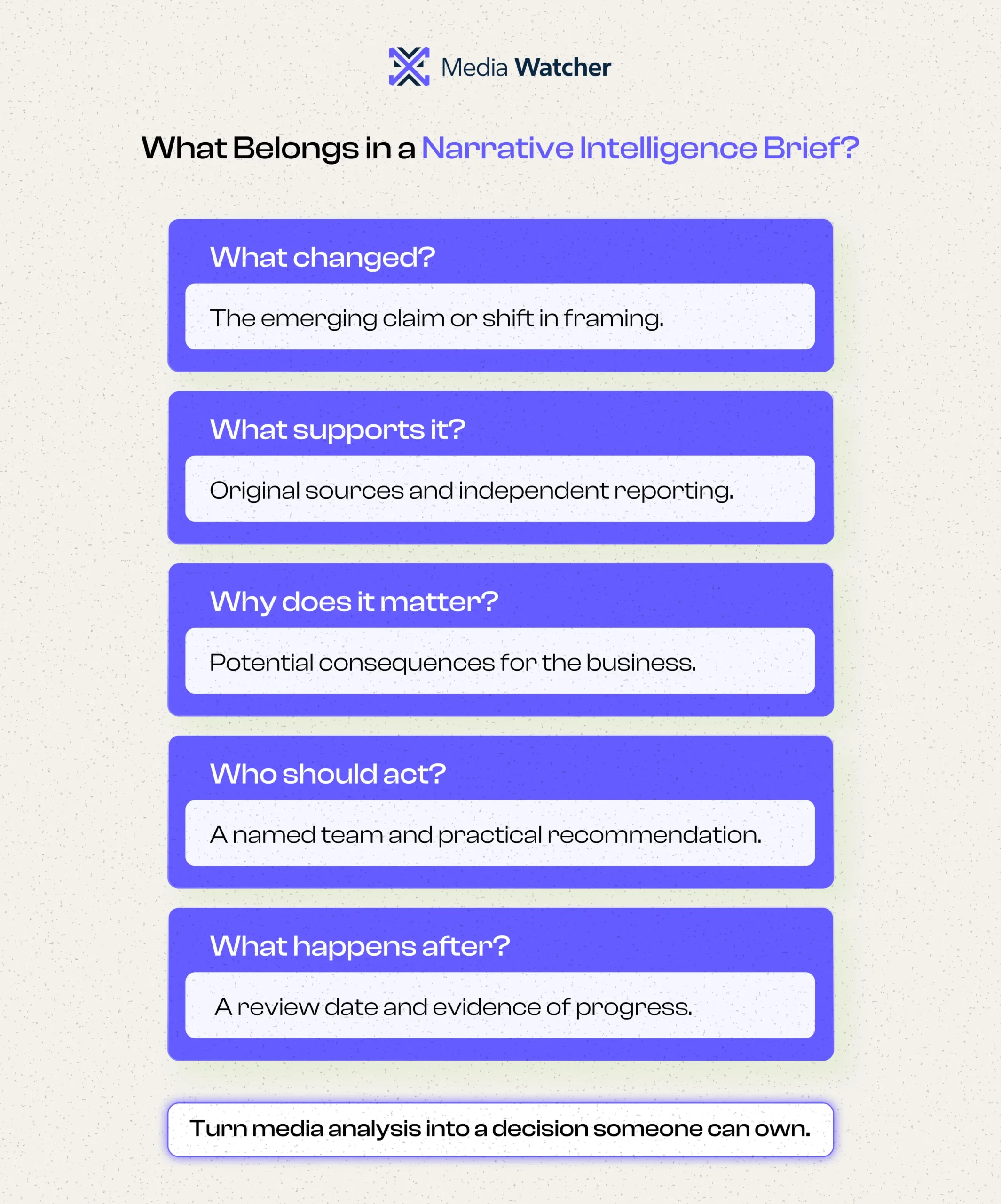
The best result of narrative intelligence is a quick, informative brief that helps a decision be made more easily. It should describe the change, why the change and who should change.
Start With a Business Question
Establish the decision first, gather information afterwards. One communications team set up for a launch could wonder if privacy issues are now a major focus of coverage. A brand team might explore the needs that are becoming synonymous with its competitors.
Being able to identify relevant sources and useful evidence is facilitated by specific questions.
Establish the Baseline
Review the usual conversation before interpreting a spike. Which complaints recur regularly? What coverage normally accompanies an announcement? Which publications consistently discuss the business?
A baseline helps distinguish familiar criticism from an emerging issue. It also prevents routine seasonal activity from being presented as a sudden reputation threat.
Separate Evidence From Interpretation
A good brief will set out to separate the facts from the analysis. An observation is that four independent publications raised questions about the policy this week. An assessment is an evaluation that could influence procurement.
These can be helpful if they are properly identified. Decision-makers should be aware of what is known and what is still not known, and what more information might alter the recommendation.
Assign an Action and Owner
Recommendations should be a specific action, with the team responsible for the recommendation identified. If data retention is an issue, product and legal departments may need to confirm the data retention policy.
Website information may need to be clearer to avoid customer confusion. A claim that is not supported and has a low circulation may require additional surveillance.
Each recommendation should include a review point so the team can assess whether the situation changed.
What This Looks Like in Practice
Now think of a software company that moves away from the product’s features and into the world of customers’ information.
The first alert is for an increase in negative mentions. Further review shows that journalists and prospective buyers are referring to an outdated policy.
A helpful brief would clarify the misconception, connect to the coverage and articulate the impact on the conversation around sales.
This response might involve confirming the current policy, clarifying ambiguous documentation and creating standard answers for customer facing teams.
Follow-up analysis would be conducted to determine if subsequent articles accurately portray the policy, and if buyers keep repeating the same concern.
This links the media signal to a business response, but doesn’t assume that a statement solves the problem.
Using Competitive Narrative Monitoring
Competitive narrative monitoring assists teams in recognizing the connections that competitors are forming and what expectations are beginning to form throughout the category.
The competitor can earn an increasing amount of recognition for implementation support as your organization focuses on technical performance. The strategic question is whether buyers are getting more and more interested in the support while selecting the provider.
That finding could inform customer research, sales materials or service investment.
Teams should examine the evidence behind competitor narratives rather than copying their messaging. An association supported by customer experiences is harder to challenge through promotional language alone.
Choosing Narrative Intelligence Solutions
When assessing a narrative intelligence solution, look for evidence access, relevant coverage and clear analysis.
A Narrative Intelligence Platform should enable users to explore original content, identify repetition of reporting, and compare content over time. The languages used and sources should be aligned with the organization’s markets.
When it comes to reputation monitoring, teams must also be able to produce information that is comprehensible and actionable to colleagues.
Media Watcher can assist in this process through cross-channel monitoring, context filtering, sentiment analysis and insights into source influence and narrative changes. These are the capabilities that enable evidence teams to investigate and make decisions.
The aim is to highlight how the talk is changing from one to the other. Once analysis has resulted in a clear owner, an informed action and measurable follow-up, narrative intelligence will be part of how the business responds.
Learn how to navigate Media Watcher, discover the narratives that make up your brand, and use the signals to inform strategy.