

The human rights report was once an exclusively specialist document. Lawyers, policymakers, advocates. Everyone else had the abbreviated version, if they had it.
That’s changed. On September 23, the OSCE’s election office said it hadn’t been invited to observe the U.S. midterms. Within days, that one thing or statement became a press release, a Human Rights Watch response, wire stories in the U.S. and Europe, editorials on both sides, podcasts, and a steady stream of social posts.
We need to understand what human rights media monitoring really means. We must grasp its concept.
Human rights media monitoring involves tracking media coverage of human rights issues in all forms of news, radio, video and social media.
It’s relatively easy to count mentions. But sentiment is the useful part of a story: how it is told, how it is changed, and who is telling it.
So, people are conversing, as a thousand articles will tell you. Sentiment provides cues about what they are saying and how it’s received.
PR teams, NGOs, researchers, and newsrooms also use it. They need to understand where the conversation is headed before it ends, especially when it involves a rights issue in the news.
What Does a Human Rights Story Mean? What are Human Rights Stories about?
Human rights in an election story appear when the vote itself is involved. In 2026, several do. The most evident problems being exhibited in the coverage are:
Proof of Citizenship Rules / Federal Citizenship Checks: Voter Registration
The observer team for midterm elections is too small to include international observers. The observer team for midterm elections is too small for international observers.
Immigration Enforcement At Polling Places: Federal Agents And Monitors Close To Polling Places
The problem with measuring sentiment is that each of these issues has two facets. One side argues it’s election integrity or security. The other sees it as a threat to access and rights. That split is what moves the sentiment line.
In the Weeks Leading Up To The Election, Why Is Sentiment Important?
Public mood can shift during an election season. A story that is even on Monday can be a screaming good or bad story by Thursday, after a judge’s ruling, a viral clip, or a political reaction.
Hence, sentiment needs continuous monitoring. Real-time tracking of people’s responses can identify changes early so teams can see when one side of the story becomes the other.
How One Story can be Split into Two Sentiment Tracks
A single development, dividends coverage and the SAVE ruling, is a good illustration.
- The administration believes it has a duty to help election officials verify voters’ citizenship.
- Wrong information could exclude eligible voters from the voter rolls, voting rights groups warn.
The same is true for immigration coverage. The Justice Department will dispatch approximately 1,000 monitors to polling locations, HRW says. Lawsuit activity also occurred during the primaries close to polling sites as a result of ICE activity.
Allegations of excessive force were made by Amnesty, and some of those arrested had criminal records, according to DHS.
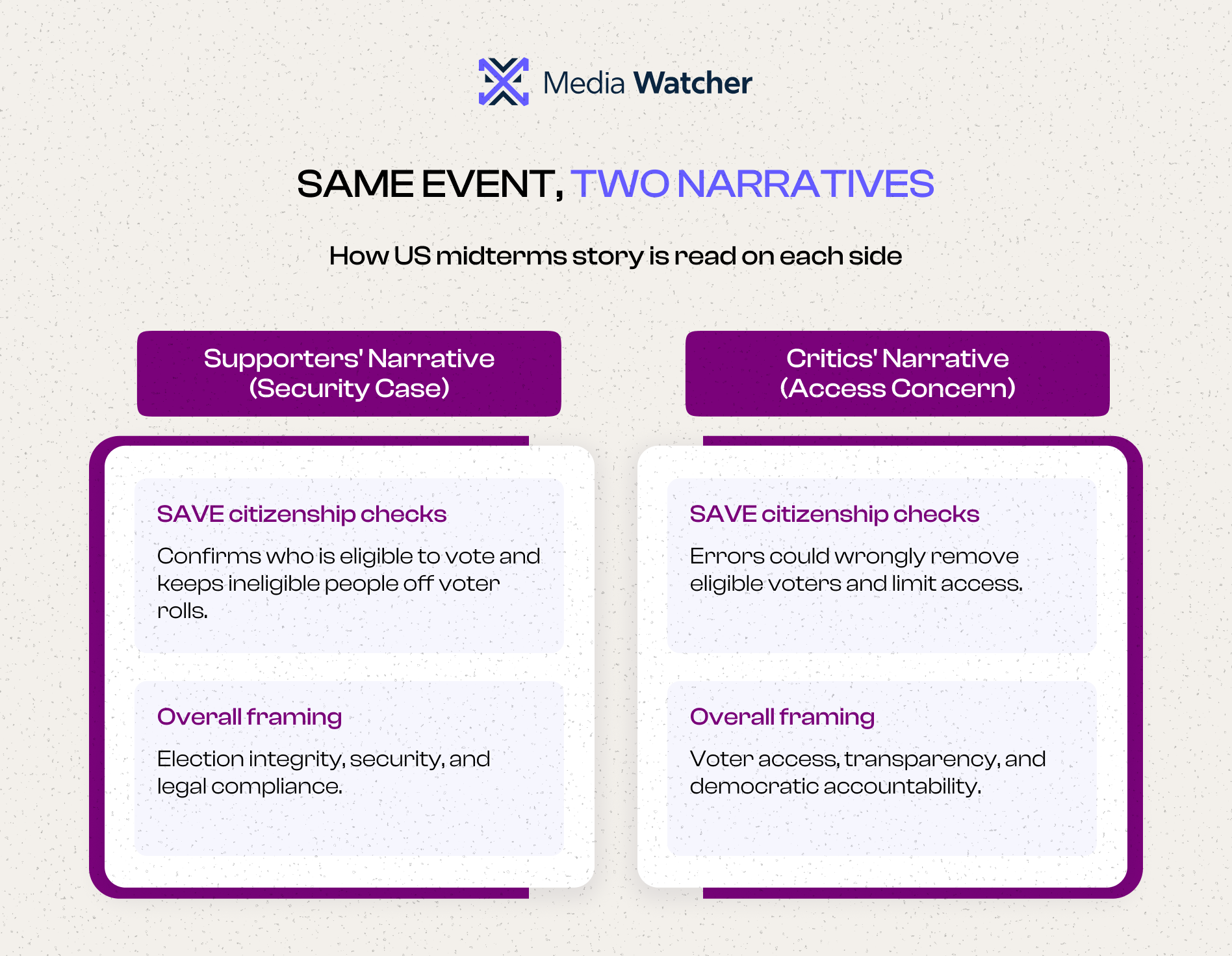
One side is talking about security. Another one refers to intimidation. If your sentiment model can’t distinguish those framings, it won’t tell you anything.
Why This Coverage Travels Beyond U.S. Outlets
Human rights stories rarely stay domestic. The OSCE decision is one example. Another is the UN: the U.S. skipped its UN human rights review in November 2025, and that review has been moved to November 2026, the same month as the midterms.
For monitoring teams, that means the same development can be framed one way in U.S. outlets and another way abroad. If you only watch domestic sources, you’re only seeing part of the sentiment picture.
Why Mention Volume Can Mislead You
Here’s a trap many teams fall into: treating a spike in human rights media coverage as a shift in public opinion.
A single report can generate hundreds of articles. But many are wire pickups, syndicated copies, or opinion pieces repeating the same point. Count them all equally, and one voice starts to look like a consensus.
The better question is how many unique stories sit behind the total, and which of them are actually new. Media Watcher’s guide to duplicate and syndicated news content goes deeper on this.
What Makes Human Rights Sentiment Hard to Score
When a story involves politics, rights, and competing narratives, one sentiment score can hide what is actually being said.
- Reporting vs. opinion: News reporting and commentary can describe the same event very differently. Separating them gives teams a cleaner view of the conversation.
- Positive and negative signals in one story: An article can criticise a policy while positively describing the court ruling that blocked it. A single article level score can miss that distinction.
- Headlines lose context: A headline may simplify or even misrepresent the underlying facts. Media Watcher can look beyond the headline to understand the sentiment around specific entities and passages.
That last one is common. Take the UN Human Rights Council. A headline saying the U.S. left the Council this year would be wrong. Its last term ended in 2024, and a February 2025 executive order said it wouldn’t participate or seek re-election. It isn’t a member in 2026.
This is why passage level and entity level sentiment analysis give a truer picture than a single score per article.
What to Track Before the Midterms
The weeks before a vote don’t leave much room for guesswork. If you monitor election media, these are the signals that matter most:
- Unique stories, not just total mentions
- Sentiment by issue, such as voting access, enforcement and observation
- Framing shifts between rights, security and integrity
- Domestic vs international coverage of the same event
- Spread to social platforms such as X, Reddit, YouTube and TikTok
Together, they show whether a rights issue is shaping sentiment or just making noise.
What Media Watcher Brings Into Focus
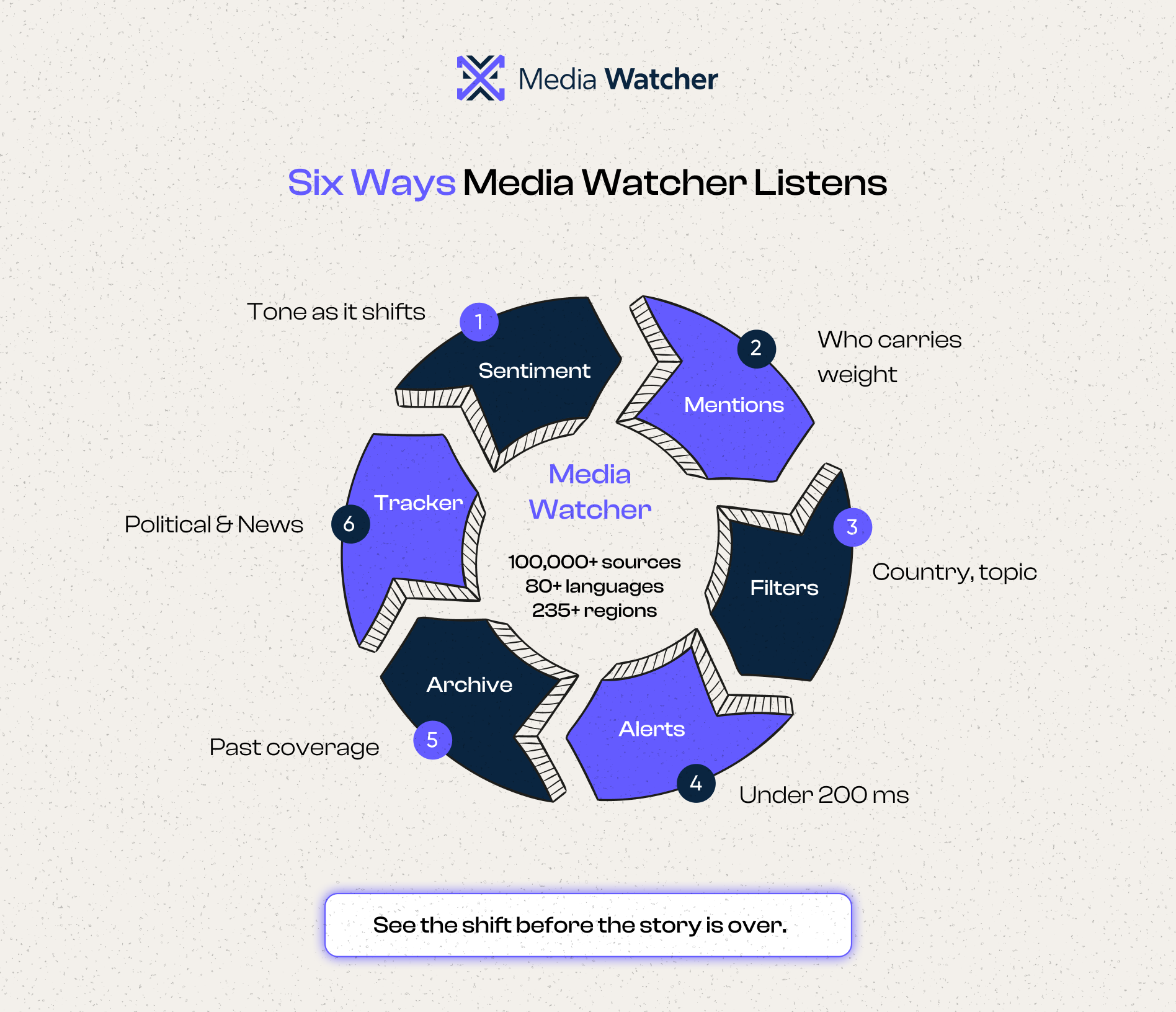
This is where Media Watcher comes in. It monitors more than 100,000 sources across 80+ languages and 235+ regions, covering news, broadcast, podcasts and social media.
Its sentiment analysis tracks tone as it shifts, and mention analysis shows which sources and influencers carry the most weight. You can filter by country, language, source and topic, so domestic and international coverage stay separate.
Say you’re a voting rights NGO following the SAVE ruling. You could:
- Set media alerts on the ruling and your own name, delivered in under 200 milliseconds
- Use election media monitoring to read sentiment at passage level
- Compare this week with earlier coverage using archive and historical data
- Follow the wider policy conversation in the political & news tracker
- It works the same way whichever side of a debate you’re on.
The Bottom Line
As human rights issues increasingly become tied to the vote itself, they are becoming part of the 2026 midterm dialogue. The same story can be told in so many different ways that it can strip the media of the message and influence sentiment.
Rumours of increased mentions do not indicate a change in opinion. Unique stories, language, and framing can tell you much more than coverage volume.
But standard sentiment scores don’t always work. Human rights coverage often blends facts, opinions, political tone, and multiple narratives, which is where passage level and entity level analysis can help determine what is being said.
Teams monitoring sentiment and framing will be able to view shifts in conversation from now through November 3. Want to see how your group can follow the shift? Schedule a demo with Media Watcher.
Frequently Asked Questions
In 2026, Human Rights Watch Stated That The U.S. Was Doing What?
In its World Report 26, published Feb. 4, it expressed concern over voting rules, immigration enforcement, free expression and deployments of the National Guard. These are HRW’s opinions and not official findings.
In 2026, Will The U.S. Be A Member Of The UN Human Rights Council?
No. It will not participate or run for office in a 2025 election; its last term ends Dec. 31, 2024, per a Feb. 2025 executive order.
Why Is Sentiment Analysis Important For Human Rights Media Coverage?
The same event is presented in totally different ways through the media. Sentiment analysis shows changes in tone over time, by topic, and by source.
Doesn’t Tracking Mentions Count?
Not really. A mention tells you it was said. Sentiment is a clue to how it’s being presented and how people are responding.
Is This Just For Election Times?
No, just more apparent. If any rights issue hits the news, it can shift the tone of sentiment around an organisation, policy, or cause.