

Markets used to reward investors who had better access to information. Today, everyone has access to more information than they can possibly process, thus making it a challenge in the industry.
A company drops an announcement. A regulatory comment is starting to make the rounds. A geopolitical headline spreads across regional media.
Social media was picking up and running with it. Analysts weigh in. Traders move. By the time the price chart actually reflects what happened, it’s too late; it’s baked into the price.
As one analyst might put it, “The market does not wait for certainty, as it moves on interpretation.”
That’s the reason why it is important for today’s investors to use real time market intelligence. It aids teams to monitor the evolution of stories, sentiment, and attention to companies, industries, and macro events, before they are clearly visible in price action.
The scale of the market makes this even more important. SIFMA reported that global equity market capitalization increased 8.7% year over year to $126.7 trillion in 2024, while global fixed-income outstanding totaled $145.1 trillion.
In markets that large, investors are not just competing on data access. They are competing on signal recognition.
What Real Time Market Intelligence Actually Means
Real time market intelligence is not simply “following the news.” It combines:
- Market sentiment tracking
- Media monitoring for investors
- Stock sentiment alerts
- Investment signal detection
- Historical baseline comparison
- Narrative and attention monitoring
In simple terms, it helps investors understand what the market is starting to care about.
A headline alone is not always a signal. The signal is how quickly that headline spreads, whether sentiment changes, whether coverage expands across sources, and whether investor attention rises above normal levels.
That is where financial market intelligence software becomes valuable. It turns scattered information into structured signals that analysts can actually use.
Why Traditional Research Is No Longer Enough
It still counts to do traditional investment research. You know, earnings, filings, macro stats, analyst reports, and financial records remain critical. They tell you about things that have already happened.
Markets now react to faster-moving inputs:
- Geopolitical uncertainty
- Policy comments
- Supply chain disruption
- Executive interviews
- Legal and regulatory pressure
- Social amplification
- Sector-wide narratives
The World Federation of Exchanges noted that 2025 markets were shaped by forces including critical minerals, energy security, next-generation computing, currency shifts, and climate-related pressures. It also reported record trading volumes and market capitalization across all regions.
That matters because high-volume markets punish slow interpretation. When narratives move faster than research workflows, investors need systems that can detect early changes instead of waiting for a complete picture.
Or as the sharper version goes: “By the time everyone agrees on the story, the trade may already be crowded.”
How Market Sentiment Tracking Becomes an Investment Signal
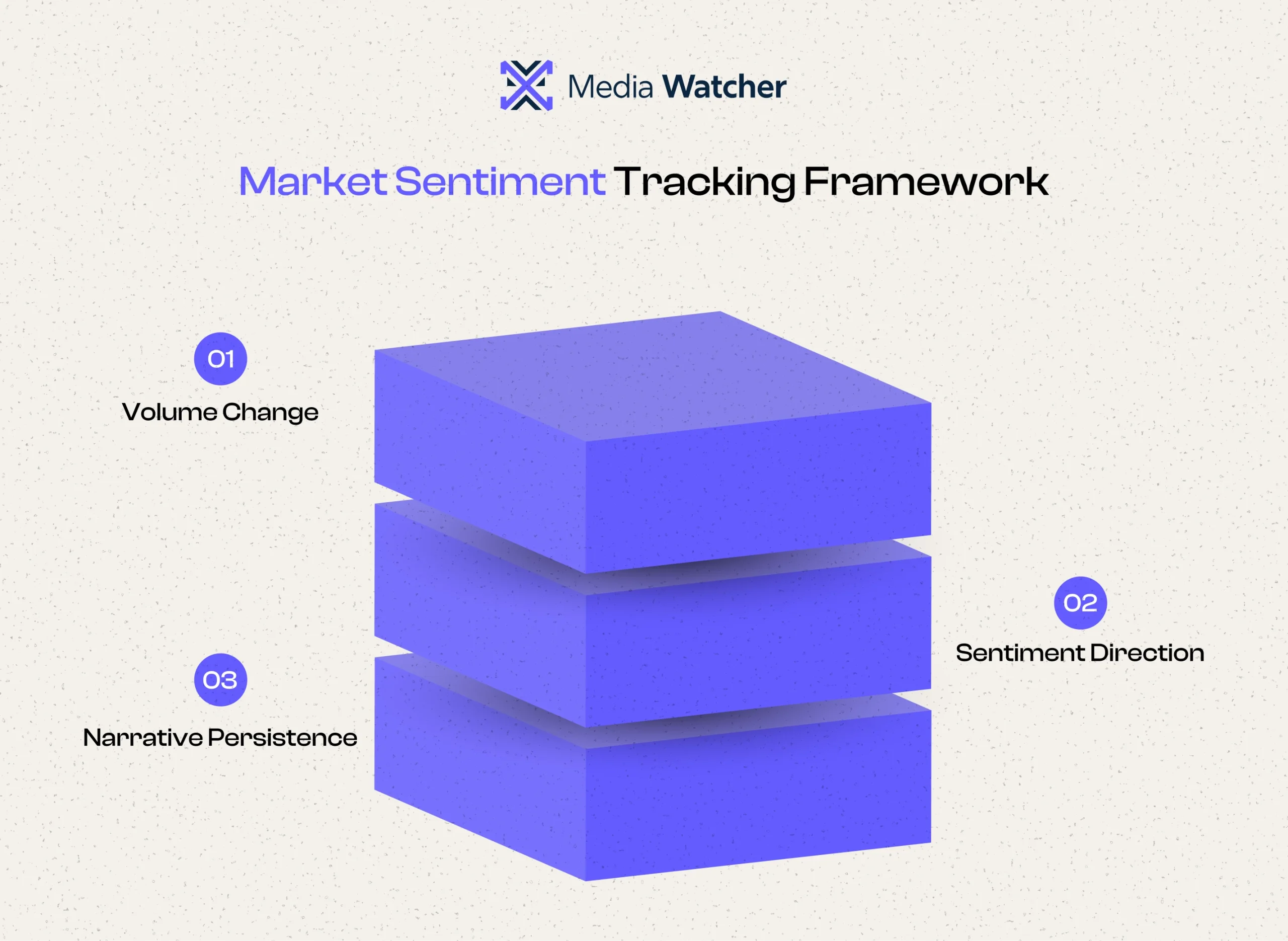
Market sentiment tracking helps investors understand whether perception around a stock, sector, or theme is improving, weakening, or becoming unstable.
But the useful question is not simply: “Is sentiment positive or negative?”
The better question is: “How is sentiment changing compared to its normal baseline?”
For instance, while an organization or company may still have mostly neutral coverage, if the tone of this coverage has shifted from stable to unstable in a short span of time, then it may be worth focusing on.
Likewise, a small company with limited coverage may suddenly attract unusual media volume. That spike may indicate a developing catalyst.
This is where investment signal detection becomes practical. Signals can include:
- Sudden negative sentiment around a portfolio holding
- Unusual attention around a ticker
- Rapid increase in coverage volume
- Repeated mentions of litigation, regulation, or executive change
- Positive narrative momentum around a sector
- Cross-market spillover from one industry to another
A strong market intelligence system does not treat every article as equally important. It ranks the signals that matter.
Why Media Monitoring for Investors Is Now a Core Workflow
Media monitoring for investors is no longer about reading more articles. Nobody needs a larger pile of tabs. We have enough tabs to qualify as architecture.
The real value is filtering. Investors need to know:
- Which companies are gaining abnormal attention?
- Which narratives are spreading across sources?
- Which sectors are being pulled into the same story?
- Which sentiment changes are temporary noise?
- Which signals are persistent enough to deserve action?
This is especially important during volatile periods. The WFE’s H1 2025 market highlights described the first half of 2025 as a “rollercoaster,” pointing to geopolitical risk, trade tensions, the war in Ukraine, the Middle East conflict, and Iran-Israel escalation that affected oil prices.
In such conditions, market behavior is shaped not only by facts but by how those facts are interpreted. Investors who can track that interpretation in real time are better positioned to respond.
The Role of Stock Sentiment Alerts
Stock sentiment alerts help investors move from passive monitoring to active awareness. Instead of manually checking every stock in a portfolio, analysts can receive alerts when sentiment, volume, or narrative attention changes meaningfully.
Useful stock sentiment alerts may include:
- Negative media spike around a specific ticker
- Sentiment deterioration across trusted financial sources
- Unusual increase in company mentions
- Sector narrative acceleration
- Sudden reputational risk signal
- Positive sentiment recovery after a weak period
The point is not to replace the analyst. The point is to make sure the analyst looks at the right thing first.
As one portfolio manager might say, “Good alerts do not make the decision. They tell you where judgment is needed.” That distinction matters. Alerts should not create panic. They should create a priority.
Why Stock Market Sentiment APIs Matter for Advanced Teams
For quantitative teams, research desks, and institutional workflows, a dashboard alone may not be enough. They often need market sentiment data inside their own systems.
That is where a stock market sentiment API becomes useful. A stock market sentiment API can help teams:
- Feed real-time sentiment into internal models
- Connect media intelligence with portfolio dashboards
- Compare sentiment trends against price movement
- Automate watchlist monitoring
- Support risk scoring and signal ranking
- Combine narrative signals with financial and technical data
This aligns with the broader direction of financial markets. The OECD notes that AI is increasingly used in financial markets, including asset management, portfolio management, trading, and risk analysis. It also emphasizes the importance of quality data, good governance, and effective implementation.
IOSCO has also observed that the use of AI in financial markets has grown in recent years, building on recent advances in large language models and generative AI, with potential benefits and risks to investor protection, market integrity, and financial stability.
In simplest words, intelligence tools are becoming more powerful, but they must also be transparent, structured, and reliable.
What to Look for in Financial Market Intelligence Software
Not every platform that tracks sentiment is built for investors. Strong financial market intelligence software should offer:
- Real-time market intelligence
- Broad media source coverage
- Ticker-level monitoring
- Market sentiment tracking
- Stock sentiment alerts
- Portfolio watchlists
- Historical baseline comparison
- Narrative trend detection
- Source-level transparency
- API access for advanced workflows
The best tools do not simply show what is being said. They help investors understand whether what is being said is unusual, relevant, and actionable.
How Investment Watcher Supports This Workflow
Investment Watcher is built around this exact problem: helping investors detect narrative and sentiment movement before it becomes obvious in the market.
It supports real time market intelligence by monitoring media signals across large-scale source coverage, tracking sentiment shifts, detecting unusual attention patterns, and helping investors prioritize watchlists based on narrative movement.
For investors, this means less manual scanning and more focused analysis. Instead of asking, “What happened today?” teams can ask:
- Which holdings are gaining abnormal attention?
- Which narratives are accelerating?
- Which sentiment shifts may affect exposure?
- Which signals deserve analyst review now?
That is the real product angle. Investment Watcher does not just provide more information. It helps turn market narratives into structured intelligence.
Modern markets move through stories before they move through spreadsheets. Financial results still matter. Fundamentals still matter. But investor perception can shift long before the next report is published.
Real time market intelligence gives investors a way to track that shift while it is still forming. With market sentiment tracking, media monitoring for investors, investment signal detection, stock sentiment alerts, and API-ready intelligence, teams can move from reactive research to earlier awareness.
The edge is no longer just seeing the news. The edge is understanding when the narrative starts to change.