

Markets move on information, while investors move on expectations. The challenge is that things change in expectations well before things change in earnings, in revisions, or in the economy.
A trend is often detected by the old timers’ signals when it has already been priced. It is for this reason that media monitoring for trading is becoming more and more valuable. Investors nowadays are no longer merely monitoring prices.
They’re watching the news, changing sentiment, and new stories that influence the market.
Recently, Boeing is an example. After the Alaska Airlines door plug incident occurred in early 2024, the media coverage went beyond that incident. What was originally conceived as a safety story turned into issues of manufacturing quality, governmental oversight, executive responsibility, and future competitiveness.
Those investors who followed those trends noticed a shift in the storyline of the company months ahead of its actual business effect. Therefore, the lesson is simple. Market sentiment often changes before market prices fully adjust.
What Is News Sentiment Data?
News sentiment data reflects the tone of media coverage of a company, industry, market event, or economic development.
For example, a company experiencing positive sentiment would have media coverage of revenue growth, product launches, partnerships, regulatory approvals for products, or expanding its business into new geographic areas.
Negative sentiment includes regulatory investigations, lawsuits, product recalls, operational disruptions, governance issues, and reputational damage affecting the company.
Neutral sentiment would refer to reporting only factual information, without generally emphasizing its relative positive or negative nature.
Although it is helpful to classify sentiment, very few sophisticated investors will invest solely on the current sentiment score.
The true value of sentiment lies in monitoring how it changes over time for the company. A positive sentiment trend for a company generally will not provide useful investment information.
However, if the company was consistently receiving positive coverage and suddenly received negative coverage, this could indicate that investors are adjusting their expectations for the company and its stock. The trend of sentiment is more important than the current snapshot.
Why Sentiment Shifts Matter More Than Headlines
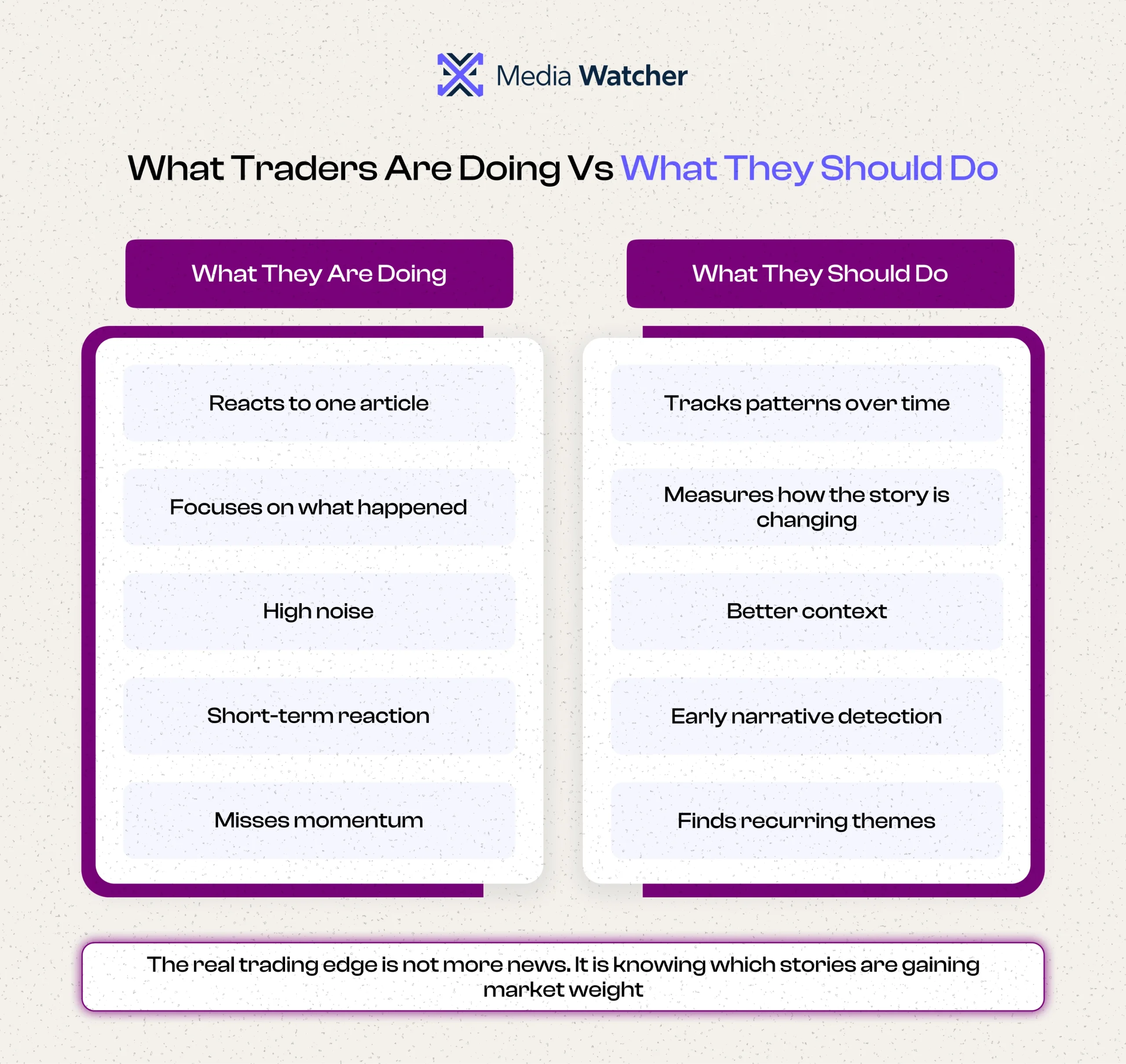
Many investors react to individual headlines. Professional investors often focus on patterns. A single article rarely changes an investment thesis. Repeated coverage, growing attention, and changing sentiment can. This distinction is important.
Imagine a company receives one negative news story. The market may view it as an isolated event. If similar concerns continue to appear across major publications over several weeks, investors will begin to recognize a broader issue.
This was evident in Boeing’s case. The initial incident generated substantial coverage. What followed proved more significant. Additional reports examined manufacturing processes, production delays, regulatory scrutiny, and leadership challenges.
Each new story reinforced the previous one. The result was a sustained narrative that shaped investor perceptions long after the original event.
This highlights a crucial principle for traders and investors. Sentiment itself is not always the signal. Changes in sentiment often are.
How Media Monitoring Supports Trading Decisions
Media monitoring helps investors discover emerging stories that are not yet apparent to the rest of the trading community. There is a typical pattern of an information cycle, which includes
- An event occurs.
- Media coverage begins.
- Sentiment starts shifting.
- Coverage volume increases.
- Investor attention grows.
- Market expectations change.
- Prices react.
Often, there is a window between the first and last steps of this cycle during which this opportunity can be utilized.
By monitoring media sentiment, investors gain visibility into how stories evolve. They can identify risks, opportunities, and changing perceptions before they become fully reflected in asset prices.
This does not guarantee market predictions. It provides additional context that traditional market data may not immediately reveal.
Five Ways Investors Can Use News Sentiment Data
News sentiment data provides investors with an additional layer of insight beyond traditional market analysis. Here is a list of ways the finance industry can use new sentiment data:
Detect Emerging Risks Earlier
Risk rarely comes unannounced. Media attention tends to focus on operational problems, regulatory scrutiny, court cases, and governance problems, rather than on financial results.
Sentiment analysis can be used to gauge shifting risks and inform investors on the potential for market events in the near future.
Identify New Opportunities
Positive media coverage can show up new growth narratives. If you notice more coverage of technological innovation, market growth, product adoption, or industry change, you might see more investment interest. Investors can gain insight into where the attention is going by monitoring these developments.
Measure Market Expectations
The only thing that drives financial markets is expectations, not results. Even if earnings are good, the company may be down if expectations are raised. Modest gains, in turn, can lead to gains when expectations were low. News sentiment gives us a glimpse of the changes in those expectations.
Monitor Competitive Positioning
Businesses are not alone. A tide shift in sentiment towards competitors can provide a window into the industry’s broader sentiment, competitive strengths, or emerging issues.
Thus, media monitoring can help investors gain insight into how the market views companies in their industry.
Track Narrative Momentum
Some stories disappear within days. Others develop into scripts that affect the flow of investment and investor actions, as well as market valuations.
Media monitoring helps investors determine whether a story is dying down or on the rise. Understanding that difference can be valuable when evaluating market opportunities.
How Investors Can Separate Market Signals from Information Noise
One of the biggest challenges investors face is information overload. Thousands of financial articles are published every day. Social platforms generate even more commentary, opinions, and speculation.
Not every story deserves attention. Successful investors focus on context rather than isolated headlines. Several factors help distinguish meaningful signals from market noise.
Coverage volume indicates whether attention is increasing. Source quality helps determine credibility. Geographic reach shows whether a story is expanding internationally.
Narrative consistency reveals whether concerns are becoming recurring themes. Historical context helps investors compare current developments against previous events. When these factors align, a potential signal begins to emerge.
Without proper monitoring systems, identifying those signals becomes significantly more difficult.
Why Media Monitoring Is Becoming Essential for Modern Investors
Access to information is no longer a competitive advantage. Most investors receive financial news almost instantly. The challenge is deciding what deserves attention.
Markets today move faster than ever. News spreads globally within minutes. Investor sentiment can shift rapidly. Narratives can gain momentum before traditional financial indicators respond.
As a result, investors increasingly need tools that help them identify changing market perceptions in real time.
Media monitoring provides that capability. Rather than reacting solely to price movements, investors can track the information and narratives driving those movements.
This creates a more proactive approach to investment research and risk management.
Turn News Sentiment Into Investment Intelligence With Investment Watcher
Successful investors do not simply consume more news. They focus on the signals hidden within it.
Investment Watcher helps investors keep an eye on market-moving events across a vast number of global news sources.
This helps monitor sentiment changes in real time, identify emerging narratives, and receive alerts when significant stories begin to gain momentum.
Regardless of whether you are monitoring a corporation, a business sector, or a macroeconomic movement, Investment Watcher collects all media coverage and transforms it into usable investment intelligence.
Rather than chasing news headlines after markets have reacted, investors now have the context they need to understand market sentiment shifts before prices widely reflect them.
Thus, by booking a demo, you will find out how Investment Watcher can help you turn news sentiment, media monitoring, and narrative intelligence into a tangible market advantage.