

Novo Nordisk was crowned Europe’s most valuable company in 2023, not because traders suddenly found a way to profit from pharmaceuticals, but because one narrative began to compound across the market. GLP-1 weight-loss drugs had changed, and they were no longer just medicines. They were turning into a healthcare, consumer, insurance, food, and macro-economic narrative.
Reuters later noted that by June 2024, when the company hit a value of nearly $660 billion, the cultural and medical ascendancy of “Ozempic” and “Wegovy” had helped Novo Nordisk to become an important force in the medicare industry. The company was even big enough to warp Denmark’s national economic accounts.
This illustrates narrative momentum: before the price fully reflected the opportunity, attention had already begun to shift.
Healthcare media discussed obesity treatment. Investors talked about drug demand. Analysts questioned supply capacity. Ozempic became a household name thanks to consumer headlines. Then the market started to “re-price” the company around a much larger story.
This is all done through financial sentiment tracking. Rather than serving as a simple “positive or negative headline” indicator, it helps traders identify when a story is gaining momentum, being picked up by other media outlets, and becoming significant enough to influence capital movement.
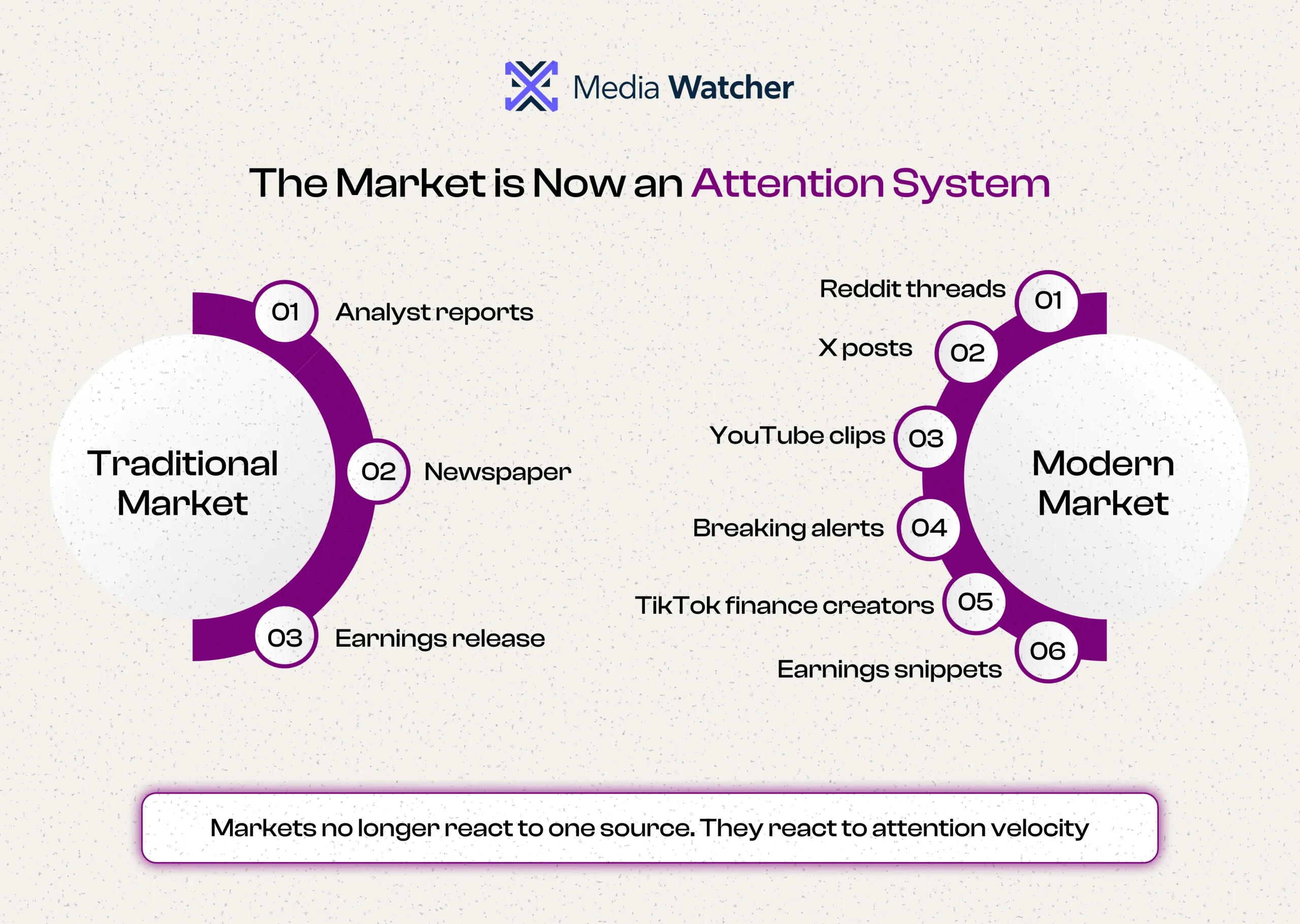
The Market Is Now an Attention System
Since the dawn of time, financial markets have responded to information. However, the change is in the speed, scale, and chaos of that information.
The democratization of information has completely upended traditional capital markets, and investors dont wait for one analyst note or one newspaper column anymore.
They are more likely to react to earnings clips, X posts, YouTube breakdowns, CEO comments, regulatory updates, Reddit threads, short-form videos, and breaking news alerts.
FINRA’s 2025 report on social media-influenced investing found that 45% of investors receive financial advice from the internet, while 24% get investment information from social media. Among investors under 30, that social media figure rises to 35%.
That matters because market sentiment is no longer shaped only by formal research, but by attention. A company can have good news, but if the market sounds negative, the price may reflect bad news anyway.
In short, traders require more than just news monitoring. They must track the market sentiment to determine whether their attention is increasing, decreasing, or changing.
Price Is Often the Final Signal
Price is a real-time indicator, though not the earliest. However, in the market, price is the definitive gauge of public sentiment around a news event. Normally:
- Headline breaks
- Story gains traction
- Sentiment starts to move
- Social conversations increase
- Analysts/Investors reassess
- Volume increases
- Price then adjusts.
A trader looking only at price is acting after the market has already reacted; a trader who follows the momentum of a narrative can often spot developing pressure before it hits the price level.
This doesn’t supplant or diminish the role of fundamental/technical analysis. Instead, it provides an additional perspective.
While an event may not move price immediately, repeated media attention from authoritative sources, growing social commentary, and languishing sentiment can give a trader an early warning of a looming risk reassessment and potential price shift.
That is the gap a financial sentiment tracking tool fills. It helps traders answer:
- Is this just one headline, or is a larger story forming?
- Is attention unusually high compared to the stock’s normal baseline?
- Is sentiment improving, weakening, or becoming more divided?
- Is the market ignoring a risk that media attention is already amplifying?
Financial Sentiment Goes Beyond Positive and Negative
A weak sentiment tool labels articles as optimistic, pessimistic, or mixed. A serious financial sentiment tracking platform goes deeper. It looks at:
- Search volume
- News volume
- Source credibility
- Sentiment direction
- Rate of change
- Historical baseline deviation
- Narrative durability
- Cross-platform amplification
- Ticker-level attention spikes
That is important because markets do not react equally to all sentiment. One negative headline from a low-authority source may not matter. Ten negative headlines across financial media, regulatory sources, and social discussion probably deserve attention. The signal is not the emotion. The signal is the change.
A good way to think about it:
Sentiment is not the opinion. Sentiment is the pressure building around the opinion.
For traders, that pressure can become an early warning system.
Why Narrative Momentum Matters
Narrative momentum happens when a story starts gaining speed across the business industry.
For instance, an organization begins with one earnings concern. Then, the media coverage starts focusing on margin compression. Social media starts debating whether growth has peaked. Analysts begin asking sharper questions. Competitors get mentioned more often. The topic keeps returning.
At this stage, the price may still look stable. But attention is no longer stable. That is where Investment Watcher plays a strong part.
The application is not just about tracking news. It is about assisting traders in identifying narrative movement in stocks by monitoring media alerts, sentiment shifts, influence scores, historical trend patterns, and changes in abnormal attention across large-scale media coverage.
This matters because traders do not need more headlines. They need to know which headlines are becoming market-moving narratives.
Do you know that SIFMA’s 2025 Capital Markets Fact Book reported that global equity market capitalization increased 8.7% year over year to $126.7 trillion in 2024. In markets of that size, even small changes in sentiment can redirect large amounts of capital.
Social Media Has Made Signal Detection Harder
Social networking sites have made investing more accessible, but they have also made markets louder.
FINRA Foundation research published in 2026 found that 29% of retail investors used social media or message boards for investment decisions, while 26% made investment decisions based on recommendations from social media personalities. Among investors aged 18 to 34, those figures rose to 60% and 61% respectively.
That does not mean social sentiment is always reliable. It means traders cannot ignore it.
Social discussion can amplify uncertainty, accelerate hype, and turn small stories into large market conversations. Sometimes that attention is justified. Sometimes it is pure noise wearing a nice jacket.
A financial sentiment tracking tool helps traders avoid reacting blindly. It provides structure to messy information by showing whether social and public attention line up with news coverage, whether sentiment is sustained, and whether the spike is unusual compared with normal activity.
As the saying goes:
The edge is not knowing everything. The edge is knowing what deserves your attention first.
How Traders Can Benefit from Financial Sentiment Tracking
A trader can utilize a sentiment tracking platform in three different ways.
Firstly, traders can track sentiment across portfolio companies rather than checking each holding individually across all watchlists. If a ticker receives more than usual attention or negative coverage in a single review, it will rise in the review list.
Second, to find an early catalyst, as they aren’t always events scheduled. It often starts with a group of stories on regulation, leadership, product demand, layoffs, lawsuits, geopolitical risk, etc., or any combination of these.
Third, for the comparison of sentiment to price action. You could see a positive sentiment swing, but the stock’s price isn’t moving, which could indicate the market hasn’t fully priced it in.
However, when the stock’s sentiment and price seem to be going in the same direction, the story is likely to be very active.
This is one of the instances where an investor must get into the habit of media monitoring, as it becomes a part of the trading process.
Why Investment Watcher Fits This New Workflow
Investors and traders looking to find out how narratives build around tickers now have a tool that they can use. Investment Watcher is exactly built for this purpose.
It combines several elements of trading into one application and lets traders measure and monitor attention, sentiment, media alerts, influence signals, historical trading trends, portfolio watch lists, and market context.
The value is not “AI says this stock is good.” That would be lazy. And frankly, a little suspicious. The value is:
- This ticker is getting abnormal coverage.
- The tone is shifting.
- The story is spreading.
- This deserves review before the price fully reacts.
This is a much better product position as it takes into account the severity of traders’ work. They are not interested in blind recommendations. They desire improved input, quicker context, and clearer signal detection.
The idea of measuring financial sentiment has moved beyond the headlines, and it is now used to determine when the market narrative begins to shift.
The traders who are waiting for the price might also receive the signal later, but they will receive it. The traders who are paying attention to sentiment and witnessing changes in the narrative can see the risk and opportunity in the market as it is still digesting the story.
In today’s market, attention moves first. Price follows when enough people believe the story.