

A financial news API tells a desk what was published. But it does not tell a desk where the narrative is heading. For traders and analysts who are assessing data vendor capabilities, the above point can easily be overlooked when comparing features.
Pricing tiers, WebSocket latency, and sentiment scoring look similar across the Finnhub API, Benzinga API, and Alpha Vantage news API. However, for institutions, other aspects are more important.
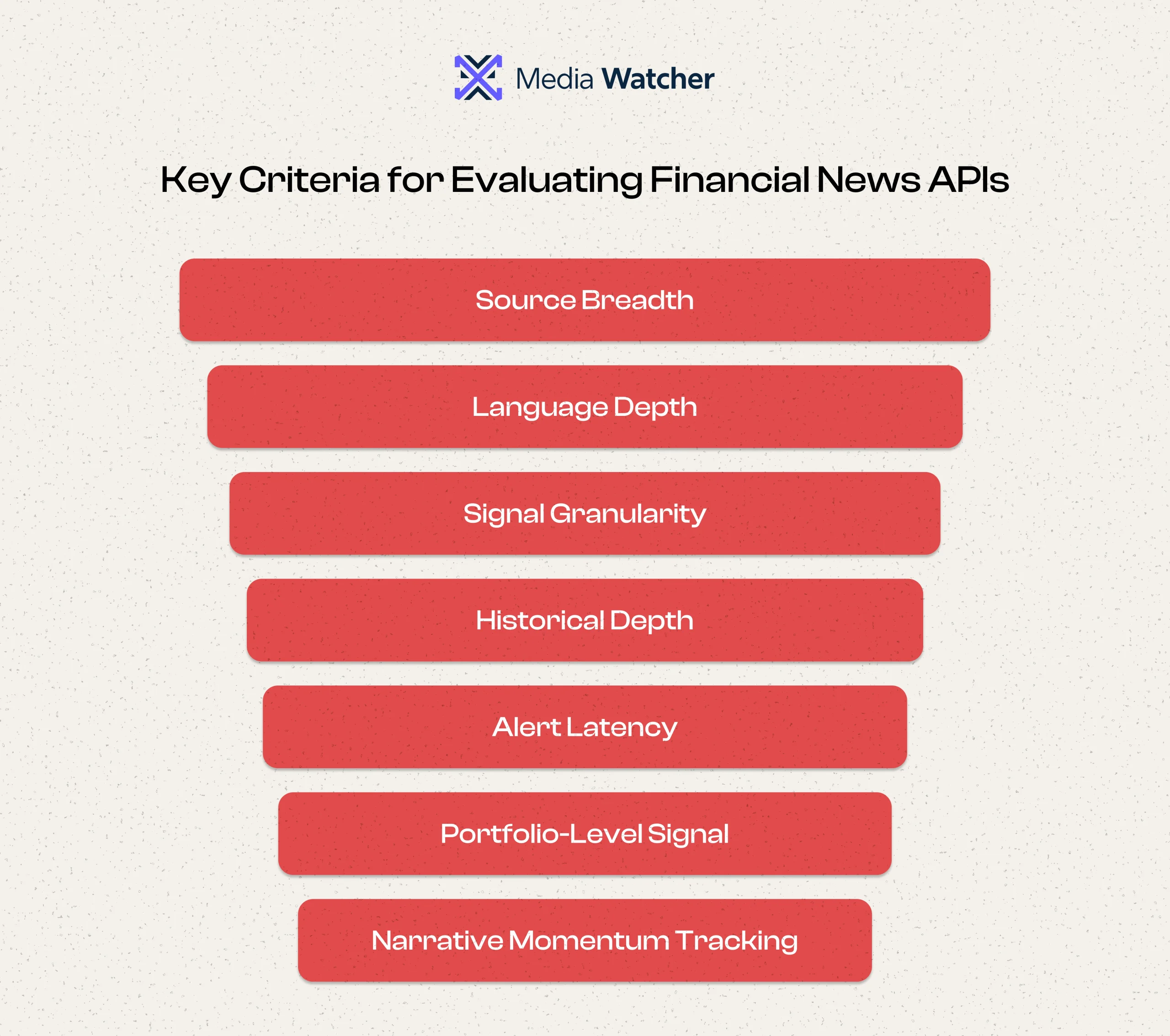
This may include coverage by language and geographic area, tracking of narrative momentum across hundreds of news sources, and the time, down to the millisecond, when alerts are delivered.
In this blog, we compare all three on the features that show up in vendor brochures and on the capabilities that do not, the narrative intelligence layer that forms before price reacts, and disappears before most structured feeds register it.
A Breakdown of Each API’s Functionality
Finnhub API integrates market quotes, fundamentals, earnings calendars, and news feed into one REST API. It is popular among developers due to its free tier allowing 60 calls/minute, an ample number compared to most free offerings.
It can be accurately described as a Swiss Army knife with a wide selection of features, including affordable pricing, extensive documentation, and quick integration for those building out trading algorithms.
On the contrary, Benzinga API sources its content directly from its own newsroom, not third parties. This is a crucial difference, as proprietary content is delivered to users much faster than aggregated content, thus allowing Benzinga to power several large brokerages.
The Essential subscription plan at $166/month includes access to real-time news feed, squawk box, sentiment indicators, and calendars. From an economic point of view, using it on a US equities desk for catalysts-based trading intraday is quite sensible as long as the feed operates live through market hours.
One more interesting tool is Alpha Vantage, which includes coverage of over 200,000 tickers from 20+ global exchanges. Its news API provides articles along with sentiment scores ranging from -0.35 (negative) to +0.35 (positive).
The NASDAQ-licensed data is production-grade, but the free tier caps at 25 requests per day, a limit that disappears quickly when tracking a diversified portfolio.
Financial News API Comparison: Features That Matter on a Desk
| Feature | Finnhub API | Benzinga API | Alpha Vantage News API |
|---|---|---|---|
| News source type | Aggregated | Proprietary + partner | Aggregated |
| Sentiment scoring | Basic headline scores | Sentiment indicators on higher tiers | Per-article scores (-0.35 to +0.35) |
| Real-time WebSocket | Available (caveats on live delivery) | REST + TCP streaming | REST; MCP server for AI agents |
| Free tier | 60 calls/min; some endpoints gated | Free trial available | 25 requests/day |
| Geographic coverage | Global markets | US-primary | 20+ global exchanges |
| Historical depth | 25 years (US market) | Configurable | 20+ years |
A documented limitation of the Finnhub API is worth naming directly. One user building a news-driven intraday trading system on a paid Fundamentals + US Market Data subscription found the WebSocket news feed delivering only historical items, none newly published during US market hours.
For a financial news API comparison framed around a real-time desk utility, this gap is material.
Key Limitations of Sentiment Analysis Across All Three Models
One-time news sentiment analysis of an article is quite different from analyzing sentiment momentum in hundreds of articles over a period of time.
Baker and Wurgler (2006, Journal of Finance) have shown that investor sentiment explains future cross-sectional stock returns. This is a process that happens via the accumulation of information rather than an article’s polarity.
One positive score (+0.2) on one article won’t move anything, whereas a change in narrative momentum in 300 articles over 12 hours will move the desks.
The Finnhub API is good only for basic sentiment tagging on headlines. The scoring at the Alpha Vantage level is more detailed, although it is done on a curated list of news feeds. Benzinga’s sentiment scores are available only for their proprietary news list.
Each platform covers sentiment within its own source universe. Cross-language narrative velocity and portfolio-level fear and greed signals, updated within 200ms of publication, are not part of any of the three offerings
For the best API for trading platform evaluation, the missing layer is the one that serves institutional clients.
How Investment Watcher Fills the Narrative Gap
Investment Watcher is not a financial news API in the Finnhub or Benzinga sense. It is a narrative intelligence layer that sits on top of a desk’s existing price and fundamental data.
The infrastructure monitors 100,000+ media sources in real time, covers 235+ regions, and delivers alerts within sub-200ms of source publication, before a story reaches a second outlet.
For stock analysts, the portfolio builder monitors up to 15 tickers for media coverage, sentiment change, and media interest. When a ticker’s story is out of line with the Fear and Greed index for the market, it shows up on the Market Sentiment Context Line as a signal, not a verdict.
The Influence Score also refines the information by source, discerning between a major media source and a content aggregator that publishes the same news two hours later.
This is the value added that trading signals based on raw news feeds don’t offer. A multinational hedge fund that used Media Watcher’s technology to feed real-time media alerts with sentiment scores into its algorithmic trading system.
They were first to respond and boosted their returns by 15% in six months.
The media intelligence layer, source weighting, trend analysis, and narrative velocity transform a news feed into an investment signal.
If your current data stack tells you what happened but not where the narrative is heading, you are making allocation decisions in the dark.
Book a demo and explore more!
Frequently Asked Questions
What is the Best API for Trading Platforms that Need Multilingual News Sentiment?
Platforms that require sentiment analysis across multilingual, cross-border media sources often find that standard financial news APIs cover headlines but not the narrative beneath. Investment Watcher addresses that gap directly, built on Media Watcher’s infrastructure with coverage across 80+ languages and sub-200ms alert delivery.