

On a random day of 2023 in March, Twitter/X lit up with posts about Silicon Valley Bank deposit risk hours before regulators made a formal statement. House Financial Services Chair Patrick McHenry later described it as “the first Twitter-fueled bank run.”
By the time the official news broke, USD pairs had already moved.
Depositors pulled $42 billion in a single day, not because the data said so, but because the narrative said so first.
This pattern is not limited to banking crises; it also occurs every month on the release day of economic news. The trader who trades on this pattern recognizes a change in the story before the spike, not after the candle forms.
The Spike Is the Last Part of the Trade
When a Non-Farm Payrolls number or a Federal Reserve rate decision drops, the visible price move happens in under two seconds.
As per the Bank for International Settlements’ 2025 Triennial Central Bank Survey, algorithms constitute more than 92% of global forex volume. The explosion is caused by machines operating at sub-millisecond latency.
Prop traders who execute strategies by speed strategy are dealing with a partly executed trade. With the SVB situation, an illustration of another strategy implementation can be presented.
Well, by monitoring the Twitter thread throughout the day, the trader would have more than a couple of hours’ notice before the official declaration of the bank run.
The trader relying solely on price action was lagging behind the trade and responding only to confirmation of execution by the more knowledgeable party in the market.
The narrative that builds up prior to the launch within the 24 to 72-hour period is an indicator that can be measured. This shows up in the form of media tone and changes in financial news articles.
That signal precedes the consensus number because the consensus is built by analysts reading the same media environment.
What the Economic Calendar Does Not Tell You
There are four elements to consider when a prop trader views an economic calendar: date, time, previous outcomes, and analysts’ forecasts.
There is no information in the economic calendar about the media’s narrative around the news, nor about the central bank’s story in the previous week.
It should be noted that the forecast is influenced by both hard facts and the stories of the financial media.
The direction in which the coverage of the particular incident is going to be done is usually determined even before fifty economists start publishing their calculations regarding the estimates. The trader who starts off by looking at the calendar starts where all the rest do.
The differentiation window opens in the days before, when of financial media coverage can reveal whether tone around a central bank is turning hawkish or whether concern around a specific economic indicator is building. That is information the calendar does not carry.
How Narrative Shapes the Surprise Factor Before a Release
Currency pairs don’t react to the figures themselves, but to the gap between expectations and actual outcomes. That difference is the surprise factor, and the larger the gap between the consensus, the larger the price movement.
The factors driving the consensus prior to the release are both hard data, such as previous readings, seasonal trends, and PMI sub-elements, and soft data, the media narrative around it.
The work of narrative economics by Robert Shiller developed the idea that the spread of stories across media forums and channels affects investor positioning, without regard for underlying economic data.
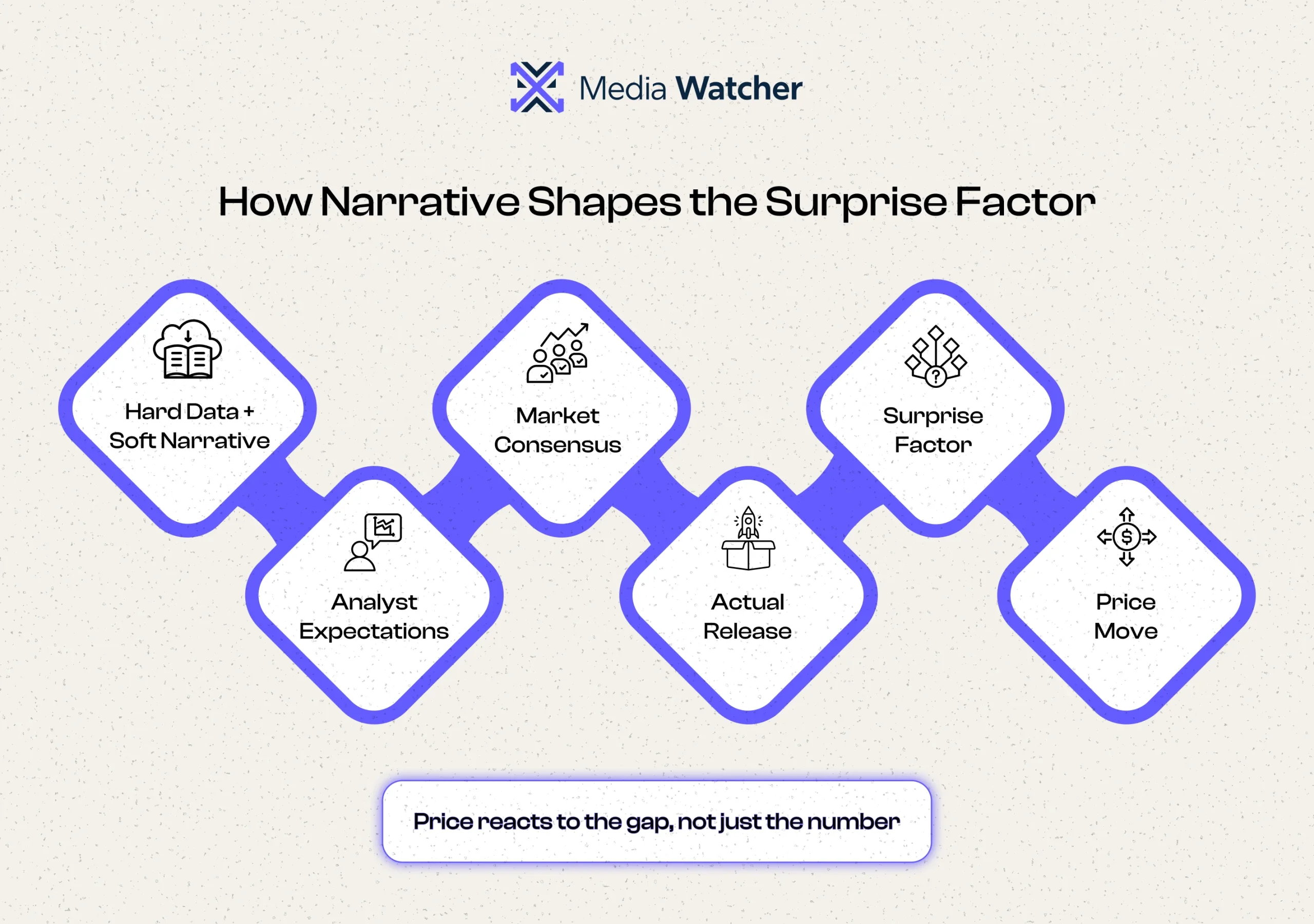
Thus, when the financial media sentiment surrounding a central bank becomes hawkish in the week leading up to a rate decision, the transition propagates analyst forecasts and re-prices market forecasts ahead of the release of the number.
A prop trader who is operating a forex news in the days prior to a Tier 1 release is monitoring the same inputs that will spur market response. Reading the headlines is not like that.
It is observing whether the weight of coverage, which is rated by tone and filtered by source authority, is shifting in a direction that the consensus has not yet been able to follow.
Why Standard News Feeds Fail Forex Traders
A raw news flow provides headlines only, without assigning sentiment scores to headlines, without weighing news by source authority, and without highlighting changes in tone towards a currency pair or a central bank.
In other words, two headlines that may explain the same Federal Reserve policy can present different perspectives on the Fed policy, depending on whether they use a cautious or a firm tone. For example, the cautious perspective versus the firm one.
It is the difference between knowing a story ran and knowing whether the overall media weight around a release is tilting in a direction that the price has not yet moved to reflect.
Without source authority weighting, a sentiment shift on Reuters carries the same signal value as the same story picked up by 40 aggregators. That is not how market participants process news, and it is not how a forex news trading strategy should either.
How Investment Watcher Gives Prop Traders the Narrative Layer
A prop trader running the pre-NFP or pre-FOMC workflow described above needs three things before the release: visibility into media volume changes around the relevant central bank or indicator, a read on whether sentiment tone is shifting directionally, and an alert the moment that shift happens. That is what Investment Watcher delivers.
It sits on top of the economic calendar and the technical setup. It does not replace either. What it adds is the media narrative layer that price data and the calendar leave out.
In the 48 to 72 hours before a Tier 1 event, Investment Watcher tracks media volume and sentiment shifts around the relevant central bank, currency pair or macro indicator across 100,000+ sources in real time.
When tone changes direction, such as more hawkish Fed coverage, rising concern around Eurozone growth, or a surge in negative sentiment around a commodity-linked currency, the platform delivers media alerts within 200ms of publication, before the story reaches a second outlet.
The Influence Score weights each piece of coverage by source authority rather than counting mentions equally. A shift on a tier-1 financial outlet carries more signal weight than the same story republished by aggregators an hour later.
This is what separates a trading signals layer from a raw alert system: weighted direction, not just notification volume.
For traders who want to test whether sentiment signals preceded price moves in past events, Investment Watcher’s historical data archive supports backtesting of narrative tone against documented price action around prior releases, including NFP prints, ECB decisions and CPI surprises.
The mechanism applies whether a trader is running a manual workflow or feeding signals into an automated system. A global hedge fund using Media Watcher’s infrastructure fed real-time media alerts with sentiment scores directly into its algorithmic trading system.
The fund responded to narrative shifts faster than desks relying on price-triggered entries, increasing returns by 15% over six months. The latency advantage that produced that result, seeing the narrative before the price confirms it, is the same advantage available to a prop trader monitoring the 48-hour window before a scheduled Tier 1 release.
A prop trader who waits for the price to confirm the narrative is not trading news. They are trading the confirmation that the informed side of the market has already acted on. The SVB case made that sequence visible in a banking crisis.
It runs the same way every month around a scheduled release, less dramatically and more reliably.
The 48-hour window before an NFP print or a Fed statement is where media tone, analyst positioning, and consensus expectation are still forming. That window closes the moment the number drops. A forex news trading strategy that operates only inside the candle starts after the edge has already passed.
If a release is on the calendar for Thursday, the narrative around it is already forming on Tuesday. Book a Demo at Media Watcher to see how Investment Watcher surfaces that narrative layer before your current setup does.