

Markets seldom operate without making noise. Before stocks show any change, there is something else that moves first.
It could be a headline, an announcement from a regulatory body, a new product release, an insider’s tip on earnings, a viral social media discussion, or a drastic change in analysts’ tone. Price is typically the last thing to be seen, while sentiment is the starting point of the story.
This is why a particular analysis known as news sentiment analysis has become an important indicator for investors today. Investors do not need to know merely what has happened but how the market is reacting to it. As a result, in markets, feeling often becomes flow
“The chart tells you what moved. The narrative tells you why it may keep moving.”
What exactly is News Sentiment Analysis in Stock Trading?
The concept “News sentiment analysis” is the process of reading the tone, understanding the direction, and intensity of media coverage around a stock, sector, executive, product, regulation, or market event.
It concludes whether coverage is positive, negative, or neutral. But good stock sentiment analysis delves deeper than that, as it asks:
- Is the coverage becoming more negative?
- Is positive attention rising faster than usual?
- Are people talking about this company more than they normally do?
- Is one story starting to dominate the market conversation?
A stock may not necessarily move immediately after a headline. But if the tone of coverage shifts across credible news sources, social channels, financial blogs, and market commentary, that shift can become an early signal. And that is the gap Investment Watcher is built around.
It tracks how public narrative forms around tickers across news and social sources, helping investors see sentiment, mentions, media alerts, influence scores, historical trends, sector movement, and market context in one place. Because in fast markets, the question is no longer just “What is the price doing?”
The sharper question is:
“What story is forming before price reacts?”
The Role of Market Sentiment in Anticipating Stock Prices
Traditional traders watch charts, volume, earnings, support levels, resistance zones, and macro data. All of that is important, but markets are not merely spreadsheets with candles on top. They are built on reaction and narrative patterns.
Like,
- A stock can move because of a CEO comment.
- A lawsuit.
- A product recall.
- A regulatory fine.
- A viral analyst note.
- A supply chain rumor.
- A single sentence in an earnings call.
Sometimes the market reacts instantly. Other times, the narrative builds slowly before the price catches up. And that is where stock market sentiment analysis and narrative detection becomes useful. It helps traders spot:
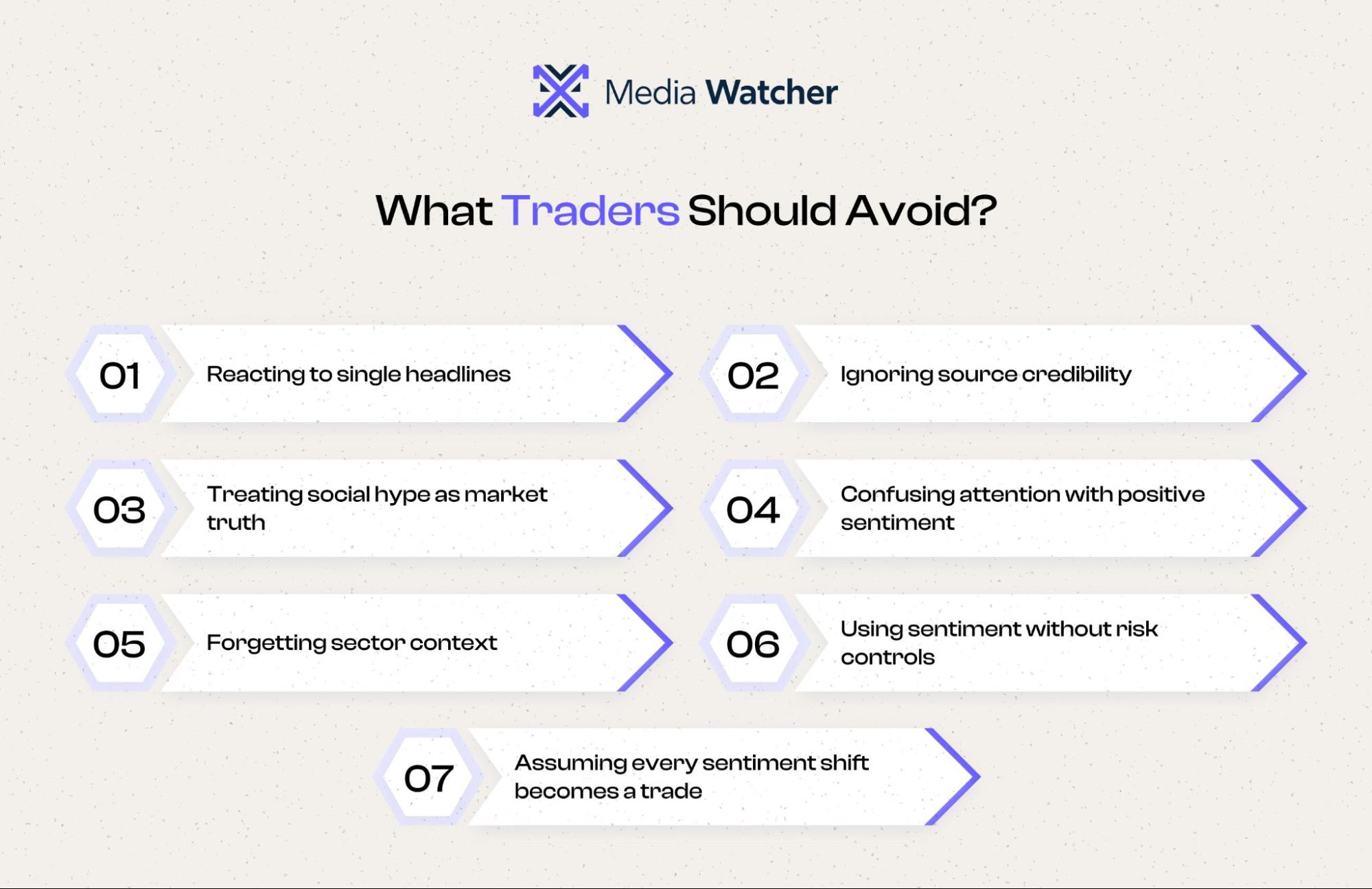
- Rising negative coverage before downside pressure
- Improving sentiment before a recovery narrative
- Attention spikes before volatility
- Sector-wide narrative shifts
- Social hype without serious media support
- Credible news momentum around a catalyst
A sentiment signal is not a magic buy button. Sadly, markets still refuse to be that polite. But it can help traders decide where to look, what to verify, and which stocks deserve attention before the broader market catches on.
How does Stock Sentiment Analysis Help Traders Spot Signals
It’s not every time that a headline may matter. Every spike may not mean opportunity, and not every “breaking news” alert deserves a trade. However, the real value of stock sentiment analysis comes from connecting these three things together.
1. Sentiment Direction
Sentiment direction, as the name suggests, shows whether the tone around a particular stock is improving, worsening, or staying neutral.
A company may have stable price action, but if news coverage starts turning negative, pressure may be building. Analysts may question guidance and customers may react negatively. Also regulators may be circling. And consequently, the story may have changed.
On the other side, a stock with weak recent performance may begin attracting better sentiment because of product demand, restructuring, earnings optimism, or sector tailwinds.
Investment Watcher helps traders keep track of these changes by monitoring sentiment across media sources and showing whether public tone is shifting around a ticker.
“Sentiment direction does not predict every move. It tells you where the market’s attention is leaning.”
2. Attention Velocity
Attention velocity is about speed. A stock getting 50 mentions a day is normal if it always gets 50 mentions a day. But if it usually gets 50 and suddenly gets 500, something changed. That “something” matters.
A sudden rise in mentions can signal a catalyst, rumor, earnings reaction, policy exposure, activist pressure, or social-driven momentum. Investment Watcher helps determine these spikes against historical patterns, so traders don’t just see noise. They are seeing deviation.
This matters because markets often punish late attention. By the time everyone is talking about the same stock, the best entry may already be gone. Or worse, the move may already be crowded.
3. Narrative Quality
Not all attention is valuable. A stock trending on social media because of memes is very different from a stock being discussed across credible financial publications, filings, analyst coverage, and sector reports.
Investment Watcher helps to separate the two by looking at five metrics, which include source coverage, sentiment trend, media alerts, influencer score, and trend history.
News Trading: Capture Sentiment Without Chasing Headlines
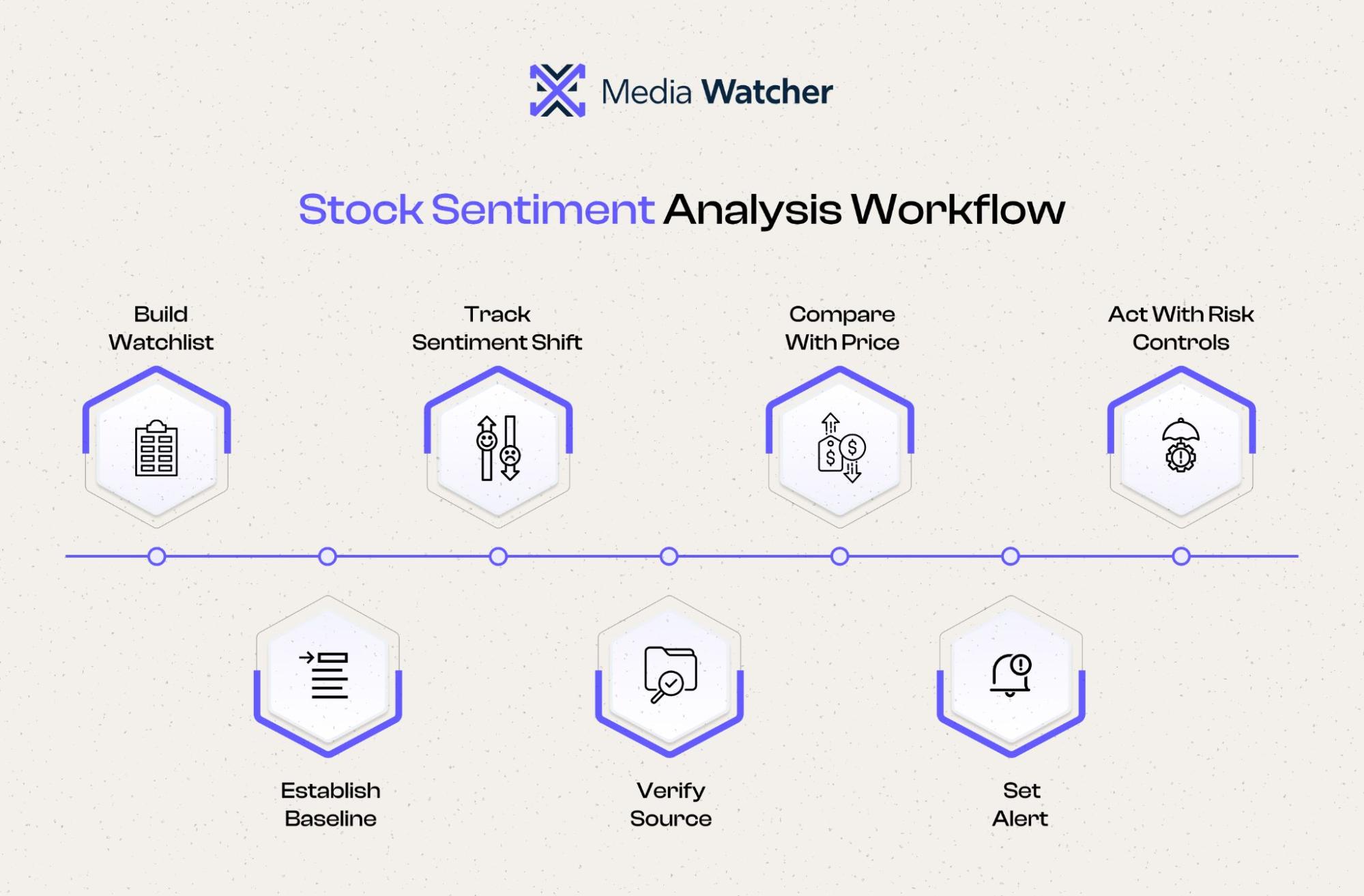
News trading does not mean reacting to every headline the second it appears. That is not a strategy, but a cardio with financial consequences. A stronger workflow looks like this.
Build a Focused Watchlist
Start with stocks you actively follow. Portfolio names, sector leaders, earnings candidates, volatile tickers, competitors, or companies exposed to regulation.
Investment Watcher lets users build a portfolio of up to 15 tickers and monitor sentiment around those names. This keeps research focused instead of turning the market into a giant flashing casino screen.
Set up the Baseline
Instead of jumping to any conclusion or reacting to a spike, understand what “normal” looks like.
- How often is the stock mentioned?
- What is the usual sentiment range?
- Which sources cover it most?
- Does social attention usually match price movement?
Trend analysis allows traders to compare current social media attention with historical media trends. However, without this baseline, everything seems significant and urgent.
Look for Sentiment Shifts
Once the baseline is clear, traders can watch for meaningful alterations in stock market sentiment, such as
- A positive sentiment shift may support a bullish thesis.
- A neutral sentiment shift with rising attention may signal uncertainty.
- A sharp mention spike may suggest volatility ahead.
The goal is not to trade every movement, but to give priority to the research.
Compare Sentiment With Price
Sentiment itself is not enough. A changing sentiment is even more useful when analyzed alongside price trends, volume, sector strength, and overall market outlook. We can see it as:
- If sentiment improves but price has not moved, there may be early upside interest.
- If sentiment worsens but the price is holding, the market may be ignoring risk for now.
- If attention spikes and price moves sharply, volatility may already be underway.
- If social hype rises but credible news stays flat, caution is needed.
Investment Watcher brings sentiment context into the same workflow as portfolio tracking, market signals, top gainers and losers, earnings calendars, sector returns, and the Fear & Greed Index.
That gives traders a wider lens, and not just “what is the stock doing?” But “what is the market environment around this stock?”
5. Use Alerts to Move Faster
The markets won’t hold off while one completes their market research manually. Real-time news updates from Investment Watcher allow investors to spot changes instantaneously. Using alerts with less than 200 ms delivered across more than 100,000 media outlets, you can react before the news becomes history.
Speed does not replace judgment, but waiting too long in fast trading markets can cost you money.
How Investment Watcher Powers News Sentiment Analysis
Well, Investment Watcher is built for traders and investment professionals who want to track the narrative before it becomes obvious in price.
It brings together:
- Real-time media alerts
- Stock watchlists
- Portfolio tracking
- Sentiment scoring
- Mention volume
- Influence score
- Historical trend analysis
- Sector returns
- Top gainers and losers
- Earnings calendar
- Fear & Greed Index
- Market sentiment context
- Coverage across 100,000+ media sources
- More than 80 languages and 235+ regions
- API and RSS integration
Rather than checking five dashboards, seven news tabs, three social feeds, and one chaotic group chat, traders can monitor how public sentiment is shifting around specific stocks that matter to them.
Investment Watcher supports news sentiment analysis by helping users detect sentiment shifts, attention spikes, media movement, and historical narrative patterns around specific tickers.
Because the market does not just move on numbers. It moves on belief. And belief usually leaves a trail.
Book a demo and explore more!