

Peak season in e-commerce is not just a sales moment but a pressure test, which became evident in the last months of 2023 when Temu didn’t just enter Black Friday but flooded the entire holiday season.
Across YouTube, TikTok, Google, and social feeds, Temu’s ads became impossible to miss, with shockingly low prices and free shipping everywhere. Lots of influencers were unboxing hauls in real time on Instagram, and for many shoppers, Temu seemed to appear overnight and take over the internet.
As a result, the sales of the brand surged, and app downloads spiked. Temu noticed that attention was increasing, but alongside that momentum, a second story emerged just as quickly. It included social media, which was filled with questions like:
- “Is Temu legit?”
- “Why is everything so cheap?”
- “Is this safe?”
- “Where is my order?”
That tension, explosive growth paired with growing skepticism, is one of the reasons brands should know why media intelligence for E-Commerce business is essential during peak seasons.
This is because peak season is no longer just about capturing demand, but requires proper management of narrative velocity.
E-commerce Brand and the Peak Season Attention Storm
Temu’s rise is one of the most aggressive e-commerce expansions in recent years.
According to a recent report, Temu became one of the most downloaded shopping apps in the U.S. in 2023 and maintained that position till 2025. It was driven heavily by peak-season advertising.
Another source framed Temu’s Black Friday strategy as ‘burning cash’ and investing heavily in promotions to compete with Shein and Amazon.” The goal of the brand is to win the season by being everywhere.
Well, Temu succeeded in one sense as it captured massive demand. But that demand is only half the equation for peak season, while the other half is perception.
As it surged, Temu faced growing scrutiny over product quality, shipping timelines, and data privacy. Those concerns did not stay confined to articles or reviews. They spilled into comments, threads, reaction videos, and side-by-side comparisons with Amazon and Shein.
Thus, this is where E-commerce media intelligence becomes the difference between growth that compounds and growth that leaks trust.
Why Peak Seasons Are No Longer Just Sales Windows
Traditionally, peak e-commerce seasons were treated as volume problems, where brands get more traffic, order and pressure on fulfillment. But today, peak seasons are attention events.
According to Adobe Digital Economy Index, U.S. consumers spent $9.8 billion on Black Friday 2023, a 7.5% increase year over year. At the same time, social platforms recorded their highest engagement levels for brand mentions and product reviews during the same period.
It means more buyers are a source of more voices, and more voices mean faster opinion formation. Further, these opinions travel faster than campaigns.
Why Customer Sentiment Escalates Faster During Peak Seasons
During peak seasons, weeks of customer sentiment compress into hours. For instance, a single issue that might have stayed isolated in June can become a headline in November. It usually happens because:
- Consumers are actively comparing brands
- Expectations are higher
- Patience is lower
- Social proof matters more than ads
One of the studies revealed that 88% of consumers indicate that trust is equal to the product itself in their buying decisions. Thus, trust is not developed gradually over peak seasons. It’s stress-tested.
At this point, most e-commerce strategies adopted by brands are ineffective because they optimize for clicks and not for conversations. And there are times when they track conversions and not context.
Why Traditional Monitoring Fails During Peak Seasons
Most brands and business teams rely on a mix of notifications and manual checks. Here are some of the reasons
- Someone watches comments.
- Someone checks reviews.
- Someone flags something on Slack.
This strategy, however, fails in the peak season since the volume surges and the discussion is shared across platforms. The complaints are transferred from one social media platform to another, including TikTok, Instagram, Reddit, and even news coverage.
Thus, by the time a weekly report highlights the issue, the narrative is already established. That is why media monitoring for e-commerce should be real-time and cross-channel, not occasional and platform-specific.
Why Media Intelligence for E Commerce Industry is a Decision Layer, Not a Report
A lot of brands think media intelligence is something they do after the season ends; however, during peak season, it is something they should use daily to make decisions. The real media intelligence for E-Commerce industry use looks like this:
- What topics are spiking right now
- How brands should upgrade inventory and adjust product offerings based on real-time customer feedback
- Which platform is driving the narrative
- Is sentiment rising or slipping today
- Are we being compared to a competitor, and why
- Is the issue isolated or becoming a pattern
So, this is how brands respond early rather than apologizing late. A retail analyst once put it:
“During peak season, brands do not compete on price alone. They compete on trust velocity.”
What Happens when Revenue Looks Good, but Sentiment Looks Bad
The most expensive peak season mistakes happen when perception and performance separate. It happens when sales stay stable, but negative sentiment grows, and customers start warning each other publicly.
This leads to delayed effects: higher return rates the next week, fewer repeat purchases after the holidays, and more chargebacks. The customer acquisition costs will be higher next quarter.
In other words, you might win the week and lose the customer base. Thus, media Intelligence software for E-Commerce is crucial for turning customer conversations into an early warning system, not a post-mortem.
How Media Intelligence Helps E-Commerce Teams Act Faster
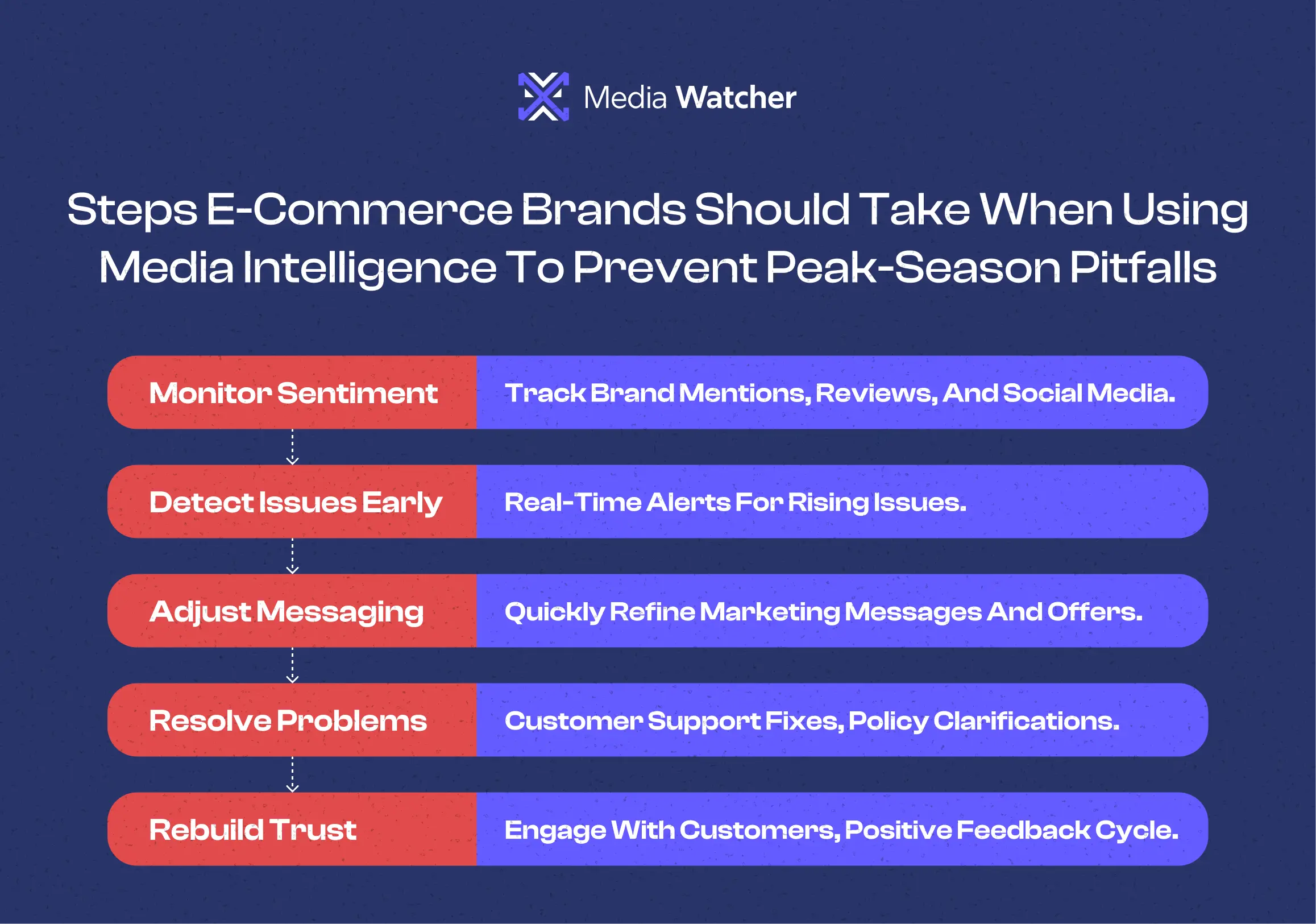
The best use of media Intelligence for E-Commerce is not just identifying problems. It is shaping decisions across teams, such as:
- Marketing uses it to refine messaging before complaints spread.
- CX uses it to respond with the right tone and context.
- Operations use it to detect recurring issues early.
- Product teams use it to understand what customers truly want this season.
In order to understand this with clarity, consider a consumer electronics brand that realized that customers were talking about how easy it was to return products at other stores, even though the product itself wasn’t the problem.
The issue was with the brand’s unclear and frustrating return policy. Within two days, they updated their messaging and customer support to clarify the policy.
As a result, the complaints died down, and their sales remained stable. This shows how media intelligence doesn’t just help brands aim for perfection, but helps them react quickly to fix problems before they get worse.
Suggested Read: How Media Intelligence Services Help Businesses Navigate the Noise
Media Watcher as a Smart Media Intelligence Tool for E-Commerce
Given the challenges e-commerce brands face during peak seasons, Media Watcher is built for those who need to stay ahead of narrative shifts during high-pressure moments. Instead of just tracking mentions, it helps teams understand narrative momentum across channels, including social, news, reviews, and forums.
During peak season, Media Watcher helps e-commerce teams:
- Spot sentiment shifts early
- Identify what is driving the conversation
- Understand competitor comparisons in real time
- See which issues are gaining momentum
- Align marketing, CX, and operations around the same signals
In short, it acts as a smart media Intelligence software for E-Commerce teams that need speed, clarity, and context when attention is volatile.
If you are heading into your next peak season, Media Watcher can help you stay ahead of the conversation, not behind the cleanup. Book a demo today!