



The UK’s plans to cut £5bn from disability benefits are driving a sharp public debate. In Wales and the North of England, disabled residents, carers, and local groups describe the changes as a direct risk to daily survival. In contrast, some voices from outside these regions defend the reforms as a necessary budget decision. Online discussion shows strong emotional responses formed by geography, income, and past experience with welfare reductions.
What Media Watcher’s Media Monitoring Insights Reveal About Disability Cuts in Wales and Northern England?
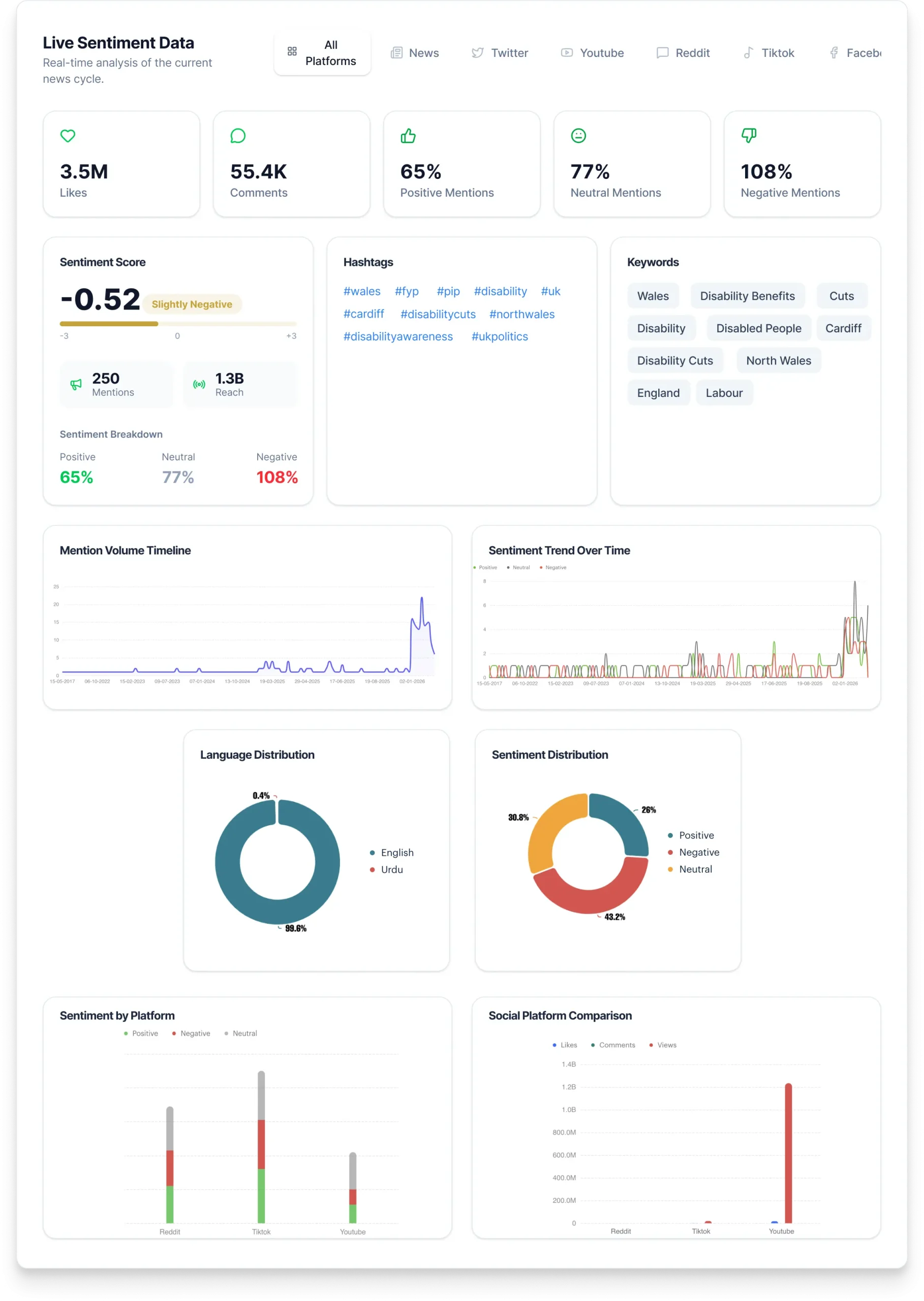
According to media monitoring data of Media Watcher, the feeling of unease among the population with regard to the reduction of disability benefits turns out to be eroded over time and replaced with frustration and anger. The general sentiment score is at -0.52, indicating a weakly negative public sentiment. The tone is a result of 250 tracked mentions, but those mentions are far-reaching, creating an estimated 1.3 billion of reach, an indicator that a comparatively narrow discussion is spreading far and wide across high-traffic venues.
The emotion breakdown explains why the conversation is one-sided. There are more negative than positive mentions (108% vs 65%), and there is a large percentage of neutral commentary (77%), indicating that many are still working out what it means and are not making hard stances. The data indicates uncertainty overlaid on frustration, rather than indifference.
Engagement patterns across platforms help explain how the debate is developing. YouTube has the strongest reach, promoting emotionally evocative explainers and personal testimonials, whereas TikTok and Reddit exhibit more abrupt sentiment shifts, frequently connected to lived experience or local activism. Hashtags such as #wales, #northwales, #disabilityawareness, and #ukpolitics indicate where the focus is building up, with keywords spiking around Disability Benefits, Cuts, Cardiff, and North Wales. Language data is also concerned, although the dominant language is English, references to the Urdu language (around 8%) indicate concern in minor communities, which are usually underrepresented in the welfare discourse.
Why Supporters and Opponents are Talking Past Each Other?
The strongest opposition is in Wales and the North of England, which are more historically reliant on disability and social welfare support because of post-industrial economies and worse health outcomes. To the disabled residents and carers, the reforms are just another austerity chapter that was never completed, particularly after reports of increasing hate crimes against disabled people.
Proponents, who frequently take a wider UK-wide or London-based view of the issue, justify the cuts as a solution to curtail expenditure and to make the welfare system more modern. It is a gap less of ideology than of proximity, lived vulnerability, and abstract budget discipline.
How Disability Benefit Reforms Reflect Austerity and Regional Disparities?
The controversy on disability benefit reform could not be isolated from the long history of austerity in the UK. The past reforms of benefits restructured the daily survival of disabled families, especially those living outside the South East. A national disability strategy, on one hand, is well received, but on the other side, it is strongly criticised due to its lack of ambition and the inability to remedy historical damage. That historical backdrop is one of the reasons why trust is low, and reactions are strong.
When people start to look beyond headlines and superficial trends, they will see how disability benefits reforms are received by the public. Media Watcher shows how the sentiment of various regions, platforms, and communities changes by tracking contrasts, identifying contemporaneous shifts, and tracing regional and cultural nuances to convert popular response into a concise, practical understanding.
Suggested Read: