

In September 2023, the US Securities and Exchange Commission fined DWS, Deutsche Bank’s asset management arm, $19 million for misleading investors about how it built ESG factors into its investment decisions. But the story did not start with the regulator.
The allegations became public in 2021, when DWS was already the subject of negative public criticism over its ESG credentials, and remained in the media spotlight for two years before the penalty was imposed.
That is the pattern ESG monitoring is built to catch. Sustainability claims rarely fail all at once. They are questioned first by a journalist, an NGO, a former employee or a regulator, and those questions play out in the media long before they reach a courtroom.
This article addresses the questions of why sustainability claims are a threat to reputation, how ESG controversies can escalate and how teams can monitor ESG narratives around the world in real time.
Why Do Sustainability Claims Create Reputation Risk?
Every ESG statement sets an expectation. A company that promises to cut emissions by 50% or reach net zero is inviting stakeholders to check. And they do:
- Investors look at ESG performance before investing.
- Consumers wonder if they are substantiated.
- NGOs and journalists compare commitments against what happens on the ground.
- Now, regulators have real penalties. The UK’s Competition and Markets Authority has been granted the power to fine businesses up to 10% of global turnover for failing to comply with consumer protection laws, such as false environmental claims, since April 6, 2025.
The threat lies between a company’s words and what the world sees. A Sustainability Report is produced annually, but it’s discussed every day in the news, trade publications, on social media, and in regulatory statements. Companies which only do checks once a year are most likely to find issues when they are public.
What Is ESG Monitoring?
ESG monitoring is the continuous tracking of how sustainability topics connected to your organization are discussed across the media. Teams utilise media monitoring and listening to follow:
- Brand and executive mentions alongside ESG keywords such as labour rights, emissions, and greenwashing
- Environmental incidents and regulatory developments
- Reactions from NGOs, investors and employees
- Competitor ESG coverage, for benchmarking
From Counting Mentions to ESG Intelligence
A large company may receive hundreds of sustainability mentions every month. The useful question is not how many times it was mentioned but what the conversation means. That is where sentiment analysis turns monitoring into ESG intelligence, answering questions like:
- Is sentiment around our climate commitments improving or declining?
- Is a supply chain concern spreading from one outlet to many?
- Which stakeholder group is driving the conversation?
Where do ESG Controversies Surface First?
Not usually written in English. Often, local-language media break supply chain and environment stories first, near the event, for example, a safety report at a Bangladeshi factory or a mining dispute in Brazil, before global editors and readers take notice. These stories are not seen by monitoring that covers only major English-language publications.
How Do ESG Controversies Escalate?
Most ESG crises follow a similar path:
- A concern appears in a few sources: a local report, an NGO briefing or a post from a former employee.
- Coverage spreads to trade and national media.
- Stakeholders start asking questions.
- The issue becomes a reputation crisis, and sometimes a regulatory one.
The earlier a team sees stage one, the more options it has.
| ESG pillar | Risks to monitor | Example keywords |
|---|---|---|
| Environmental | Pollution incidents, emissions reporting, climate commitments | spill, emissions data, greenwashing |
| Social | Worker conditions, human rights, supply chain practices | forced labor, factory safety, protest |
| Governance | Transparency, leadership controversies, compliance failures | whistleblower, investigation, fine |
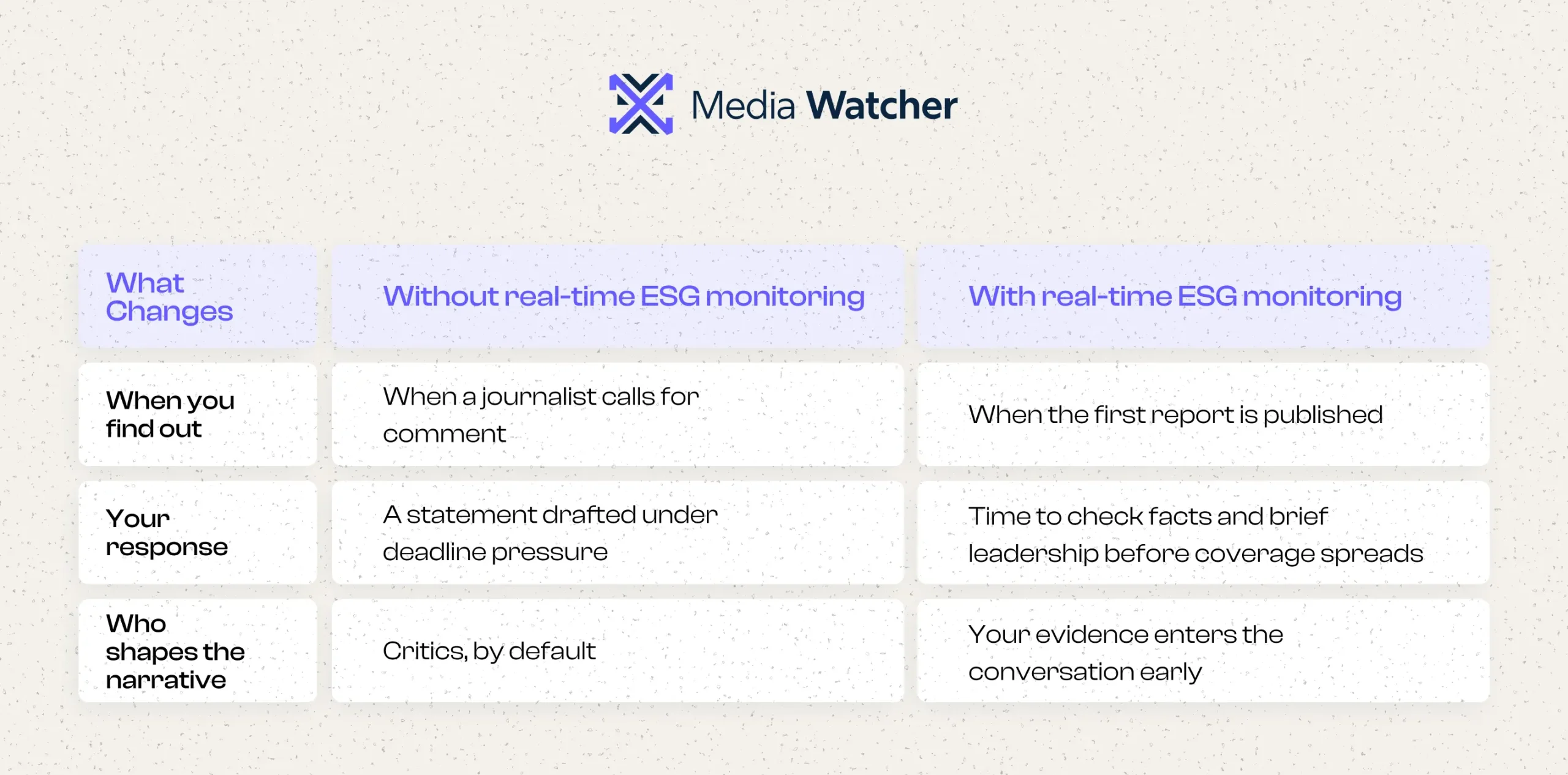
Early detection gives teams time to investigate and respond on their own terms. For response planning once an issue breaks, see our guide to PR and crisis management.
What Do Volkswagen and H&M Teach Us About Early ESG Signals?
Volkswagen: The Warning Came More Than A Year Early
Volkswagen marketed its diesel cars as a cleaner alternative. In May 2014, a study commissioned by the International Council on Clean Transportation and carried out by West Virginia University found two VW diesel models emitting nitrogen oxides at 5 to 35 times US limits.
The EPA issued its notice of violation on September 18, 2015. The scandal affected around 11 million vehicles and had cost VW $33.3 billion by June 2020.
What monitoring would have caught: the research was public more than a year before the headlines, while it was still confined to specialist coverage.
H&M: A Positive Campaign Under Regulatory Scrutiny
In 2019, the Norwegian Consumer Authority said H&M’s marketing of its Conscious collection gave insufficient information about its sustainability claims, calling them too general. The concerns were first reported in Norway in June and reached international media by August.
What monitoring would have caught: a local-language regulatory statement in one market that became an international greenwashing story within weeks.
How Media Watcher Helps You Monitor ESG Risk
Media Watcher tracks ESG conversations across 100,000+ sources in 80+ languages and 235+ regions, including the local and trade outlets where many sustainability stories first appear.
- Real-time ESG Alerts: Set up real-time media alerts that combine your brand and suppliers with ESG keywords. Alerts arrive in under 200ms from publication, so your team sees the first report, not the fiftieth.
- Sentiment by ESG Pillar: See which area is building risk and which is building trust.
- Social Conversations: Use social listening across X, Reddit and TikTok, where activist campaigns often start.
- Competitor Benchmarking: Compare your ESG coverage and sentiment against peers.
ESG Monitoring for Investment Teams
ESG controversies also move valuations and can put holdings in breach of fund mandates. Investment Watcher gives asset managers portfolio-level ESG controversy monitoring, with attention signals and narrative inflection detection that flag when coverage of a holding shifts.
Start Monitoring the Conversation Around Your ESG Claims
A sustainability pledge can impact the reputation for years. The discussion can turn in an hour. DWS, Volkswagen and H&M illustrate this: the first warning was in the public eye long before the crisis.
That is where ESG monitoring comes into play. It turns an annual sustainability report into a real-time picture of investor, regulatory, and media reaction to your assertions. An NGO report released at 9 pm can reach European newsrooms by morning in São Paulo.
Book a demo with Media Watcher to set up ESG alerts for your brand, your suppliers and your portfolio.