

A government can publish a message in minutes. Understanding what happens after it reaches the public takes more work.
US TV ads paid for by tax payers featuring President Donald Trump were subject to criticism from lawmakers from both sides in September 2026, according to Reuters. The ads were met by critics who questioned the political messaging, and the White House called them public service announcements meant to foster patriotism.
The case highlights that the purpose of official communication can be debated. It does not establish that a monitoring platform was used or that the reaction constituted a public safety threat.
For public agencies, the wider lesson is practical: communication continues after publication. People ask questions, share interpretations and describe experiences that may reveal information gaps.
To keep tabs on conversations available to everyone, government social media monitoring is available. Used with verification and clear response procedures, it can support earlier awareness of misleading claims, service disruptions and emerging safety concerns.
What Governments Can Learn From the Conversation Around Their Decisions
Government social media monitoring refers to the process of tracking social media for mentions or posts about agencies, policies, services, and events. A team may be followed by a question about an application deadline, reports of a road closure, or claims of emergency assistance.
Basically, social media monitoring is used to collect individual mentions and changes in activity. Social listening looks at trends, questions people repeatedly ask, problems they often encounter, and more.
They both can contribute to decision making. But neither provides a comprehensive picture of public opinion. People who post online don’t represent the broader population, and an uptick in posting may result from repetitive posting of the same content, not many independent experiences.
Agencies should evaluate these alongside any actual complaints, service records, etc. Feedback criticises a government decision. Threat assessment involves documentation of a threat.
1. Read the Sentiment Shift Behind a Sudden Spike in Mentions
A rise in mentions tells a communication team that attention has increased. It does not explain why.
People may be welcoming a policy, questioning its wording or reporting difficulty using a service. Those conversations can happen at the same time. Treating the entire discussion as positive or negative can hide the issue that needs attention.
Tracking public sentiment becomes more useful when teams connect reactions to specific topics. Are people discussing eligibility, waiting times, accessibility or the conduct of an agency?
Sentiment analysis can help organize large volumes of content and flag changes for review. Human interpretation remains essential, particularly when posts contain sarcasm, mixed opinions or local expressions.
Consider a hypothetical benefits announcement. An increase in negative posts might initially appear to be opposition to the policy. Reading the posts could reveal that people cannot determine whether they qualify.
The response would be clearer eligibility guidance, followed by checking whether the recurring questions decrease. The useful signal is the reason behind the reaction.
2. Connect Scattered Reports Before the Disruption Becomes Clear
Early reports of a disruption may appear separately. One person posts about a cancelled bus. Another describes a closed station. A local outlet reports passengers waiting without information.
Real-time monitoring can help an agency notice that these reports concern the same service or location. Their combined pattern may warrant investigating with the operator before the full scope of the problem is identified.
If an alert is issued, it should start a verification process. Teams should review if posts were published recently, if sources are independent, and if operational information backs up the posts. Multiple posts that are repeats of the same post are not multiple confirmations.
Once verified, findings can be shared with the team running the service and those preparing public updates.
The value comes from that connection. A swift alert helps someone investigate, establish the facts, and determine what action is required.
3. Catch False Instructions While People Are Still Sharing Them
Misleading public instructions can create practical risks. A fake emergency notice might direct people toward the wrong location. An outdated screenshot could suggest that assistance applications have closed.
Monitoring can surface repeated claims and help teams assess which ones require urgent verification.
A useful response process starts with the claim itself: What does it tell people to do? Which official source can confirm or correct it? Could following it cause harm?
Teams should then publish an accessible explanation with current instructions and a link to the authoritative source. Where appropriate, they can report impersonated accounts through the platform’s reporting process.
Monitoring systems cannot establish truth simply by measuring how often a claim appears. Popularity is a distribution signal, and verification requires evidence.
Agencies also need to distinguish factual errors from criticism and unanswered questions. A person challenging a policy is not necessarily spreading misinformation. Clear corrections work best when they address a specific claim and explain the facts.
4. Find the Unanswered Question That Keeps Returning
Some important signals develop gradually. A question may appear every day without ever producing a dramatic spike in mentions.
Social listening helps teams identify these recurring concerns. People may repeatedly ask which documents they need, where they can access a service or why an application keeps failing.
A hypothetical permit process illustrates the difference between communication and operational problems. Repeated requests for document guidance may call for a clearer checklist. Reports of upload failures may require a technical investigation.
Grouping these concerns by topic helps agencies route them appropriately. Communication teams can improve instructions while service owners examine the underlying process.
Direct feedback matters here too. Comparing social conversations with support requests and service data can show whether the issue extends beyond the people posting about it.
Resolving a repeated question can make a service easier to use and give staff fewer avoidable queries to handle.
5. Let Verified Public Reports Shape the Next Crisis Update
In crisis situations, there is a need for certain information like what occurred, where to go, and what services are available.
Monitoring can help during crisis management, as it can help identify gaps in existing updates. The public may be confused about evacuation routes, shelter access, or the timing of the next message.
Confirmed findings can be used in the future update. When people don’t know which shelter is open, a general message to shelters may leave the question of what to do unresolved.
Departments should also have a common understanding of the facts which they know to be true. A short “brief” can distinguish between information that has been confirmed, information being verified, and questions that require a response.
Once an update is published, teams can check whether the same confusion is still going on. If questions remain, the wording, distribution, and/or information may need improvement.
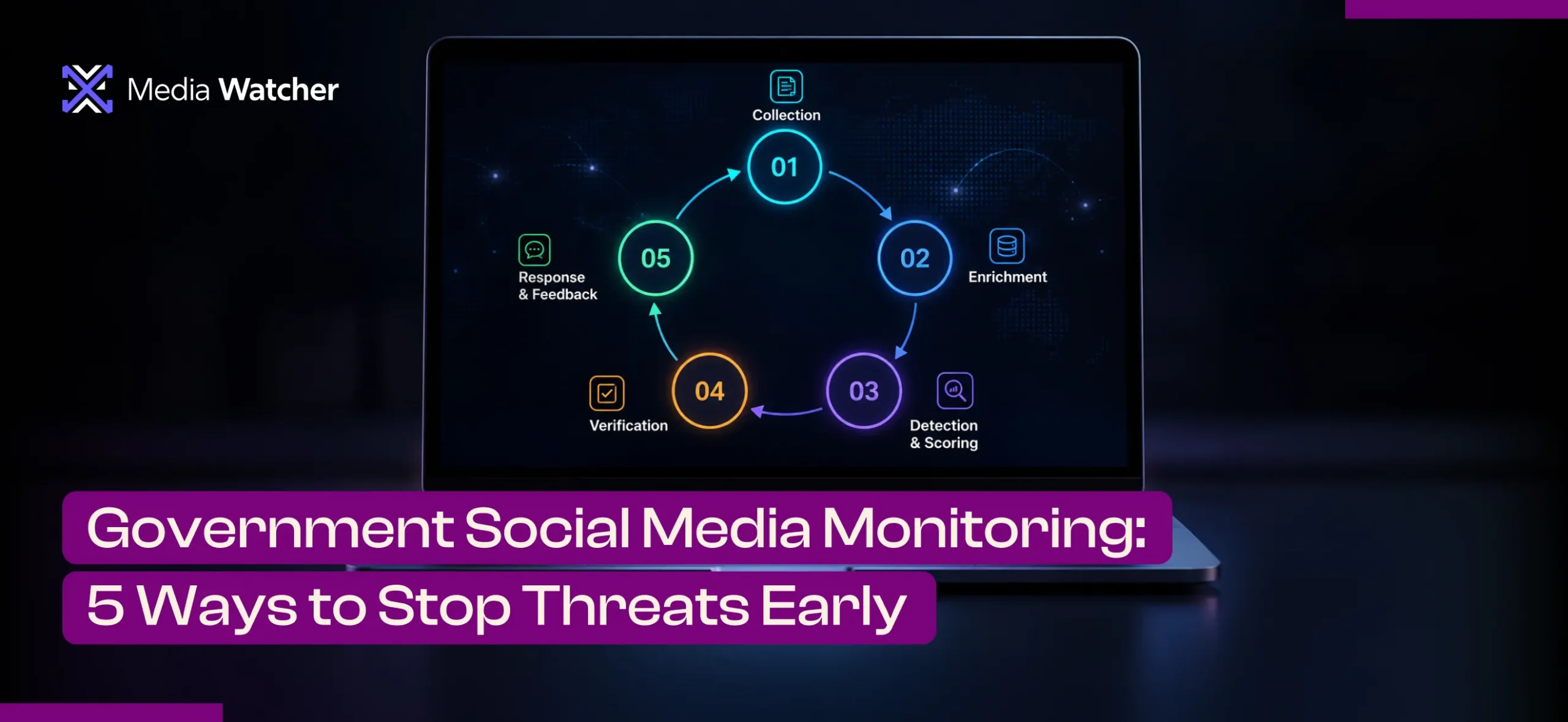
This creates a helpful response cycle: identify the concern, check it, provide guidance, and see whether the guidance helps.
Bring the Signals Into Focus With Media Watcher
When conversations start on social media and reach the people who can take action, government social media monitoring kicks in.
Begin with the questions that your agency needs to answer. What are the priorities for escalation of concerns about services? What are the claims that need to be tested? Whose problem is this? How will the team evaluate the information’s effectiveness in helping?
Use those requirements to evaluate how Media Watcher fits into your monitoring workflow and which capabilities support your priorities.
See the signals earlier. Respond with better information. Explore Media Watcher.