

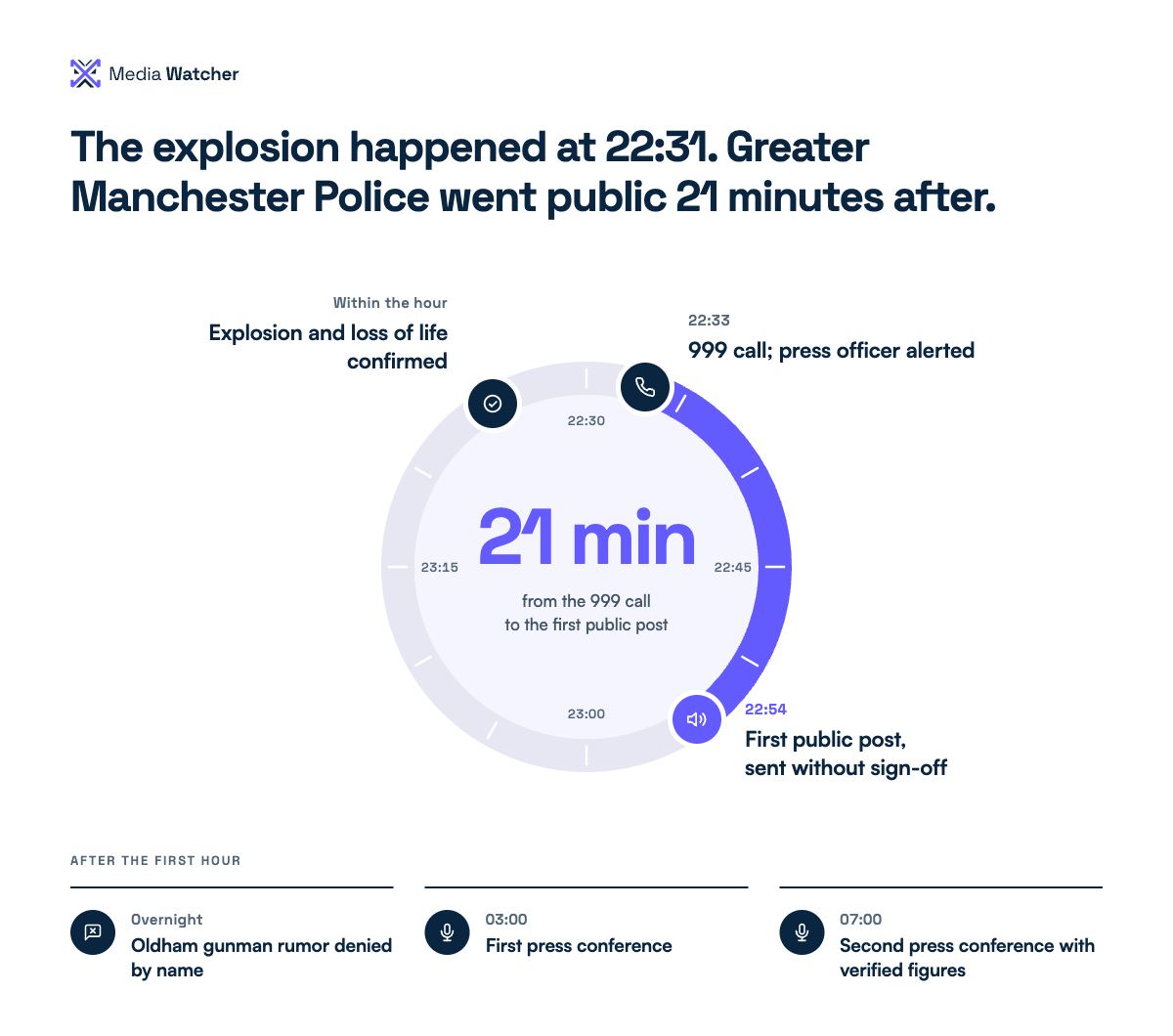
Greater Manchester Police (GMP) released its first public alert regarding the Manchester Arena attack about 20 minutes after the initial emergency call was made, back on May 22, 2017. It was dispatched by an express office without any senior sign-off and was dispatched at night.
However, a study on behalf of Freshfields, involving over 100 senior crisis communicators, found that the average business takes 21 hours to issue meaningful, lawyer-approved external communication in a crisis.
The reputations are protected or lost between 20 minutes and 21 hours. In this piece, we analyse what happened during Manchester’s first hour of crisis communications, using the then-head of communications for GMP, Amanda Coleman’s account, and the public record.
We also explore lessons to be learnt from the overall outcome and what PR/brand teams can do in their first 60 minutes.
What Happened at Manchester’s (First) Hour?
The explosion occurred at 22:31, as the last few moments of an Ariana Grande concert took place in the City Room of Manchester Arena. Manchester Arena was the venue for the blaze, which happened at 22:30 during an Ariana Grande concert.
Twenty-two people were killed, including many children and youths and hundreds were injured in the attack. Over 240 requests for medical and police assistance came in, and medical teams and more than 400 police officers were deployed overnight.
Now communicators faced an easy, heartless problem. Many parents knew their child was in the building, but few knew what had happened, or even whether a second perpetrator might be on the loose. At 22:47, the police issued an order for a whole country in case of a marauding terrorist attack: Operation Plato.
Soon, this information void was filled. Social media was flooded with fake posts asking for the recovery of missing children, including one fake post that was retweeted 17,000 times. The breaking news of a gunman outside the Royal Oldham Hospital was published by two national newspapers and one Facebook post, before being denied.
It’s the chain all PR teams need to know. An unverified post became a headline, and an unverified headline change sent families on a search for their own families. Onegle academic data alone included 28,136 tweets about the attack on Mayelf.
Why are Most Organisations Slower Than This?
It was a “low water mark”, and this vacuum was universal! Freshfields research found that over a quarter of crises spread within an hour or less, and more than two-thirds within 24 hours. In 18% of incidents, companies responded more than 48 hours after the incident.
This shift in schedule is not necessarily unexpected. In 58% of the time, there would have been days or months’ notice. The process issues were that all of them began with a blank page, drafting, legal review and executive approval.
Meanwhile, misinformation is spreading well before traditional sign-offs can even get out the door. A study from MIT, published in Science, reveals that fake news can proliferate on Twitter over 60 hours, while true news takes over 10 hours, about the time it takes 1500 people to read it. It takes 10 hours for a rumour to be accepted, and 21 hours for the official statement to be accepted.
There is a value that can be assigned to the cost. The research by Aon shows the average share price of a company falls by 5% in a year after a big crisis.
What did the Manchester Communications Response do Well?
Four members of communications staff worked throughout the night, and Coleman briefed her colleagues at Manchester City Council, British Transport Police and the fire service. There are three pivotal points of decision.
Approval was not required for the first message. The first one was given by phone by Coleman from the off-duty press officer, and it was sent without any further questions. It said no more, and much less, in record time, bridging the roughly 20-minute gap of “is anybody in charge?”
Substance was taken out of speed. GMP blurted out what it knew and didn’t reveal information until it was verified. It also pointed to a source of information and dispelled some misinformation.
There was a centre for those who remained. One of the commonalities in Coleman’s work is a focus on the impactees as the central focus in all considerations. First, her question is the following: “Why are you not giving information? Why should you? These can be tackled in a three-phase approach described in her book Crisis Communication Strategies.
These can be managed in a three-phase approach mentioned in her book Crisis Communication Strategies, which is prepare, respond and recover. Manchester kicks off tonight with a head start, hence their first-hour advantage.
Where Did the Wider Response Fall Short?
The Kerslake Report was an independent report that acknowledged the civic response but was critical of the lack of communications elsewhere. The Operation Plato declaration was not shared across agencies, and the fire service reached the scene more than two hours after the explosion. It took almost five hours to set up an effective information line for families.
Kerslake also found that agencies had underestimated the need to monitor social media and correct inaccuracies. Most bereaved and injured families described press behaviour the panel called intrusive and overbearing. Coleman herself says she would call for mutual aid from other press offices much sooner.
So was it a communications win? The first signal was. The system around it wasn’t built for this scale yet. Speaking fast was necessary, but the night exposed what was missing: the capability to know what was being said everywhere, in real time.
What Should PR Teams Do in the 1st 60 Minutes?
While most PR teams will likely never deal with a terrorist attack, a brand crisis follows similar principles: the need to fill an information vacuum, the quick spread of rumours, multiple partners to coordinate and push for approval, and friction.
Coleman agrees on the corporate cases. Looking back at the 2025 Marks and Spencer hack, she said businesses regularly ignore employees, partners, and suppliers when drawing up their crisis plans.
Let’s take a look at how the Manchester timeline is applied to a first hour playbook for brands.
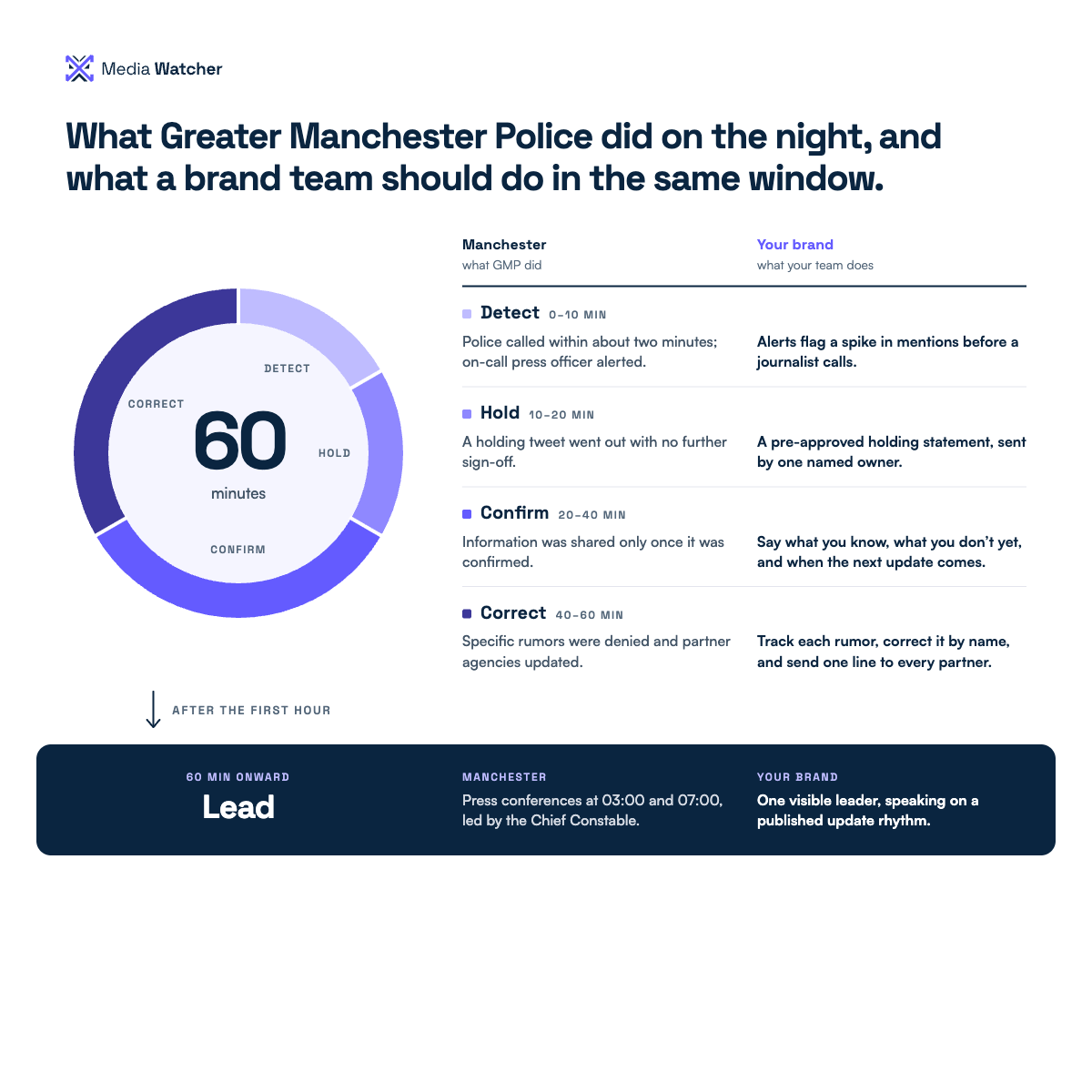
Three rules keep that table functional.
Bookkeep pre-approved first 25 words. Let them know beforehand that a brief holding statement is OK to run without escalation. It needs to state the problem, express concern, and offer reassurance about when it will be resolved, but avoid taking responsibility.
Do not correct the claim. It is no good to ask generally to “ignore speculation. A factual, named correction of the exact rumour, as GMP demonstrated with their Oldham post. We have staff on duty for a long night.
Manchester’s first night was carried by four people. Get your surge support, agency contacts and rota in place prior to a story going across time zones.
How Media Watcher Helps in the First 60 Minutes
Almost every step in that playbook depends on knowing what is being said, where and how fast. That is where Media Watcher fits.
- Early detection: Media alerts on keywords, spikes, and sentiment arrive in under 200 milliseconds across 100K+ news, social, broadcast and podcast sources.
- Rumour tracking: Social listening across X, Facebook, Reddit, TikTok, YouTube and Instagram surfaces the specific claims gaining traction.
- Global reach: Coverage in 80+ languages across 235+ regions, for the quarter of crises that cross borders within an hour.
- Impact reading: Sentiment analysis shows whether your holding statement is calming the conversation or feeding it.
On a night like May 22, that would have meant seeing the Oldham post gather speed before a national title picked it up. On a night like May 22, that would have meant seeing the Oldham post gather speed before a national title picked it up. Luckily, these 60 minutes can be rehearsed.
Check out our webinar and rebuild that hour minute by minute in the first 30-60 minutes of a PR crisis. Or book a demo and experience the first hour of real-time monitoring.
Frequently Asked Questions
FAQ 1: What should a PR team do in the First 60 Minutes of a Crisis?
Detect the problem early, send a pre-approved holding statement, share only confirmed facts, and directly correct false rumours. Name one clear leader and set a time for the next update. Greater Manchester Police posted its first alert about 20 minutes after the emergency call, without long sign-off chains.
FAQ 2: What is a Holding Statement in Crisis Communication?
A holding statement is a short, pre-approved message sent right away when a crisis starts, before all the facts are known. It says what is happening, shows concern, and tells people when to expect more news. It should not blame anyone or admit fault.
FAQ 3: Why is Media Monitoring Important During a PR Crisis?
Media monitoring shows what people are saying about your brand, where it’s being said, and how fast it spreads. Rumours often move faster than official statements, and the average business takes 21 hours to issue a lawyer-approved response. Tools like Media Watcher send instant alerts on spikes and sentiment, so your team can act before a rumour becomes a headline.