

Choosing between two media monitoring platforms becomes difficult when their feature lists start looking almost identical.
Mention and Media Watcher can both track online coverage, analyse sentiment, monitor keywords, and notify teams about relevant activity. On paper, there is plenty of overlap. The difference becomes clearer when those capabilities are put to work.
How precisely can you define what matters? What happens when coverage suddenly increases? Does the platform itself provide an interpretation of the trend rather than merely a report? How fast can your team respond from alert to comprehend what deserves attention?
In the MediaWatcher vs Mention comparison, we delve into the nuts and bolts of both platforms. We will discuss real-time detection, alerts, sentiment, filtering, intelligence, workflows and pricing options to identify which of the two is more appropriate for teams that require more than just a stream of online mentions.
1. Real-Time Monitoring: How Rapidly Does the Signal Reach You?
Mention is built around Alerts. Users create an Alert for a brand, competitor, campaign, product, executive, or industry topic, and matching conversations are collected in the Mention Feed.
It also supports notifications for individual mentions and unusual increases in conversation volume. For marketing and PR teams that want a continuous view of brand conversations, this creates a familiar monitoring workflow.
Media Watcher approaches real-time monitoring with greater emphasis on immediate intelligence.
The solution supports real-time alerts for:
- New media mentions
- Variations in sentiment
- Sudden increases in mention volume
Media Watcher also claims alert delivery in under 200 milliseconds, making speed a significant part of its product proposition.
For teams monitoring developing news, reputation issues, competitors, political events, or market-sensitive topics, the distinction matters. Finding something eventually is useful. Knowing that something significant has changed while it is developing is considerably more valuable.
2. MediaWatcher.ai vs Mention Features: What Happens After Detection?
A useful MediaWatcher.ai vs Mention features comparison should go beyond asking which platform collects more mentions.
The more important question is what each platform helps you do with them. Mention provides information such as:
- Sentiment
- Reach
- Mention volume
- Influence
- Engagement
- Source
- Conversation trends
- Influential accounts
This makes it useful for understanding overall brand visibility and measuring how conversations perform across channels.
Media Watcher adds another layer by organising intelligence around entities, cases, stories, and individual mentions.
For instance, instead of seeing ten negative articles as ten separate results, a team can investigate the broader issue those articles belong to and understand how sentiment around the monitored entity is changing.
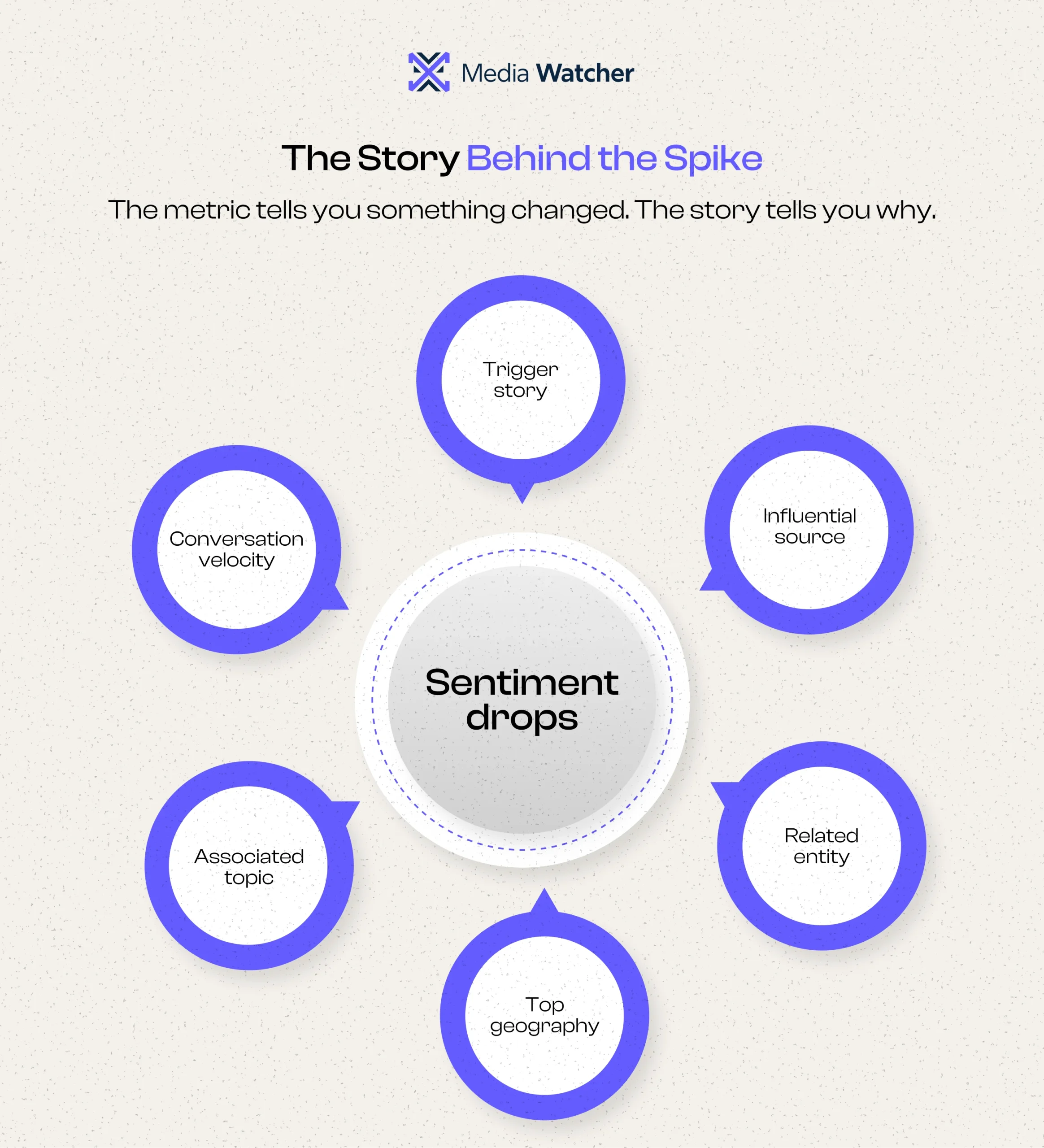
Its sentiment intelligence can also be examined across geography, platforms, related topics, and intent. This creates a different workflow:
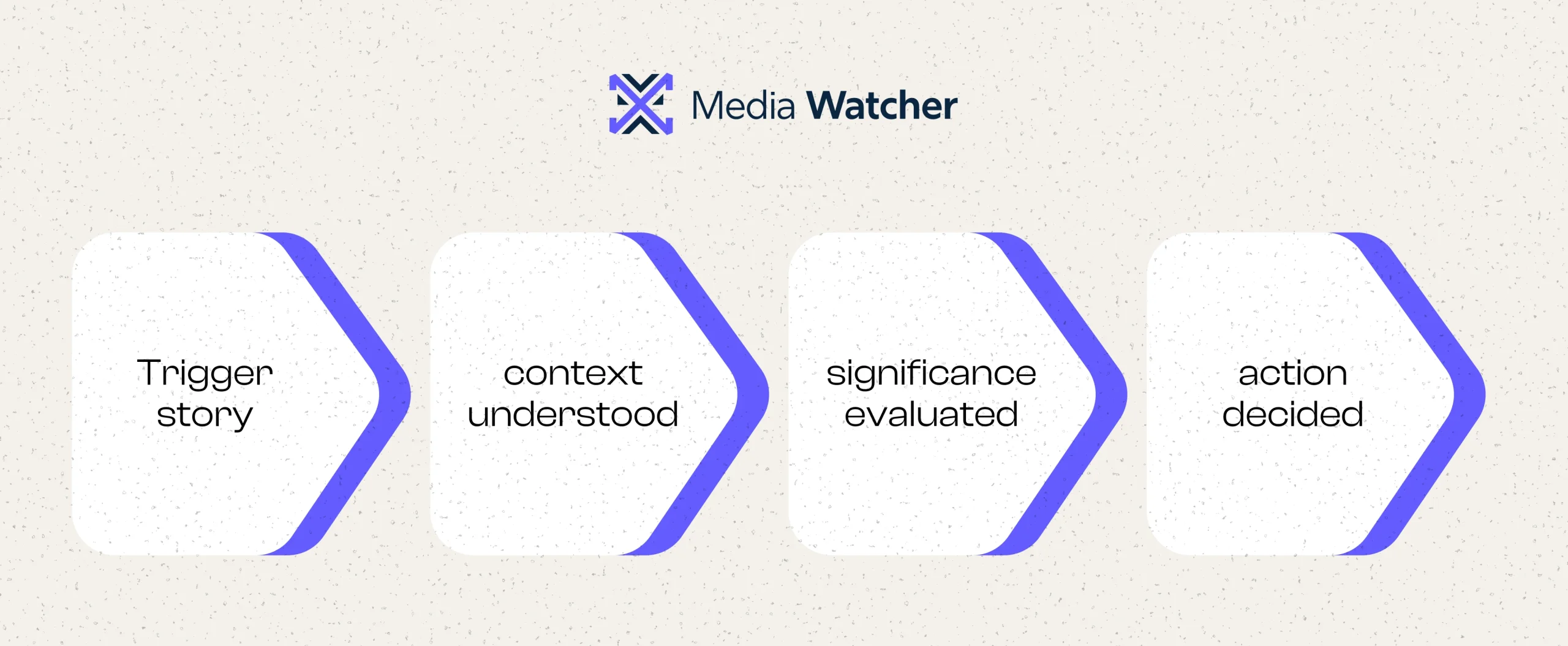
For teams comparing media monitoring tools, that contextual step can be more valuable than another dashboard full of mention counts.
3. Which Platform Handles Monitoring Noise Better?
Real-time monitoring becomes difficult when relevance is low.
Mention offers strong query controls. Users can configure keywords, Boolean searches, languages, countries, sources, excluded terms, and other conditions. This gives experienced users considerable control over what enters their monitoring feed.
The trade-off is that query quality matters. Broad or poorly configured searches can produce irrelevant results that require additional filtering.
Media Watcher also provides configurable monitoring based on entities, keywords, sources, language, region, sentiment, volume, and other conditions.
The challenge lies in what occurs after content collection, which makes its approach interesting. Contextual analysis can help teams focus on changes in sentiment or volume rather than on every matched article or post.
The distinction is particularly beneficial to teams that are tracking several markets, executives, competitors or high-risk topics at once.
4. The Comparison for Sentiment Intelligence
Well, both have sentiment analysis, with varying depth of analysis. Mention allows users to measure sentiment, volume, reach, and other metrics to monitor conversations, and classifies them as positive, negative, or neutral.
That works well for questions such as: “Did positive conversation increase after our campaign?” While Media Watcher expands the question.
Teams can examine sentiment around an entity, case, or story and investigate how that sentiment changes across locations, platforms, and related topics.
Instead of only seeing that negative sentiment increased, the objective is to understand:
- Where did it increase?
- Which story contributed to it?
- What topics are associated with the shift?
- Is it an isolated development or part of a larger narrative?
For organisations looking at an AI monitoring platform comparison, this deeper contextual analysis is one of Media Watcher’s stronger differentiators.
5. Reporting Versus Decision Support
Mention has a strong reporting environment.
Teams can build mentions, campaign, competitor, sentiment, share of voice, influencer, and other metrics-based dashboards and reports. It’s invaluable for agencies, marketing teams and communications departments that are required to report regularly on campaign or reputation performance.
Media Watcher is positioned more heavily around intelligence-led monitoring. Its entity-to-case-to-mention structure helps users move from an alert into the underlying situation.
Alerts can also be delivered through operational channels such as Slack, mobile workflows, APIs, and RSS. This makes the platform valuable where monitoring needs to influence a decision before the next weekly report is created.
6. MediaWatcher.ai vs Mention Pricing: Look Beyond the Subscription
Anyone researching MediaWatcher.ai vs Mention pricing should evaluate more than the number shown on a pricing page.
The real cost of media monitoring also includes:
- How many users need access
- Monitoring volume
- Historical data requirements
- Number of entities or topics tracked
- Reporting needs
- API requirements
- Time spent filtering irrelevant results
- Time required to investigate alerts
Mention offers different plans and capabilities based on monitoring requirements, with more advanced capabilities depending on the selected package.
Media Watcher also structures access around different monitoring and intelligence requirements. For buyers, the more useful question is therefore not simply, “Which subscription costs less?”
It is: “Which platform reduces more manual monitoring work for the team using it?”
7. Where Mention Makes More Sense
Mention remains a strong option for teams primarily focused on:
- Social listening
- Brand mention tracking
- Campaign monitoring
- Influencer identification
- Review monitoring
- Competitor reporting
- Scheduled PR and marketing reports
Organisations conducting a mention alternatives comparison should not overlook these strengths. Mention has a mature listening workflow and can be particularly practical for marketing teams and agencies whose day-to-day requirements revolve around measuring online conversations.
8. How Media Watcher Can be the Best Mention Alternative for Intelligence-Led Teams
The argument for Media Watcher becomes stronger when monitoring needs to support fast interpretation.
Its combination of real-time alerts, sentiment-change detection, entity-based monitoring, case-level investigation, multilingual analysis, geographic intelligence, topic analysis, and integration capabilities gives teams more context around what they discover.
That makes Media Watcher a compelling best Mention alternative for organisations where the question is not simply:
- “Who mentioned us?”
The questions are more likely to be:
- “What changed?”
- “Why is it changing?”
- “Where is the conversation moving?”
- “How significant is it?”
- “Does someone need to respond?”
This distinction is especially important for PR, corporate communications, research, financial intelligence, risk, reputation, and executive monitoring teams.
Which Is the Best Media Monitoring Platform?
There is no universal best media monitoring platform for every organisation.
Mention is a capable choice for broad social listening, brand tracking, campaign measurement, and recurring reporting.
Media Watcher is better suited to teams that want media monitoring to function as an intelligence system rather than simply a listening feed.
For companies evaluating media monitoring services and software, that difference should carry more weight than the length of either platform’s feature list. However, the MediaWatcher vs Mention decision ultimately comes down to what happens after a relevant mention appears.
Mention is strong at discovering conversations, organising them, measuring visibility, and turning monitoring data into reports.
Media Watcher takes the workflow further by connecting detection with context, sentiment movement, cases, entities, geographic signals, and real-time alerts.
Therefore, for teams that need to know what is happening, why it matters, and whether they should act, Media Watcher provides a stronger real-time monitoring environment.
And when media conditions can change long before the next report reaches your inbox, that difference matters.