

The average social media user uses about 6.5 to 7 platforms each month, according to DataReportal. That’s because, for a brand or creator with a hashtag campaign, a discussion doesn’t happen on a single platform.
A hashtag can reach its peak popularity on TikTok, be discussed on X, be archived on Reddit, and grow subtly on LinkedIn in a span of just 48 hours.
Planable’s 2026 survey data showed that nearly 40% of marketers handle social media all on their own, so one person is supposed to carry out all of that divided conversation in their head or 5 open browser tabs.
A reliable hashtag tracking tool brings those conversations together. Instead of reviewing each platform separately, teams can use a single system to understand where a hashtag is growing, how people feel about it, and how the conversation flows across channels.
Let’s explore what breaks when hashtag tracking is spread across platform native tools, how a unified dashboard changes the view, and how to choose the right solution for your team.
Challenge of Social Media Hashtag Tracking Across Multiple Platforms
Each platform’s native analytics were built to help users understand activity on that specific platform. They were not designed for cross-platform hashtag tracking or direct comparisons with other networks.
Here are a few areas where this creates friction.
Different Definitions of the Same Metric
“Engagement” on Instagram may include likes, comments, shares, and saves. On X, engagement can also include link clicks and profile visits. TikTok may place greater emphasis on watch time and completion rates.
Pulling these figures into one spreadsheet without normalizing them creates numbers that appear comparable but measure different behaviors.
Effective social media hashtag tracking must account for these differences so teams do not make decisions based on misleading comparisons.
Different Reporting Windows
Some platforms provide rolling 28 day reporting windows. Others reset data daily or allow users to select custom date ranges.
Aligning a hashtag across five different reporting periods can quickly become a project of its own. A unified hashtag tracking dashboard places activity on one consistent timeline, making campaign comparisons much easier.
No Cross-Platform Timeline
Native analytics show a hashtag’s lifecycle only on their own platform.
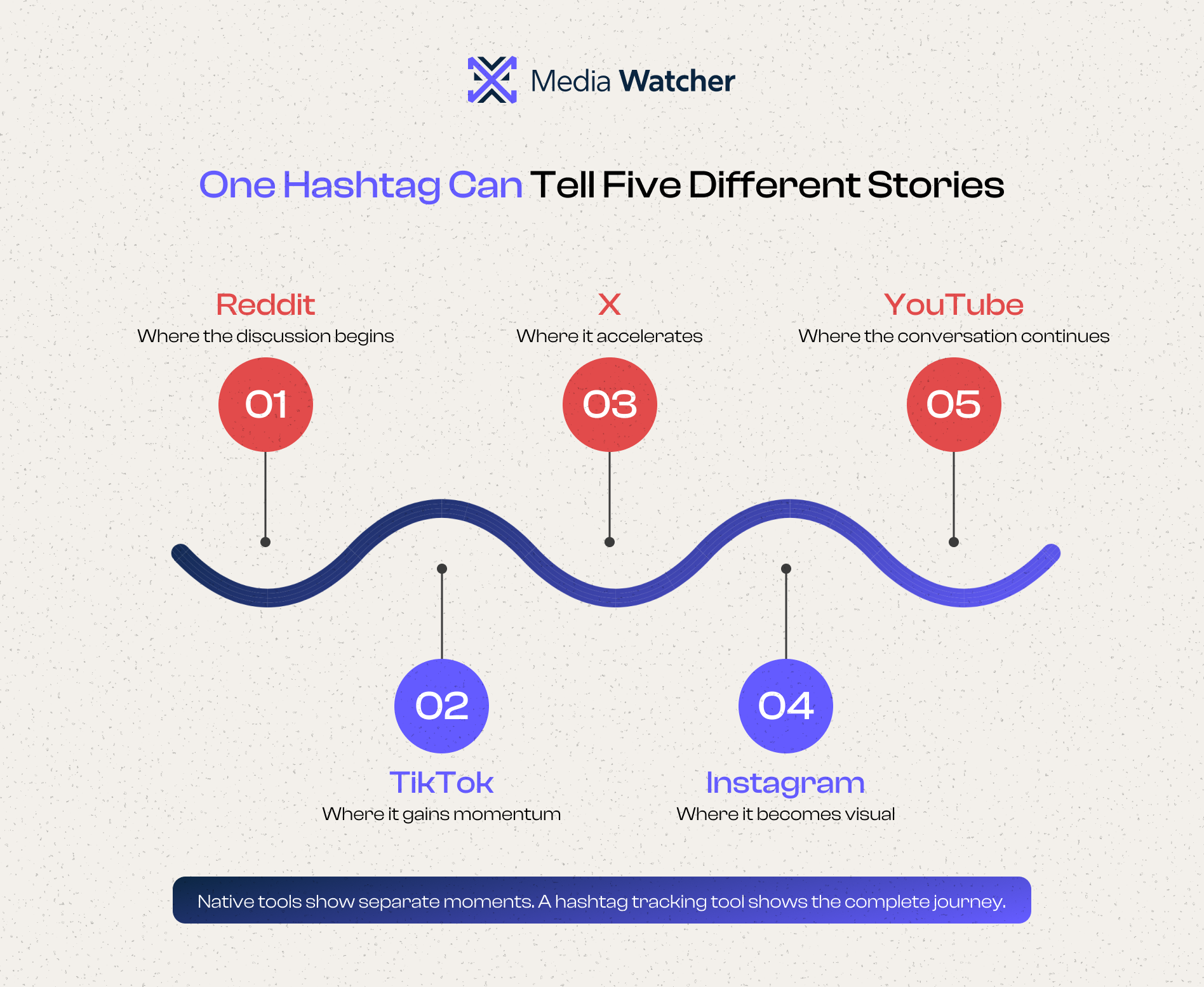
Suppose a hashtag begins on Reddit, spreads to TikTok, and then reaches X. No individual platform dashboard will show that complete journey. Your team must reconstruct it manually.
A dedicated hashtag monitoring tool can connect these events and show how conversations move between different platforms over time.
Limited Historical Depth
Some platforms retain only a few weeks or months of hashtag level data. This makes it difficult to answer questions such as: “Has this hashtag performed well before?”
Without a separate archive or hashtag tracking software, teams may lose valuable benchmarks from previous campaigns.
This is not necessarily a weakness of any individual platform. Each platform specializes in analyzing its own environment, not the complete cross-platform conversation.
What Managing Hashtag Tracking Across Five Tabs Costs
The manual tab-by-tab approach has a real operational cost, even when it technically works.
No Single View of the Narrative
When data is spread across five platforms, it becomes difficult for anyone to understand how a hashtag is performing as a whole.
Team members, clients, and stakeholders cannot simply open one report and see the complete conversation. A centralized hashtag tracking dashboard gives everyone access to the same view.
More Time Spent Collecting Data
Logging in to multiple analytics dashboards, exporting reports, taking screenshots, and rebuilding the information in a spreadsheet are recurring tasks.
For a team monitoring several hashtags across multiple campaigns, this can consume hours that could otherwise go toward content, strategy, and audience engagement.
The best hashtag tracking software should reduce this manual workload by automatically collecting and organizing hashtag activity.
More Blind Spots
Parts of the conversation may go completely untracked, not merely appear late. It is easy to under-monitor platforms where your team is less active. Reddit threads and YouTube comments are common examples.
These conversations may influence how a campaign is perceived, even when they are not visible in your primary social media channels. A broader social media hashtag tracking system helps teams identify conversations beyond the platforms they check every day.
Inconsistent Comparisons
Each platform uses its own metrics, which are often incompatible with those used by other platforms.
This can lead to misleading conclusions, such as: “Hashtag X is our best performer.” That conclusion may be based on statistics that do not measure the same type of activity.
A unified hashtag tracking tool normalizes platform data so comparisons are based on a clearer and more consistent framework.
Delayed Insights
Manual reporting can leave data a day or more out of date by the time it is compiled.
Hashtag conversations can rise and fall within hours, particularly on X and TikTok. A report built using yesterday’s numbers may miss the opportunity to respond while the conversation is still active.
Real-time hashtag tracking allows teams to act while attention is building rather than after it has already moved elsewhere.
One Dashboard vs. Five Tabs: A Side-by-Side Look
| Five Tabs (Manual, Per-Platform) | One Dashboard (Unified Tracking) | |
| Setup time per check | Log in to each platform separately | Single login, all platforms visible |
| Metric consistency | Varies by the platform’s own definitions | Normalized so platforms are comparable |
| Update speed | As fast as your last manual pull | Real-time or near real-time |
| Historical view | Limited by each platform’s retention window | Centralized archive, often much longer |
| Cross-platform trend view | Manually reconstructed, if at all | Built-in, visualized automatically |
| Best for | Very small, single-platform campaigns | Multi-platform campaigns, ongoing tracking, and reporting to stakeholders |
What a Hashtag Tracking Tool Should Actually Do
Not every all-in-one platform solves the fragmentation problem. Some simply become a sixth tab.
A useful hashtag tracking tool should do more than collect a few mentions. It should help teams understand the complete lifecycle and context of a hashtag.
Monitor the Platforms Your Audience Uses
The tool should support social media hashtag tracking across the channels where your audience is active.
This may include Facebook, X, Reddit, YouTube, TikTok, Instagram, and other relevant communities. Supporting only one or two platforms creates another partial view of the conversation.
Normalize Platform Metrics
A spike on TikTok cannot always be interpreted in the same way as a spike on LinkedIn or Reddit.
Good hashtag tracking software should organize platform specific signals in a way that allows teams to make reasonable comparisons without treating every metric as identical.
Show How Conversations Spread
A hashtag tracker should show where a conversation started, when it accelerated, and which platforms helped it spread.
This is one of the biggest advantages of cross-platform hashtag tracking. Teams can follow the journey of a hashtag rather than viewing disconnected snapshots from individual platforms.
Provide Alerts While the Hashtag Is Moving
Alerts are most valuable while the conversation is still developing.
Sub-minute or real-time alerts matter for hashtags because their popularity can change quickly. A capable hashtag monitoring tool should notify teams of unusual growth, negative sentiment, or emerging conversations before the opportunity to respond disappears.
Preserve Historical Hashtag Data
Campaign performance becomes more useful when it can be compared with previous activity. The best hashtag tracking software should maintain historical records so teams can compare a new campaign hashtag with similar campaigns from previous weeks or months.
Add Sentiment and Context
Mention volume alone does not explain whether a hashtag is helping or damaging a brand. A hashtag may be trending because customers support a campaign, because users are criticizing it, or because the conversation contains mixed reactions.
The right hashtag tracking dashboard should combine usage volume with sentiment and contextual analysis.
When Manual Hashtag Tracking May Still Matter
The manual approach can still work in limited situations. When a team is tracking one hashtag on a single platform for a short campaign, native analytics may provide enough information. Purchasing separate hashtag tracking software could be unnecessary for a very small or temporary project.
The tipping point usually arrives when a team is:
- Tracking more than one or two hashtags
- Monitoring more than two platforms
- Running campaigns continuously
- Reporting results to multiple stakeholders
- Responding to fast-moving audience conversations
At that point, manual monitoring may cost more in time, missed conversations, and reporting inconsistencies than a centralized dashboard costs to implement.
How Media Watcher Supports Cross-Platform Hashtag Tracking
Media Watcher’s Hashtag Tracker is part of its broader social listening suite. It captures hashtag activity across Facebook, X, Reddit, YouTube, TikTok, and Instagram, bringing fragmented conversations into one view.
Instead of switching between separate native dashboards, teams can use Media Watcher as a centralized hashtag tracking tool to observe how conversations develop across platforms.
Media Watcher also provides alerts within 200 milliseconds, helping teams identify hashtag trends while they are still active rather than discovering them after interest has declined.
Its hashtag monitoring tool goes beyond measuring how often a hashtag appears. It also helps teams understand whether conversations are positive, negative, neutral, or mixed across all six platforms.
This allows marketers and communications teams to distinguish between genuine campaign momentum and sudden attention driven by criticism or reputational risk.
For teams already stretched thin, especially when close to 40% of social media managers operate independently, that consolidation is more than a convenience.
A unified hashtag-tracking dashboard lets you see the full conversation as it happens, rather than reacting to an incomplete version a day later.
Curious what your hashtags look like across platforms in one view? Book a demo with Media Watcher.