

FIFA World Cup 2026 is the first men’s World Cup to feature 48 teams and the first edition hosted across three countries: Canada, Mexico, and the United States. The tournament includes 104 matches across 16 host cities in North America.
For brands, sponsors, PR teams, broadcasters, and reputation leaders, this scale creates a new challenge. The tournament is not only producing football results. It is producing public reactions, brand mentions, media narratives, fan complaints, player stories, and cultural moments across multiple channels.
This makes sports sentiment analysis an important way to understand what people are saying and how they feel while the tournament is still unfolding.
Visibility alone is not enough. A brand can be mentioned often and still miss whether the conversation is positive, negative, neutral, sarcastic, or turning into a reputation risk.
This is where sentiment analysis, brand mentions tracking, real time tracking, global media monitoring, social listening, FIFA social listening, and audience insights help teams move from noise to meaning.
Why FIFA World Cup 2026 is a Global Sentiment Moment
The FIFA World Cup 2026 is being played across 16 host cities in Canada, Mexico, and the United States. This means the event is not limited to one national media market. It moves across different regions, cultures, languages, time zones, and fan communities.
That structure matters for marketers. A match can create celebration in one country, frustration in another, and debate across global media channels.
A sponsor campaign may be praised by one fan group and criticized by another. A player moment may become a celebration, a meme, or a controversy, depending on the audience.
This is where FIFA sentiment analysis becomes useful. It helps brands understand not only that a conversation is happening, but also how audiences are reacting.
In sports, emotion changes quickly. One goal, a referee decision, a missed penalty, an injury, or a post-match quote can reshape the conversation within minutes.
Brands that track sentiment in real time can understand whether they should join the conversation, pause a message, adjust a campaign, or prepare a response.
 What Is Sports Sentiment Analysis?
Sports sentiment analysis is the process of tracking and interpreting public emotion around sports events, players, teams, sponsors, fan experiences, campaigns, and controversies.
During global events like FIFA World Cup 2026, it can help brands analyze reactions to match results, player performances, VAR decisions, injuries, national teams, sponsor activations, ticketing issues, stadium experiences, online abuse, and cultural moments.
The value of sports sentiment analysis is in context. Brand mentions tracking shows where a brand appears, but sentiment analysis shows what the mention means.
A mention can be praise, criticism, confusion, humor, frustration, or concern. However, without context, all mentions can look equal in a dashboard, even when they clearly are not.
Why Brand Mentions Tracking Needs Context
Brand mentions tracking is a useful first step because it helps teams identify when their brand, campaign, executive, sponsor asset, or competitor appears in public conversation. But during a global tournament, mentions alone do not explain intent or emotional tone.
A sponsor may be mentioned because fans love the campaign. It may also be mentioned because fans dislike the activation, question the brand’s role, or turn the campaign into a joke. A basic count cannot separate opportunity from risk.
That is why brand mentions tracking should work with social listening, sentiment analysis, and global media monitoring.
Media Watcher tracks and analyzes mentions across channels, including news sites, social media, forums, blogs, podcasts, broadcast media, and review platforms using its media monitoring feature.
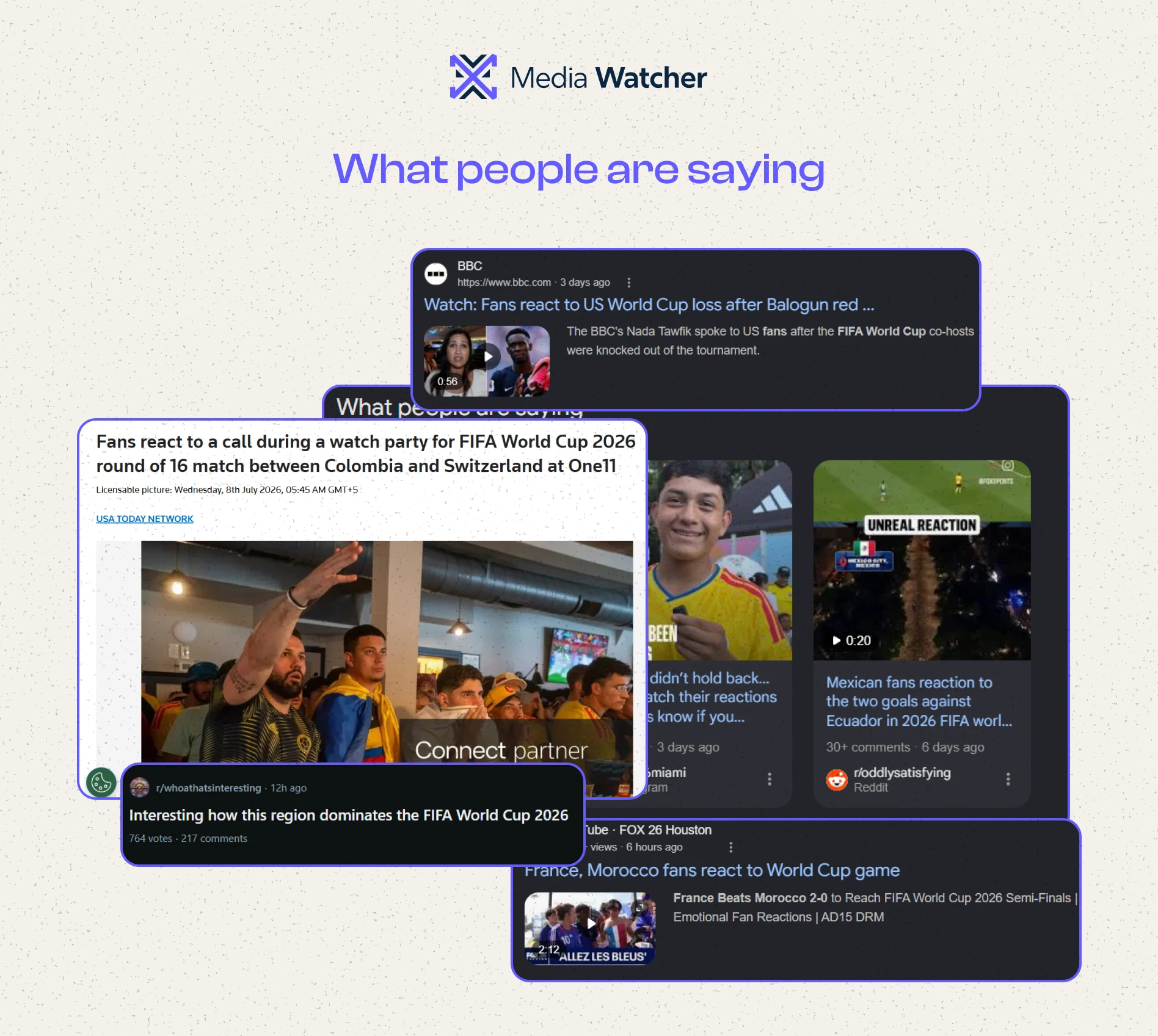
This matters during FIFA World Cup 2026 because conversations can move from one platform to another. A fan complaint can begin as a social media post, become a forum discussion, appear in a podcast, and later enter mainstream news coverage.
Media Watcher’s media monitoring also positions the platform around it’s real time monitoring across global news and media channels.
The Scale of the World Cup Conversation Cannot Be Managed Manually
The last men’s World Cup showed how large global football engagement can become. FIFA’s Qatar 2022 audience report states that the tournament generated 5 billion total media engagements.
FIFA World Cup 2026 has a larger tournament structure, with 48 teams and 104 matches. That larger format creates more matchdays, more national fanbases, more player storylines, and more media moments for brands to monitor.
Manual monitoring is not enough for this environment. Teams cannot reliably review every relevant article, post, comment, clip, forum thread, broadcast mention, and podcast reference fast enough to act while the conversation is still moving.
This is why real time tracking matters. It helps teams see when sentiment changes, which sources are amplifying the story, and whether the issue needs attention.
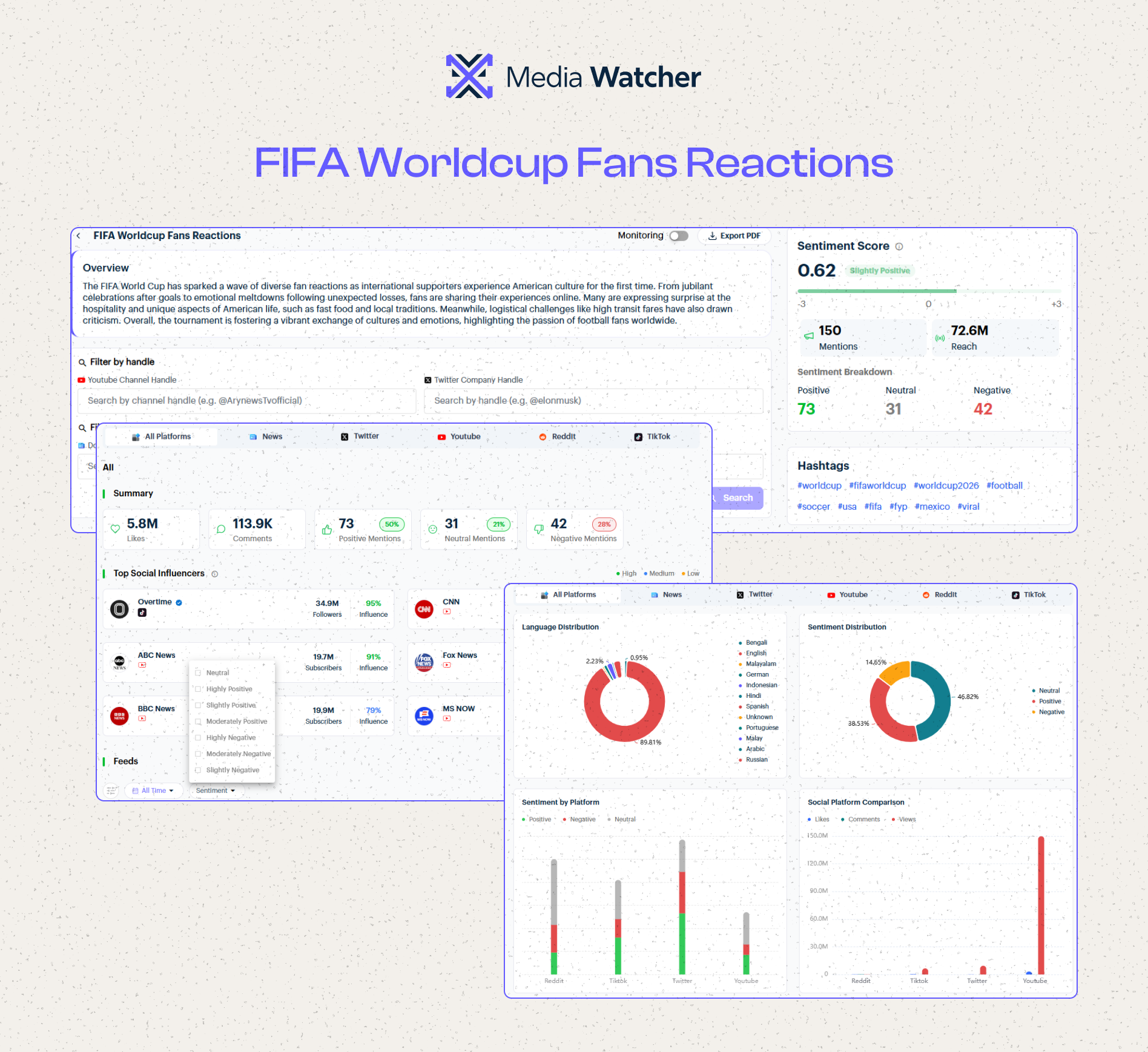
Media Watcher provides AI powered monitoring with instant alerts, sentiment analysis, competitor tracking, and executive reporting.
Key Narratives Brands Should Monitor During FIFA 2026
The strongest World Cup narratives are often emotional rather than official. Brands should monitor player stories, team momentum, fan experience, fairness debates, sponsor reactions, online abuse, and cultural moments.
Player stories matter because athletes often shape fan emotion beyond the final score. A goal, injury, celebration, missed penalty, or post match quote can change public sentiment quickly.
Fan experience also matters because issues around ticketing, travel, queues, stadium access, pricing, safety, and comfort can become reputation risks when fans feel ignored.
Fairness is another major driver of sports sentiment. Referee decisions, VAR checks, suspensions, and tournament rules often generate intense debate because fans react not only to what happened, but also to whether it felt fair.
Online abuse is a critical issue for FIFA World Cup 2026. FIFA reported that it scanned more than 6 million posts and comments during the tournament’s group stage.
FIFA said 225,000 posts and comments were referred for human review, leading to the detection of 89,000 abusive posts. It also reported that 1,000 accounts were identified for further investigation and 181,000 hateful comments were hidden as part of moderation efforts.
FIFA also stated that racially motivated attacks accounted for 11 percent of all detected offensive messages during that period.
For brands, this makes FIFA social listening more than a campaign measurement activity. It becomes part of responsible reputation management.
 Culture is Now Part of the Sports Conversation
FIFA World Cup 2026 is not only a football event. It is also a cultural media moment shaped by fans, creators, music, memes, broadcast clips, national identity, sponsor campaigns, and real-time reactions.
This matters because modern sports marketing is not limited to stadium boards or official ads. A brand can become relevant by entering the right cultural moment with the right tone. It can also lose credibility by reacting without understanding the audience sentiment first.
Audience insights help brands understand which communities are driving the conversation, which regions are reacting most strongly, and which topics are connected to positive or negative sentiment.
How Media Watcher Can Help Brands Track FIFA 2026 Sentiment
Media Watcher helps brands monitor fast-moving conversations across global media channels. It states that the platform provides AI powered monitoring across 100,000+ sources with instant alerts, sentiment analysis, competitor tracking, and executive reporting.
For FIFA World Cup 2026, this means teams can monitor sponsors, players, teams, host cities, hashtags, competitors, campaigns, and emerging issues from one place.
Media Watcher’s media monitoring, available in 80+ languages and across 235+ regions, is useful for a tournament hosted across three countries and followed by global audiences. It delivers custom alerts in under 200 milliseconds.
This helps teams answer practical questions during the tournament, including
- Which campaign is gaining positive traction?
- Which player’s story is driving conversation?
- Which sponsor is being linked to negative sentiment?
- Which country or region is reacting most strongly?
- Which issue is moving from social media into broader media coverage?
What Brands Can Track During FIFA World Cup 2026
Brands can track more than mention volume. They can monitor sentiment by team, player, sponsor, campaign, country, host city, language, and media source type.
They can also follow share of voice, positive and negative sentiment drivers, regional conversation differences, crisis keywords, influencer amplification, hashtag growth, competitor visibility, and movement between social media and traditional media.
Media Watcher’s media monitoring recommends real time alerts, sentiment filters, keyword tracking, boolean search support, and reporting functionality when configuring a monitoring workflow.
This is the difference between collecting mentions and understanding public perception. The goal is not to chase every trend. The goal is to know which signals matter.
Follow Trends at Global Level with Wider Media Coverage
FIFA World Cup 2026 proves that the modern sports conversation is bigger than the match. FIFA confirms that the tournament brings together 48 teams, 104 matches, and 16 host cities across Canada, Mexico, and the United States.
For brands, sports sentiment analysis helps turn public reaction into business intelligence. It supports reputation protection, campaign measurement, audience insights, brand mentions tracking, real time tracking, Social listening, FIFA social listening, and global media monitoring.
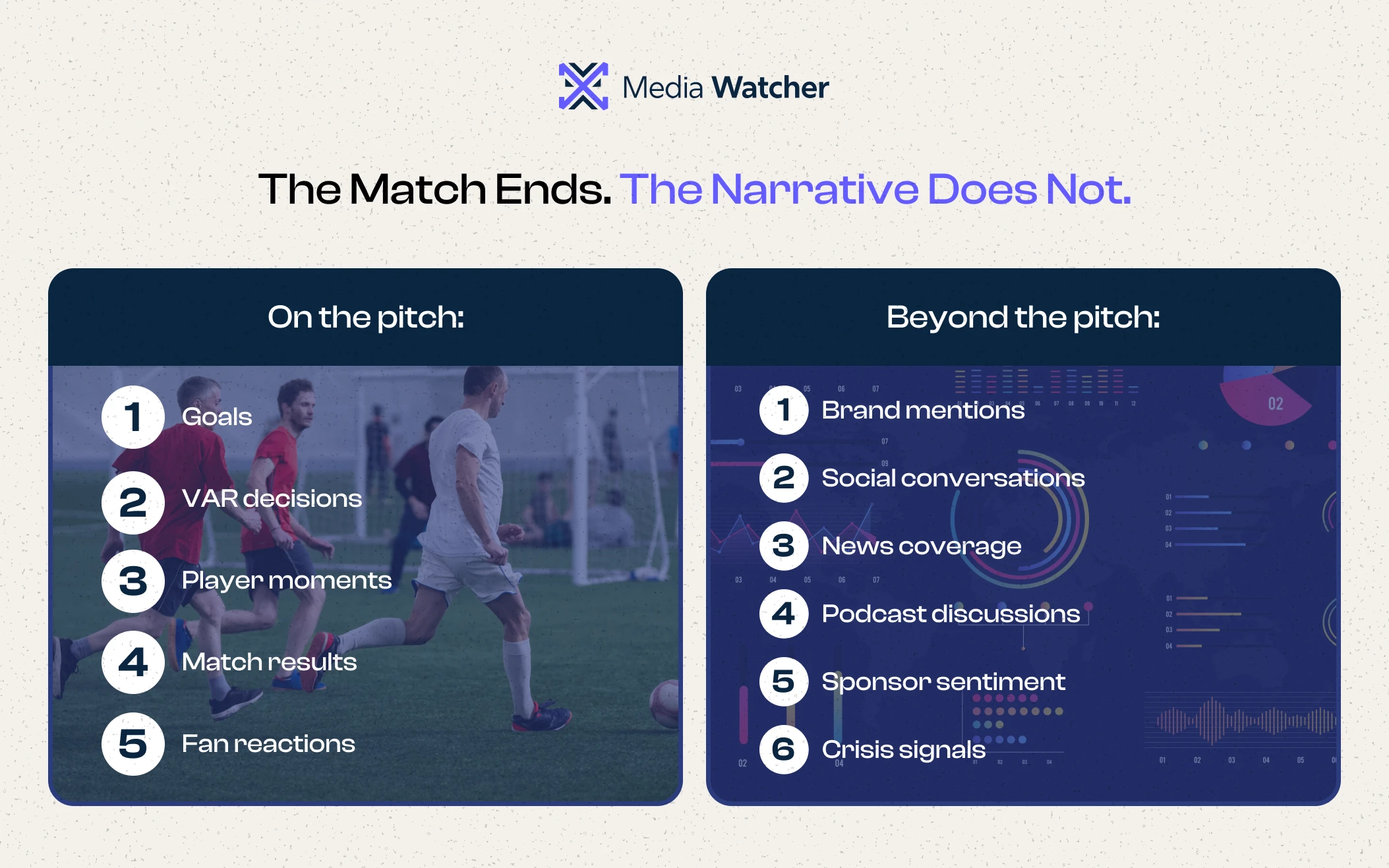
With Media Watcher, teams can track what fans are saying, understand how they feel, and respond before a narrative moves without them. Because in FIFA World Cup 2026, the match may last 90 minutes. The narrative does not.