

When Sri Lanka’s economic collapse escalated through mid-2022, the crisis moved in distinct waves, including fuel shortages, cabinet resignations, debt default, and eventually the storming of the presidential residence.
Each wave generated regional media signals well before international wire services framed them as a global business risk. Multinationals with supply chain or sourcing exposure to the region had a narrow window at each stage to assess and respond.
Those tracking only English-language international outlets consistently received the signal late. The first 90 minutes of a developing story determine how the narrative settles; after that window closes, correction costs orders of magnitude more than early response.
That is documented in MIT and Science research on how online narratives form and propagate, not marketing copy.
That’s why the demand for the best news monitoring software is increasing for enterprises. Organizations aren’t interested in tools that just gather headlines. Instead, they want solutions that can alert them to key developments as they happen, identify market sentiment, stay on top of competitors, and highlight threats that can escalate.
Why News Monitoring Has Become a Strategic Business Function
A decade ago, news monitoring was mostly the domain of public relations teams. However, it’s enterprise-wide today.
Media monitoring is a tool for communications teams to monitor brand perception and to prevent reputation risks. Marketing teams stay connected and tuned in to the competition and industry to refine positioning.
Risk and compliance departments monitor for regulatory changes that may impact operations.
Executive leadership teams depend on media intelligence to monitor new threats and opportunities.
The problem is that information is spread across thousands of sources. Significant events can occur in industry publications, government announcements, regional media, financial publications, or industry-specific publications.
Failing to install an important update can result in a missed opportunity or tardy response to a developing threat.
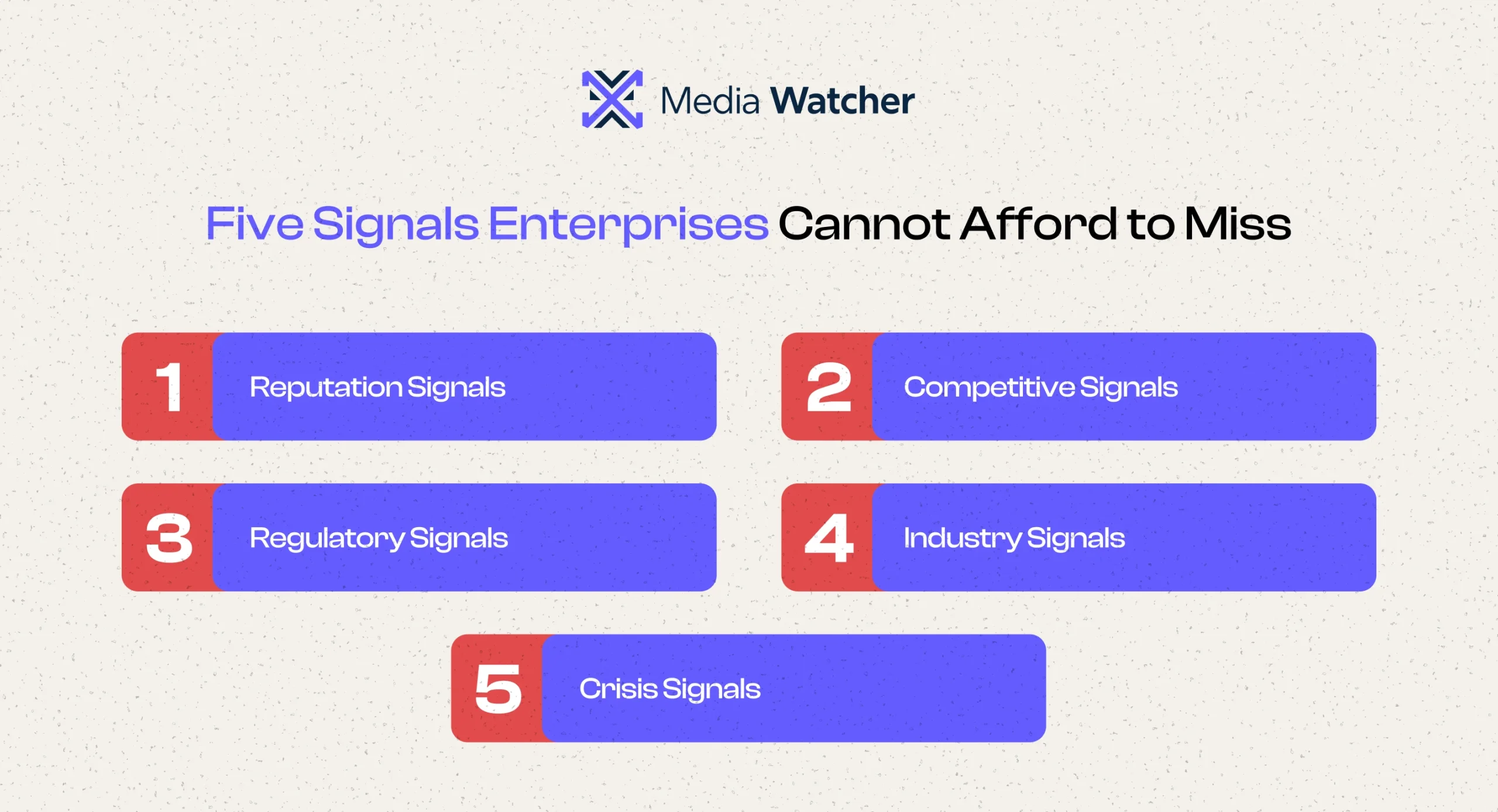
Five Signals Enterprises Cannot Afford to Miss
Not every headline carries equal weight. Successful organizations focus on identifying specific signals rather than collecting raw information volume.
Reputation Signals
Media exposure directly influences customers’ trust, investors’ confidence, and stakeholder perception. A negative story left undetected for 6 hours will reach more accounts than one caught in 20 minutes.
Time is the most important element in PR and crisis management. If companies monitor sentiment in real time, they can react before a narrative takes hold.
Competitive Signals
Before strategy documents are published, product launch announcements, acquisitions, leadership changes, partnerships, and expansion announcements can give a good indication of where competitors are going. The information is used to inform decisions, which can therefore be better informed. A competitor’s regional hiring increase in a market you’re targeting is not just a news.
Regulatory Signals
Regulatory, enforcement, consultation papers, and policy changes can impact businesses in several sectors. Awareness is crucial to prepare, not react. In the compliance sensitive industries, a 24-hour lead time on a regulatory announcement can be the difference between a prepared response and a scramble.
Industry Signals
Trade publications are often the first to feature emerging technologies, market changes and shifts, and consumer behavior, months before they are seen in mainstream business media. Efficient media monitoring is a fundamental factor in organizations making informed industry-level strategic decisions.
Crisis Signals
Cybersecurity incidents, supply chain disruptions, geopolitical tensions, and operational challenges can escalate within hours. The Bud Light 2023 controversy and the United Airlines dragging incident both showed how quickly a local story can reach a global scale. Real-time monitoring gives organizations a window into what is happening before it demands a public response.
Key Features to Look for in the Best News Monitoring Software
With numerous platforms on the market, the right choice depends on what your organization actually needs and not what sounds most impressive in a demo. Have a look at some of the key fundamentals
Real-Time Monitoring and Alerts
Business decisions often depend on timing. The best platforms deliver media alerts within seconds of source publication, and not in hourly digest emails. Delayed information increases risk exposure and reduces the window for effective response.
Sentiment Analysis
Understanding what is being said matters, along with how it is said. Sentiment analysis helps organizations measure perception, identify emerging concerns, and evaluate public reaction to events. The most useful implementations flag sentiment shifts, not just the presence of a mention.
Advanced Search and Filtering
News volume increases every year. Without effective filtering, important signals get buried in noise. The best platforms let teams configure specific keywords, source types, geographic regions, and languages, so alerts surface what matters rather than everything.
Historical or Archive Data Access
Previous data related to public events and regulatory changes provide context that real-time monitoring cannot. Organizations can analyze how topics evolved over time, identify recurring patterns, and compare current developments with previous events. This is particularly valuable for competitive analysis and regulatory tracking.
Customizable Dashboards
Communications teams focus on reputation. Risk teams track compliance. Leadership teams monitor market developments. Custom dashboards ensure each stakeholder sees the intelligence that is relevant to their function, not a firehose of undifferentiated data.
Integration Capabilities
The best solutions integrate with existing workflows through APIs, email notifications, collaboration tools, and business intelligence platforms. A monitoring platform that requires manual exports is a bottleneck, not a solution.
Why Actionable Intelligence Matters More Than Volume
There is already more information available to many organizations than they are able to process. The tough part is selecting the information that deserves focus and the reasons behind it.
Adverse coverage calls for instant visibility of a communications team. It is crucial for a risk team to receive alerts about regulatory developments. An executive team requires background information on competitors’ activities and industry trends.
A lack of relevant sentiment, risk, and strategic prioritization will turn monitoring into a data management issue instead of a competitive edge.
When a story is first reported by a manual sweep, it has typically been reported in 400 secondary accounts. That’s the window that advanced platforms are meant to safeguard.
How Media Watcher Closes the Response Window
Media Watcher monitors 100,000+ sources across 235+ regions in 80+ languages, delivering alerts within 200ms of source publication. That speed matters because the first outlet to publish is rarely the last.
A story that appears in a regional trade publication at 6pm reaches national media by 8pm if it carries weight. Organizations that detect it at the source have a different response window than those catching it in a morning digest.
The platform combines real-time monitoring with NLP-powered sentiment analysis, competitor tracking, and customizable alert thresholds. Dashboards can be configured by team function, so communications, risk, and leadership teams each see the intelligence relevant to their decisions, not a shared feed.
For financial organizations, Investment Watcher extends Media Watcher’s monitoring capabilities into portfolio-level narrative intelligence, tracking how media sentiment around companies, sectors, and markets shifts before that shift becomes visible in price data.
The Future of Global News Monitoring Software
AI and automation will become increasingly important in the future of global news monitoring software, not to replace the human eye, but to make monitoring faster and more informed.
The business industry is moving from keyword tracking to systems that can recognize patterns, detect new risks, and even surface information that a human wouldn’t notice at all. The more you’re inundated with information, the more AI-driven prioritization is going to make a difference between signal and noise.
Companies that can detect meaningful developments in a timely manner will have a structural advantage over those that wait for periodic reports and manual sweeps.
But is it worth the investment in monitoring? Or is the platform you currently use fast enough to keep the response window that makes the difference in outcomes?
Book a Demo to see how Media Watcher’s real-time intelligence helps enterprises detect, assess, and respond to the developments that matter, before the window closes.