

Portfolio monitoring is no longer just about checking prices at the end of the day. For analysts, the real job is bigger than how it looks. First, one needs to know which holdings need attention, what risks are building, where sentiment is shifting, and which news story may change how the market sees a company.
In simple words, portfolio monitoring assists you in answering one question:
“Where should I look first today?” That matters because information now moves across earnings calls, filings, news sites, social networking sites, analyst notes, and investor communities.
FINRA’s 2025 research found that 45% of investors receive financial advice from the internet, while 24% get information from social media. Among investors under 30, 35% rely on social media, compared with 13% of investors aged 65 and older.
But that does not mean every social post is useful. Far from it, some of it is noise, just wearing a suit. Thus, the essence is that analysts need a workflow capable of tracking both hard portfolio data and external signals.
The Basic Definition of Portfolio Monitoring
Portfolio monitoring refers to the systematic tracking of performance, risk, and market context of the assets in an investment portfolio.
All of this includes things like:
- Performance changes
- Price movement
- Portfolio exposure
- Company news
- Sentiment changes
- Risk alerts
- Sector movement
- Unusual media attention
The traditional investment portfolio tracking focuses on numbers, which is still important, but today, analysts also need to monitor the story around each holding.
A company may look stable on a dashboard, while negative coverage, regulatory attention, customer backlash, or social chatter is quietly building around it. And that is where modern portfolio monitoring tools become useful.
Why Portfolio Monitoring Software Matters
Portfolio monitoring software helps investors centralize, analyze, and act on portfolio data. Standard Metrics defines portfolio monitoring software as a system that helps investment firms track performance metrics, monitor risks, build valuations, support audits, and power portfolio reviews in one place. That is the foundation.
But analysts should not rely solely on internal data. A good workflow should bring together portfolio data, market data, company updates, news coverage, media alerts, sentiment movement, and risk signals.
This is because when these signals are scattered, analysts waste time jumping between tabs, tools, spreadsheets, and news feeds.
And let’s be honest, no one became an analyst to play browser-tab Olympics. Let’s walk you through building a monitoring workflow
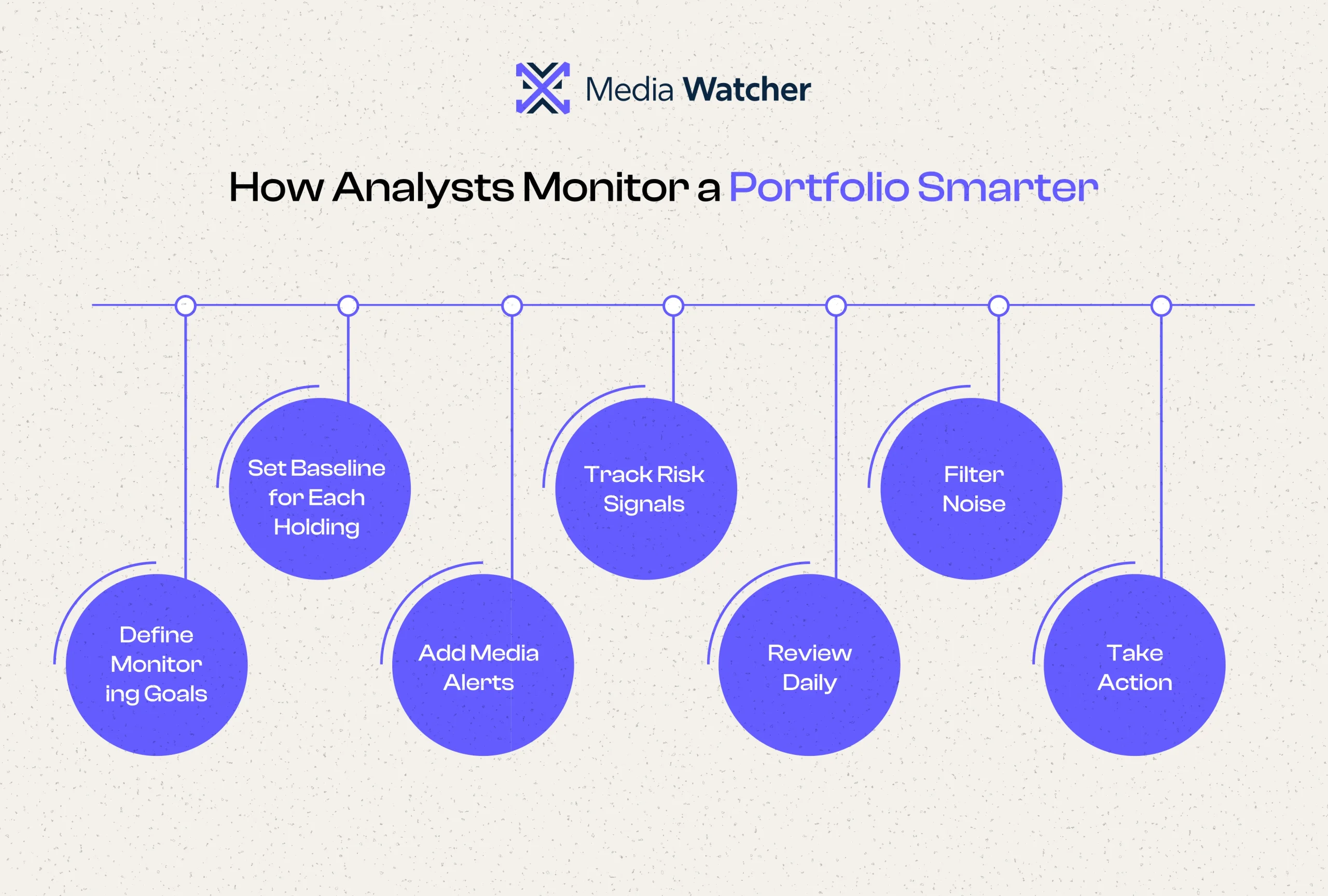
Define Your Portfolio Monitoring Goals
One can initiate by listing every company, stock, sector, or asset in your portfolio. Then group them by priority, which includes:
- Core holdings
- High-risk holdings
- Recent additions
- Volatile stocks
- Sector-sensitive names
- Event-driven positions
Not all holdings require the same amount of monitoring. If you have a stable, long-term position, you might just need to review it weekly. If a stock belongs to a sensitive sector, it may require daily monitoring, especially if it is volatile. The workflow should highlight what needs attention, rather than overwhelming you with a barrage of items.
Set a Portfolio Monitoring Baseline for Each Holding
Without knowing what ‘normal’ is, you can’t identify what is unusual.
For each holding, establish “normals” for average moves in price, average trading volume, normal media coverage, sentiment range, and typical topics of media coverage, in addition to average volume.
This is where media monitoring for investors becomes valuable. When a stock is normally mentioned 20 times a day, and then suddenly it is mentioned 300 times a day, that is important. Also, when sentiment becomes negative while price is not, that needs a review too.
But the idea is not to get panicked, but to keep informed if something changes.
Use Media Alerts for Investment Portfolio Monitoring
Media alerts and investment portfolio workflows are becoming increasingly important because markets react to information from many sources.
For investors, this matters because public attention can shape confidence, risk, and liquidity. Your media alerts should track:
- Company mentions
- Executive mentions
- Product issues
- Regulatory news
- Litigation news
- Customer backlash
- Sector news
- Competitor announcements
- Social sentiment spikes
The goal is not to trade on every headline; instead, the aim is to build a sharper research queue that helps you in the long run.
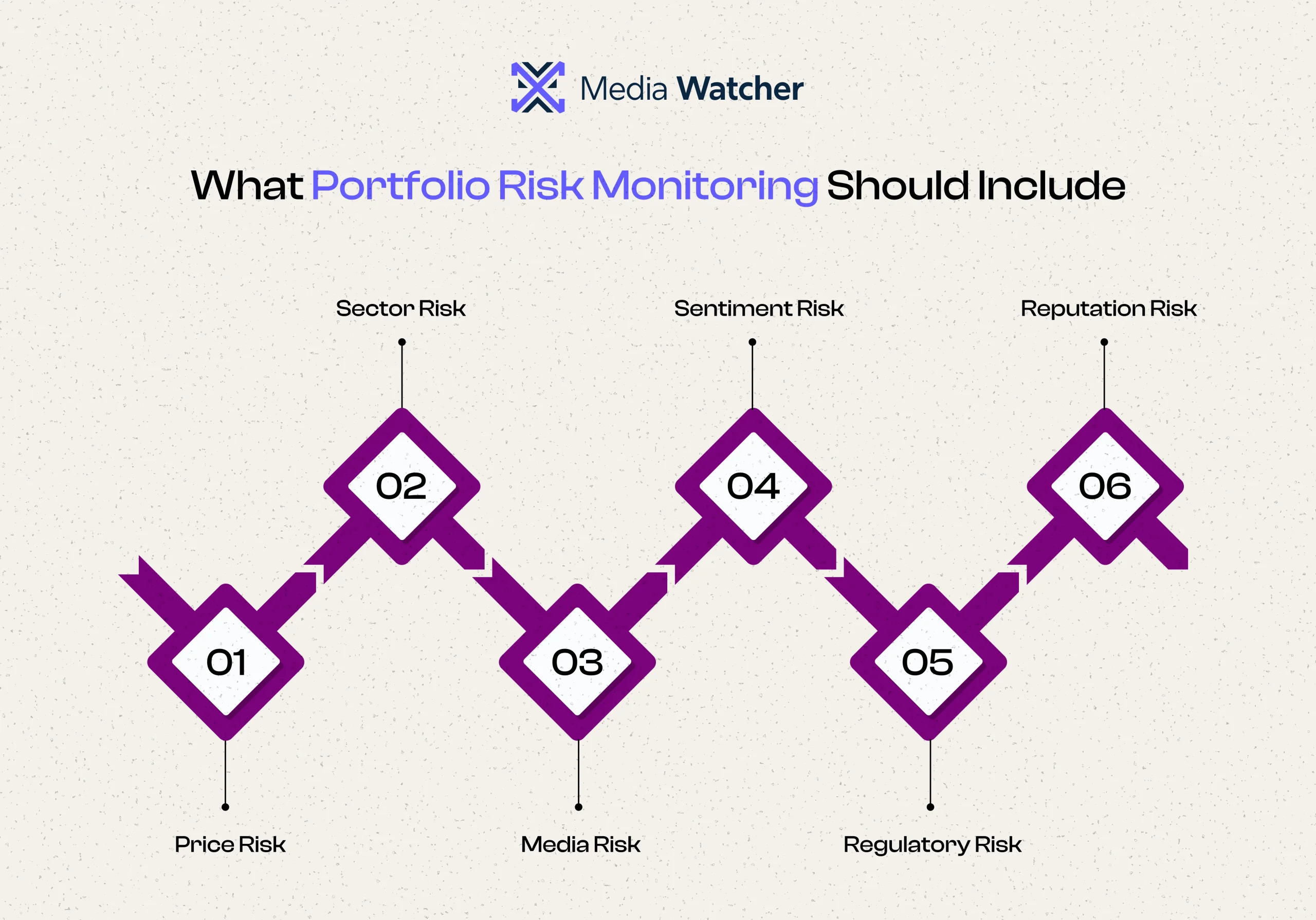
Track Portfolio Risk Signals Beyond Price Movement
Portfolio risk monitoring should include more than volatility. Yes, price movement matters. But risk can also appear in the form of negative press, regulatory scrutiny, leadership controversy, supply chain issues, public trust decline, fraud concerns, and digital media pressure
That is a reminder for analysts that a social networking site is not just a sentiment source. It can also be a source of risk.
Build a Daily Portfolio Monitoring Routine
A strong portfolio monitoring workflow should be simple enough to use every day. Here is a practical daily routine:
- First, review major price and volume changes.
- Second, check which holdings have unusual news or media activity.
- Third, review changes in sentiment around priority holdings.
- Fourth, identify whether the signal is company-specific, sector-wide, or market-wide.
- Fifth, decide what needs deeper analysis.
This helps analysts avoid reacting randomly. Instead of asking, “What moved?” they can ask: “What changed, why did it change, and does it matter for the portfolio?”
Separate Market Noise from Useful Portfolio Signals
Note that not every alert matters. A viral post may create noise, or a minor blog mention may mean nothing; also, a one-day sentiment dip may fade by tomorrow. Therefore, useful signals usually have one or more of these traits:
- They repeat across multiple channels
- They connect to a real business issue
- They involve regulation, earnings, leadership, or customer trust
- They show unusual growth compared with the baseline
This is where good portfolio monitoring software should help reduce clutter. It should not just send more alerts. It should help analysts understand which alerts deserve attention. More alerts without context are just a louder headache.
Create an Action Plan for Portfolio Risk Monitoring
Every signal should lead to a clear next step. For example:
- Low-level signal: add to watchlist
- Medium signal: review related news and sentiment
- High signal: alert portfolio manager
- Critical signal: prepare risk note or investment memo
This keeps the workflow organized. It also helps teams avoid overreacting to every headline. For analysts, the best workflow is not the one with the most data. It is the one that helps them make better decisions faster.
Where Investment Watcher Fits In
With Investment Watcher, analysts can track the ongoing narrative surrounding their investments rather than just the movement in prices. It combines real-time media alerts, sentiment tracking, attention spikes, baseline deviation, and portfolio watchlists.
This eventually enables investment analysts and advisors to see which holdings are attracting unusual attention. Moreover, analysts no longer have to manually check dozens of sources to prioritize which to check with Investment Watcher.
That means less time scanning noise and more time understanding the signals that are essential. For portfolio teams, this creates a stronger and systematic workflow that includes:
- Track holdings
- Monitor media movement
- Detect sentiment shifts
- Spot unusual attention
- Prioritize research
In the end, good monitoring is not about watching everything. It is about knowing what matters next.
Want to build a sharper portfolio monitoring workflow with real-time media alerts and sentiment signals? Book a Demo with Investment Watcher.