

Eleven seconds. That is all it took. One clipped debate moment, stripped of context, racked up millions of impressions on X in under 40 minutes. Campaign teams not watching in real time spent the next three news cycles trying to recover.
This is the new pace of political narrative. And if you are not tracking it live, you are already behind
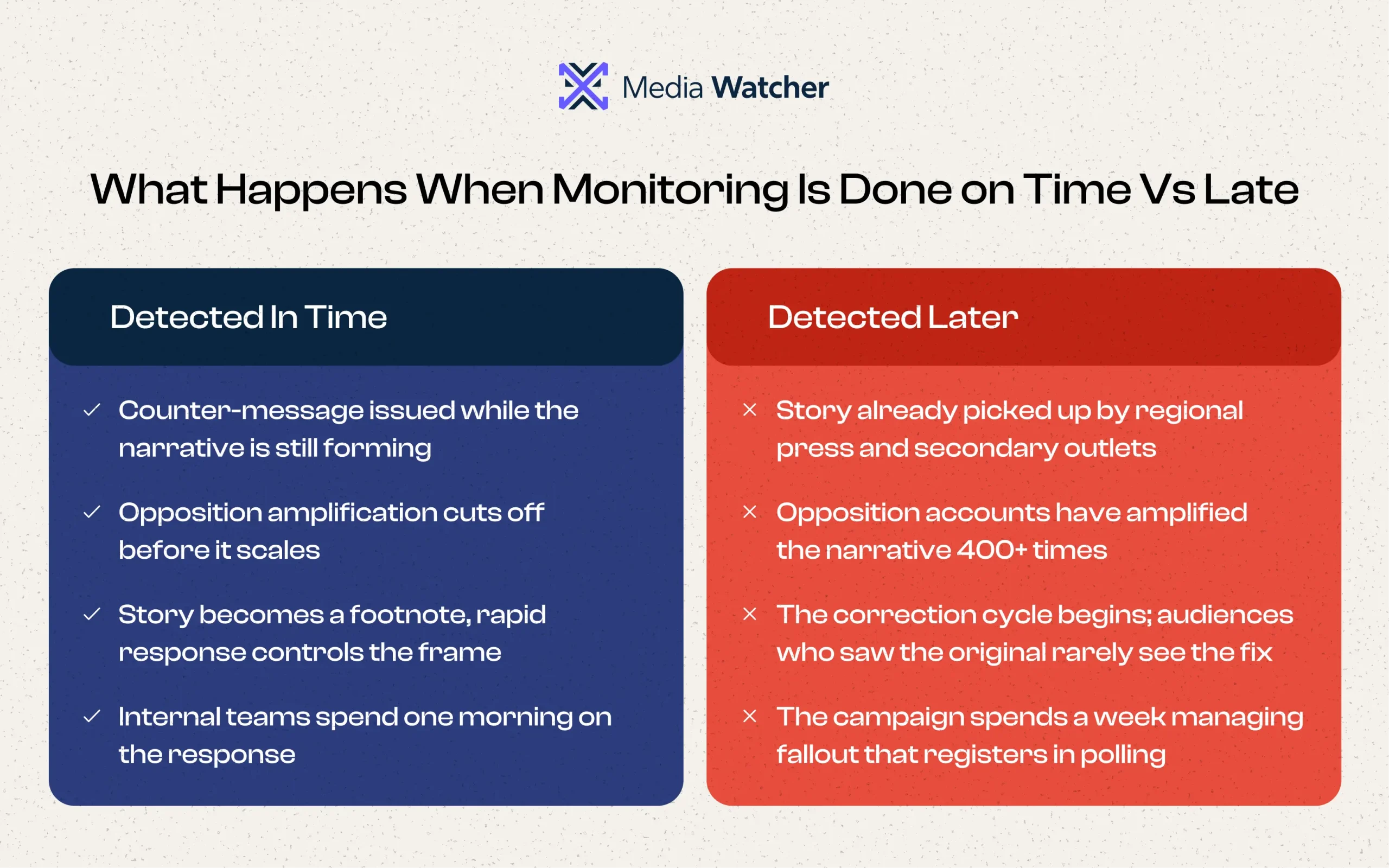
By the time manual monitoring began, the story had already been shared by other sources and was spreading on social media. It was also quoted in major news outlets. Correcting the information took a week, but real-time monitoring could have fixed it in just a few hours.
That scenario is no longer the exception. ‘A study by MIT’s Science of Fake News also found that false news is 70 percent more likely to be retweeted than true news, and it spreads much faster, reaching a larger audience in the first few minutes of its creation than corrective information does in a matter of days.’
‘In the 2024 U.S. presidential election cycle, this played out on a scale that overwhelmed manual monitoring approaches.’
For campaign strategists, political analysts, election journalists, and government communication departments, the issue is no longer a scarcity of information.
It is that you can no longer follow what is really happening across hundreds of channels in real time.
However, election media monitoring can close that gap. If it is done properly, it gives political teams a clear and continuously updated picture of how narratives are formed.
Furthermore, it helps shift and gain traction, and what voters actually think about them, before the 90-minute window that determines narrative outcomes has closed.
What is Election Media Monitoring?
“Election media monitoring means keeping track of how an election is being covered and talked about. That includes what people are saying about candidates, policies, campaigns, and voter mood across news outlets, social media, and online forums.”
What makes it tricky is the volume. After a debate, a policy announcement, or an attack ad, relevant content can jump 10x in a single night.
Moreover, manual reviews, daily reports, and keyword searches just cannot keep up with that pace.
Thus, an effective election monitoring combines three core capabilities:
| Real-time coverage | Tracking news, social, and broadcast sources simultaneously, as stories break, not hours later. |
| Narrative tracking | Following how campaign messages form, evolve, and gain media traction in real time. |
| Sentiment analysis | Understanding how voter opinion shifts in response to events, announcements, and attacks. |
What are Campaign Narratives and Why They Shift So Fast
A campaign narrative is simply the main story people are telling about a candidate or policy. Who’s ahead? Who’s credible? Who’s on the wrong side of an issue?
That story doesn’t come from the campaign alone. Press coverage, opposition attacks, endorsements, gaffes, and social media all push it in different directions.
“The Reuters Institute Digital News Report 2024 tracked major election moments like candidate withdrawals, debate performances, and late endorsements. Media tone shifted within 90 minutes each time.”
Morning briefings can’t keep up with that. Neither can end-of-day recaps. By the time a campaign team reads the summary, the story has already moved. What actually helps is knowing what’s being amplified right now, and how fast it’s spreading
Narrative tracking across sources typically covers:
- How frequently a candidate or issue is mentioned in news coverage
- Which framing is dominant? Either it is policy-focused, personality-focused, or horse-race coverage
- Which media outlets are driving narrative momentum
- Whether coverage is shifting tone, from neutral to critical, or vice versa
How Real-Time Voter Sentiment Tracking Works
Voter sentiment tracking is the practice of analyzing public opinion signals, primarily from social media, comment sections, and online communities, to understand how a population is responding to candidates, policies, or events.
It is distinct from polling. Polling gives you a snapshot of stated opinion, typically with a 24–72-hour delay between data collection and publication.
Sentiment tracking gives you a continuous, real-time signal drawn from what people are actually saying and sharing, not what they tell a pollster.
Modern sentiment analysis uses natural language processing (NLP) to classify media mentions and social posts as positive, negative, or neutral. It is increasingly possible to detect more nuanced emotional signals such as frustration, enthusiasm, anxiety, or distrust.
Platforms that rely solely on keyword matching produce volume data, not intelligence. What campaigns need is classified, contextualized sentiment and not just ‘candidate X was mentioned 40,000 times.
Instead, they need to know that 38% of those mentions carried negative sentiment, concentrated in suburban communities and amplifying the same three criticisms.
Who Uses Election Media Monitoring?
Election media monitoring serves a broader group than most people assume. The obvious users are political campaigns, but the application extends significantly beyond them.
Political Campaigns & Consultants
Campaigns use it to see what messaging is landing, hit back at opposition attacks fast, and spot which issues voters are actually talking about.
Government Communications Teams
Government teams watch how policy announcements play with the public and catch disinformation early before it spreads into civic spaces.
NGOs & Civil Society Organizations
These groups track coordinated disinformation, foreign influence, and narrative manipulation, often before mainstream outlets pick it up.
Corporate Communications Teams
Companies monitor how election cycles might shake up their industry, shift the regulatory mood, or put their brand in an uncomfortable spotlight.
Journalists & News Organizations
Reporters use it to get ahead of stories, catch trends before they peak, and check whether a claim is spreading through credible outlets or just fringe ones.
Political Pollsters & Research Firms
Pollsters layer real-time sentiment data on top of traditional polling to catch opinion shifts that surveys haven’t caught yet.
Key Capabilities to Look for in an Election Media Monitoring Software
Not all media monitoring tools are built for election-cycle demands. Here’s what separates platforms capable of handling the pace and complexity of election monitoring from general-purpose tools.
Source Breadth
Elections are played over national and local news, social platforms such as X/Twitter, Facebook, Reddit, and TikTok, podcast coverage, broadcast, and online communities. The tools that are limited to tier-one outlets miss grassroots narrative formation.
Alert Speed
A two-hour delay between a story breaking and your team being notified is the difference between rapid response and crisis management. Sub-200ms alert delivery is the operational benchmark.
Multilingual Coverage
Monitoring only English-language sources misses significant narrative activity in diverse electorates and foreign influence contexts. More than one standard language coverage is increasingly essential, not optional.
Sentiment Classification Accuracy
Platforms should classify sentiment at the passage level, not just the article level. However, a single news story may contain both positive and critical coverage of different subjects.
Historical Data Access
Election analysis often requires comparison against prior cycles or the campaign’s own baseline. Access to archives and historical retrieval is necessary for putting current signals in context.
Custom Alert Triggers
Keyword, phrase, and sentiment-combination alerts ensure teams are notified about signals that matter, without being overwhelmed by irrelevant volume.
How Media Watcher Supports Election Intelligence
Media Watcher is built for high-volume, high-stakes monitoring. The platform monitors coverage in 100,000+ sources of the global media, news forums, social media, broadcast, and podcasts, with a notification being sent in less than 200ms.
It implies that your team will be informed of a story before it spreads around different outlets.
Moreover, the platform monitors local and national news to ensure that the teams are aware of a story catching national attention in local media before it hits the national wire, with 200ms between its publication and arrival in the inbox.
The archive and historical data provided by Media Watcher enable analysts to compare current sentiments with those from previous election periods or previous campaign levels.
The ideal moment, therefore, to establish the election-monitoring facilities is not in the middle of the campaign, but before it reaches its peak intensity.
The keyword settings, sentiment settings, alert limits, and so on all have to be fine-tuned beforehand. And teams that start configuring during debate week are already operating in the dark.
Book a Demo with Media Watcher. Get your election monitoring configured before your next critical campaign moment!