

Here’s something that happens more often than most marketing teams want to admit. You spend three weeks designing a seasonal campaign, staple the creative, get sign-offs, and have everything perfectly timed.
And then you press publish and find out that the talk you were trying to enter ended ten days ago. The trend has moved on. Your audience has moved on.
This is not so much of a speed issue but a listening issue. The majority of teams are monitoring social sites to get seasonal indicators, which implies they have entered the trend when it is at its most crowded.
This has been driven by 32% of consumers researching products on social media prior to purchase, according to the McKinsey 2025 State of the Consumer report, up from 27% only two years ago. Thus, viewers are most receptive when interest is still building.
Reach them after the peak, and you’re essentially shouting into a room that’s already emptying out.
A better social listening strategy doesn’t just track more keywords. It covers more ground, earlier. Here is how this process looks in action.
Why Social Listening Alone Is Not Enough
Consider how a seasonal pattern actually moves before it is dumped in your social feed. In September, a food journalist covers autumnal flavour trends. It is picked up by a podcast, which discusses it with its audience.
Some Reddit communities and TikTok creators go with it. Then, a few weeks later, it breaks down into mainstream social at scale, and all brands are sharing the same thing.
When you listen to your social media at that last point, you are not following the seasonal trends, but merely responding to them. The algorithm rewards original content, and viewers are bored when they have already watched the same subject 12 times.
But what about the brands that got there first? The reason is that they already have the credibility and interest you are seeking.
“Success comes from predicting what people will care about next, not just reacting to what they are already talking about.”
The 4-Layer Trend Signal Stack
But seasonal trends don’t magically come into existence. They follow a pretty consistent path across four media layers before going mainstream.
Thus, good social listening platforms and media tracking software let you intercept that signal much earlier in the journey.
Layer 1: News and Editorial.
Journalists and industry writers tend to pick up on consumer shifts weeks before the public conversations kick off. If retail publications are covering a particular autumn aesthetic in August, that’s a signal worth acting on.
Tools like Media Watcher and its News Monitoring feature are part of a broader media tracking software that lets you watch thousands of sources in real time, so nothing gets missed.
Layer 2: Podcasts and Broadcasts.
Here’s where most social listening software falls flat. It simply doesn’t touch audio or broadcast content. But podcast hosts and TV commentators reach deeply engaged niche audiences, exactly the people who carry trends from specialist circles into mainstream conversation. Thus, Media Watcher covers both.
Layer 3: Niche Social Communities.
The last phase, where you remain well ahead, is on Reddit threads, YouTube comment sections, and TikTok subcultures. Media Watcher is not like a broad social listening service that treats all platforms equally; instead, it monitors each niche platform separately, filtering out noise.
Layer 4: Mainstream Social.
X, Instagram, Facebook. By the time a trend lands here, your job isn’t to discover it. It’s to confirm it’s real and make sure your messaging tone still fits the room. Media Watcher’s social listening tools cover all major platforms for real-time volume and sentiment tracking.
How Social Signals Made Starbucks Pumpkin Spice Latte A Seasonal Hit
“A small group of Starbucks team locked themselves into what they named the Liquid Lab on the seventh floor of their head office in Seattle in spring 2003.
They were consuming pumpkin pie and drinking espresso and posing this question to themselves: Do fall flavors even work well in coffee? That October, they launched the Pumpkin Spice Latte in 100 stores in Washington, D.C., and Vancouver. After one week, the sales data indicated the product was doing well.
What turned a decent seasonal drink into a cultural event was what happened after Facebook and Twitter took off in 2006. Starbucks started noticing customers posting about PSL before the drink had even officially launched each year.
The brand could also use those posts as time stamps, creating windows of release and discussions before the season around that early buzz.
This particular product, by 2023, was producing 3,000 tweets daily during its peak season and making half a billion annually.you
That level of seasonal precision didn’t happen by accident. It came from paying attention across more channels than most brands bother to monitor, and being willing to act on signals before they went fully mainstream.”
How Historical Data Can be Used for Further Plans?
Most brands think of social listening as a real-time activity. They think about what’s currently trending and respond to that. But looking to the past is where true planning benefits reside.
Looking at last year, they can see when a season peaked, which channels drove the most conversation, and the sentiment leading up to when a topic started trending. This is what a content calendar needs.
Not gut feelings, not general industry trends, but actual statistics from their own category.
With the Archive and Historical Data feature in our Media Watcher, brands don’t have to start from scratch every season.
A fashion retailer, for example, might find that “winter outfit ideas” tends to spike on TikTok about three weeks before winter fashion conversations pick up on X.
That’s a specific, actionable timing gap, and it’s far more useful than a best-guess publish schedule.
Strategic Approach to Seasonal Listening That Works
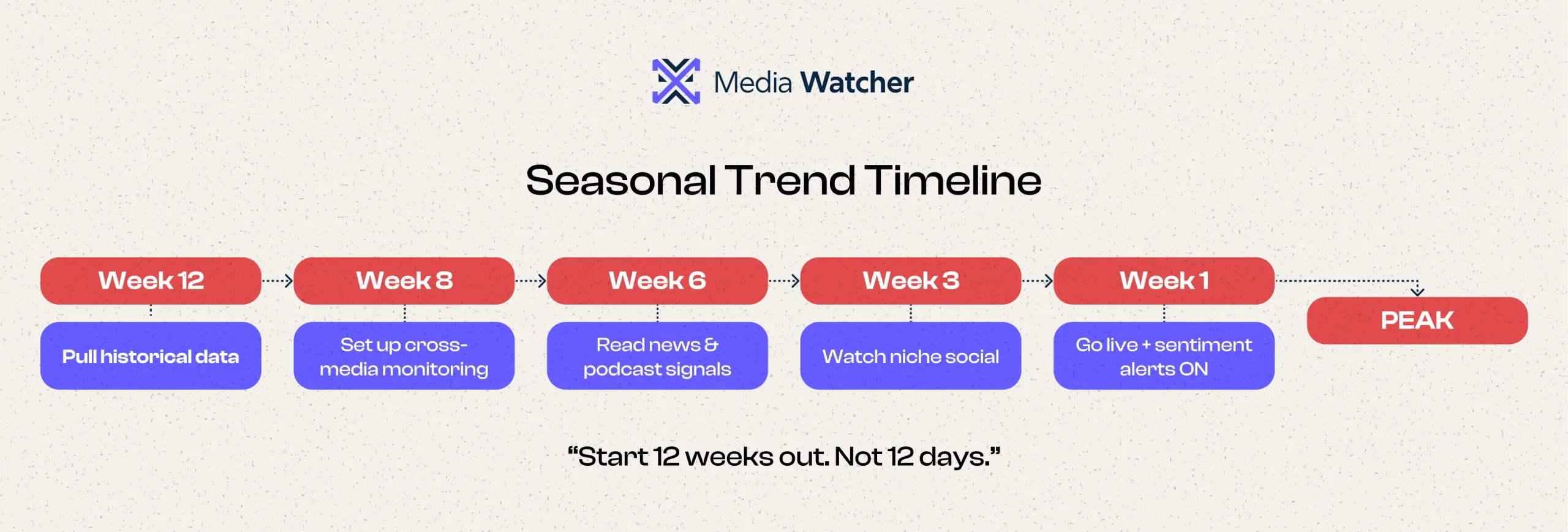
Here is the procedure to execute a seasonal social listening plan with Media Watcher on all 4 signal layers:
Extract Historical Data First
Brands, before writing anything, should think about what happened during the same season last year. Use social listening software to identify which topics were most discussed, which platforms shared the most content, and how the audience felt. Use that information to create the campaign calendar.
Open Up Cross-Media Tracking
Set up your media tracking software to watch news, podcasts, broadcasts, and social media simultaneously. Lock in your keyword clusters, like seasonal terms, relevant hashtags, competitor brand names, and product categories.
Broad coverage at this stage is what gives you the widest possible early warning.
Read the News and Podcast Signals
This is your biggest lead-time window, and most teams waste it by not monitoring early enough. Track editorial and audio coverage for emerging seasonal narratives.
Use what you find to finalize your creative direction and brief the team while there’s still proper runway to execute well.
Go Live with Sentiment Alerts Active
Switch on sentiment change alerts at launch and lean on real-time social media listening to keep a read on the room.
You’re not discovering the trend anymore; you’re staying calibrated as it evolves around you.
Start Early and Win the Season
Companies that have been able to dominate seasonal marketing have not simply been quicker; instead, they have done significantly more research and launched their campaigns much earlier.
In general, if you rely on only mainstream social channels to perform your social media listening, you are likely going to receive lagging signals.
In order to develop an effective social listening strategy, you need to acquire the tools required to monitor all types of media. Therefore, if you have access to a tool that allows you to utilize social media monitoring, news aggregation, podcast monitoring, and broadcast media tracking, you will be able to receive signals significantly sooner than others.
Whether you’re building your first social media listening strategy or improving on what you already have, one thing stays the same.
The goal is to catch social media signals before they go mainstream.
Thus, Media Watcher blends historical data, social media listening, cross-media monitoring, and real-time sentiment alerts in one place, so you’re not just tracking seasonal trends. You’re getting ahead of them. Book a demo!