

Imagine a central bank statement drops at 2:13 p.m. Frankfurt time. A human analyst is still reading the headline. Across a dozen buy-side desks, the natural-language processing engines have already captured the tone, picked up the hawkish shift, and moved position sizes.
Therefore, the whole proceeding takes less than 300ms. It was straightforward, with no drama or extreme opinions, just a clear signal delivered quickly.
That is not hypothetical; it is Tuesday. And it is exactly why alternative data for investors, specifically the real-time news intelligence, has become such a contested edge for portfolio managers.
If your team is still treating financial media as background noise, the next five minutes are worth your time.
The Market Has Already Made Its Choice
A decade ago, scanning news for investment signals was manual, slow, and inconsistent. However, today, it is systematic, quantified, and table stakes at any serious fund. One can see it in the numbers, which make this clear.
“The global alternative data market is valued at $14.16 billion in 2025 and is projected to reach $854 billion by 2035 at a CAGR of over 50%.”
“The combined expenditures by hedge funds are already approaching 10 billion a year by 2026, driven by the adoption of AI and the competitive dynamics of the information economy, where the speed of information is given precedence over nearly everything but the most essential things.”
Now look at how funds actually behave. 86% of fund managers plan to increase their spending over the next two years, with 61% already three to five years deep into the practice. This is not experimentation, but an infrastructure.
Why Financial Media Monitoring for Investors Sits at the Top of the Stack
Not all alternative data moves at the same speed. Satellite imagery refreshes on a weekly cycle, and credit card transactions settle monthly.
Employment datasets lag by weeks, while the News is structurally different, as it is the only signal that can move before the price does.
Earnings guidance, M&A speculation, policy changes, and geopolitical events all travel through financial media before they appear in any structured financial dataset. In practice, asset prices respond within milliseconds of publication.
Thus, the gap between a headline landing and a fund acting on a structured signal is, for most teams, a performance gap.
A real financial news monitoring software capability requires three things working in concert:
- Speed: signals should go from source to desk in under a second.
- Breadth: multiple sources across newswires, regulatory filings, regional press, social channels, and broadcast.
- Structure: NLP that pulls out who, what sentiment, how relevant, and whether it’s new, rather than just extracting keywords.
Without all of them, you have a news reader, not an edge.
What the Research Actually Shows
There is a temptation to treat news sentiment as qualitative and therefore unquantifiable. The academic record says something more interesting, though with important nuance.
“Tetlock in 2007 demonstrated that negative media sentiment in financial columns correlates with measurable downward pressure on equities. And Bollen et al. in 2011 found that Twitter sentiment predicted daily Dow Jones movements with up to 87% directional accuracy.”
“A 2025 backtesting study of the Dow Jones 30 stocks found that sentiment-driven models produced positive returns across all tested configurations, with the regression model delivering a 50.63% return over 28 months, well ahead of a buy-and-hold benchmark.”
The honest caveat is this: raw sentiment scores alone are not a shortcut to alpha. The edge lives in the analytical layer, entity resolution, novelty filtering, source credibility weighting, and narrative clustering.
Therefore, two funds reading the same newswire through different analytical lenses will extract completely different signals.
Media Intelligence for Investors: Three Ways It Shows Up in Practice
Geopolitical Risk at the Trading Desk
BlackRock’s Geopolitical Risk Indicator tracks market attention to top-tier risks by scanning brokerage reports and financial media, used today for scenario analysis and stress testing.
One finding that surprises many teams is that local-language sources capture geopolitical shocks that English-language global media consistently underestimates.
For any fund with EM exposure, a media intelligence platform with 80+ language coverage is not a nice-to-have; it is a structural gap-filler.
Equity Long/Short And Cultural Signals.
In 2019, Man GLG applied NLP to Chinese-language media coverage of Versace.
When a product controversy spread through domestic Chinese channels, sentiment scores on Versace’s parent company dropped from +0.4 to −0.7. The stock fell 14%. Western sell-side research caught the story days later.
The alpha was entirely in the language gap and detection speed, two things that systematic financial media monitoring for investors is designed to close.
Quant Desks And Narrative Signals.
In 2025, AI tools picked up early demand signals in agricultural tenders before prices shifted, and spotted freight bottlenecks in Asian metals routes before FX regime moves.
Every signal was timestamped, sourced, and auditable, which was a prerequisite for anything that needs to survive a risk committee review.
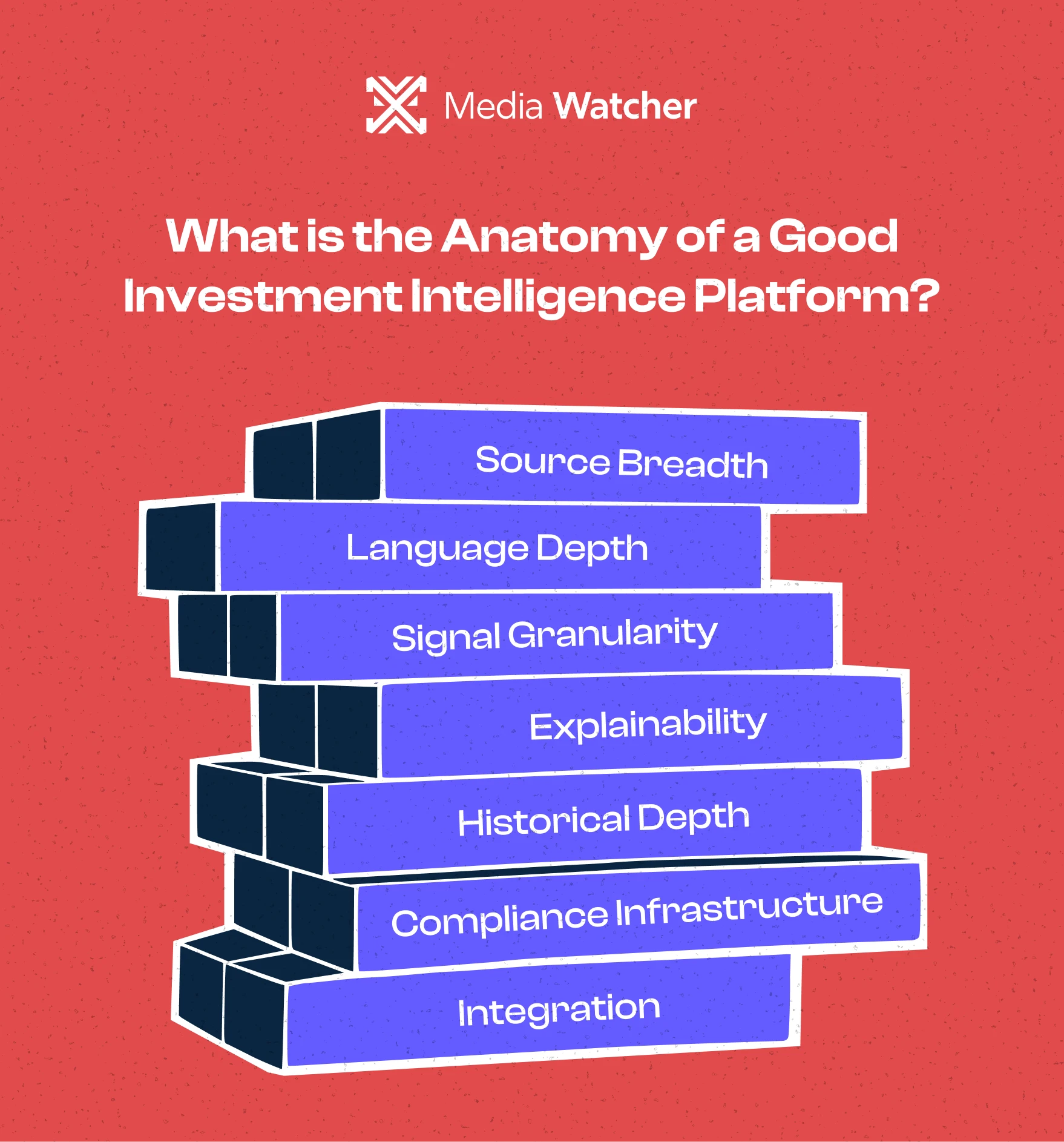
Eight Questions to Ask Any Investment Intelligence Platform
Most vendors in this space pass two or three of these criteria. The ones worth deploying in a live investment environment pass all eight.
Use this framework before shortlisting any platform, and hold every vendor to the same standard, including incumbents you have been using for years.
| Dimensions | What Good Looks Like |
| Source Breadth | It covers premium newswires, regional press, regulatory filings, social channels, and broadcast. |
| Language Depth | English-only monitoring misses significant risk. More than one standard language is a meaningful threshold for global portfolios. |
| Signal Granularity | It is beyond positive or negative polarity, that is, event classification, novelty scoring, attention spikes, and sustained narrative momentum. |
| Explainability | Every signal should trace cleanly to a source, timestamp, and article. Unexplainable signals will not survive a compliance review. |
| Historical Depth | Point-in-time data for backtesting. Historical archives drop failed assets, and that gap quietly pumps your model’s numbers. |
| Compliance Infrastructure | MNPI controls, licensing documentation, and GDPR compliance are non-negotiable for institutional deployment. |
| Integration | REST API, OMS compatibility, and latency numbers that match your actual execution stack, not a theoretical one. |
Spot Emerging Risk With Media Watcher Before It Moves the Price
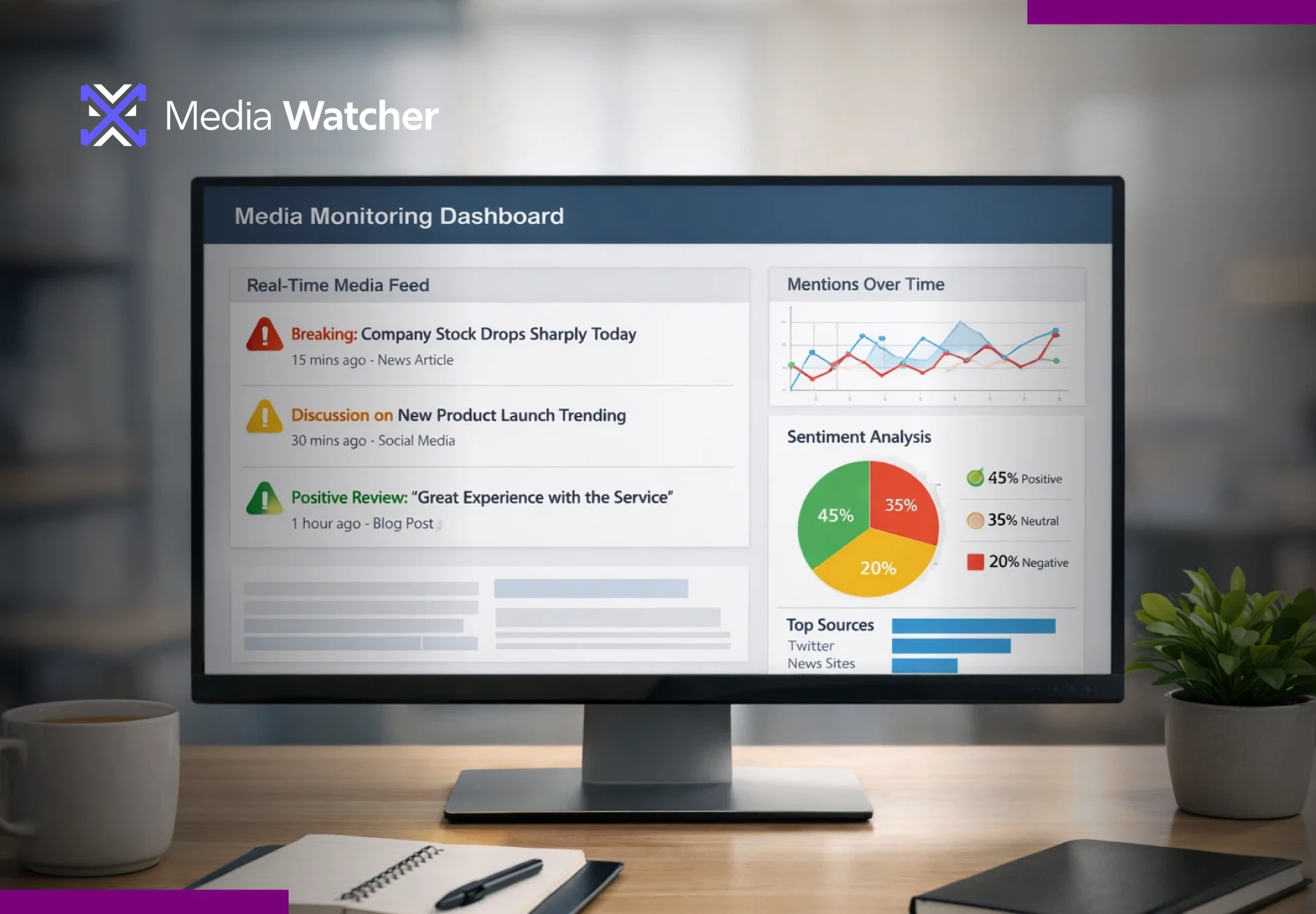
Media Watcher’s Investment Watcher is a real-time financial media monitoring platform built for investment and risk teams.
It covers 100,000+ sources across more than 80 languages and 235+ regions, delivering structured attention and sentiment signals in under 200ms, so you spot emerging risk and opportunity before it moves the price.
The tool is built for CIOs, Portfolio Managers, compliance groups, and experts. It adds a media intelligence layer across your full ticker universe, with full source provenance for every signal, enabling compliant, defensible decision-making.
Thus, it is not a news aggregator, nor a dashboard. Media Watcher is a purpose-built investment intelligence platform that tells you where attention is forming before it becomes consensus.
The window between a signal forming and a price moving is measurable in milliseconds. For most teams, the gap between those two moments is still measured in minutes or longer. That gap is a performance gap.
Talk to the team, and we will map it to your existing execution stack!