

Google search is becoming something people speak to rather than scroll through. A user can ask an AI assistant which company to trust, what caused a controversy, or whether a product is safe, then receive one confident spoken response.
Google’s Search Live supports interactive voice conversations and follow-up questions, turning search into an ongoing exchange rather than a page of links.
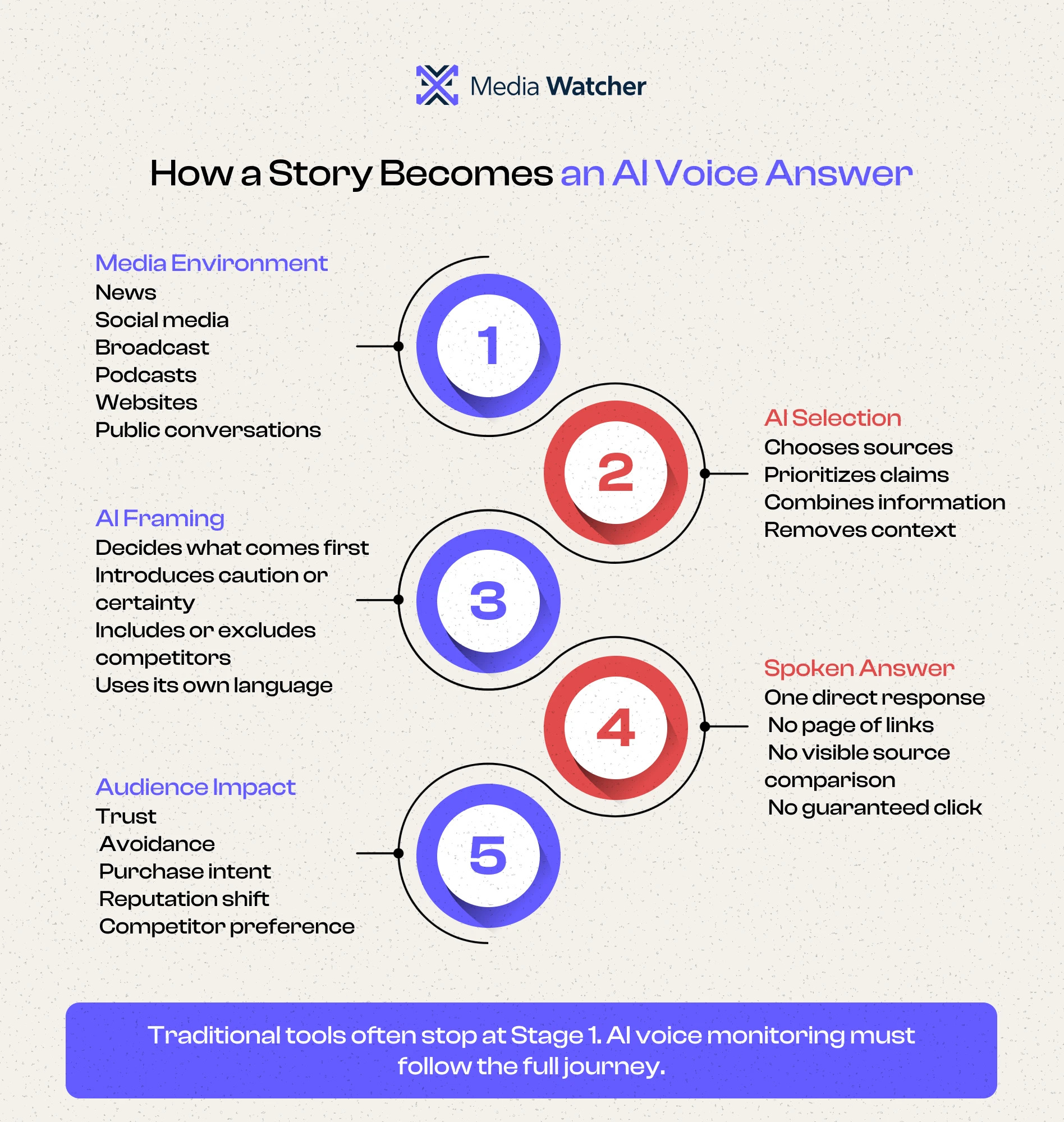
This shift creates a new problem for communications teams. Traditional platforms find published mentions across news, social media, websites, television, radio, and podcasts. AI voice assistants sit above those sources. They select information, combine it, and deliver a newly generated answer.
A 2025 European Broadcasting Union study found significant issues in 45% of AI-generated news responses, with 31% showing sourcing problems and 20% containing major accuracy errors.
That answer may influence a customer without appearing in a searchable article, public post, or referral report. AI voice search media monitoring must therefore examine what an assistant tells its users, not only what publishers originally reported.
Here are five gaps traditional tools usually overlook.
1. They Monitor Sources but Not the Spoken Answer
Traditional digital media monitoring begins with the content that is already available. A brand appears in an article, broadcast transcript, or social media post, and the platform captures the mention.
An AI voice assistant might reference multiple sources before creating its own brief synopsis in its own words. The final answer may lack some information, combine unrelated information, or give old information more weight than recent reporting.
The European Broadcasting Union (EBU) spearheaded a comprehensive study that tested over 3,000 responses from top AI assistants.
Nearly 50% had some major problems. One in three had serious sourcing issues, and one in five had significant accuracy problems, e.g., outdated or fabricated information.
A traditional dashboard might indicate that the coverage has been correct. But it might never reveal that it was a deceptive spoken response by an assistant.
A comprehensive voice search media monitoring solution should be able to store the entire answer, identify the specific claims it contains, and compare it to validated sources.
2. Keyword Alerts Miss the Way People Speak
Most monitoring queries rely on brand names, product terms, Boolean operators, and known variations. Spoken searches are often broader and less predictable.
A customer may ask:
- “Which identity verification provider is safest for online onboarding?”
- “Why are people criticizing that airline?”
- “What is the best platform for monitoring political risk?”
The brand can appear even though it was absent from the question. It can also be excluded while a competitor receives the recommendation.
Voice search monitoring needs to shift from a list of keywords to prompt clusters focused on customer issues, comparisons, reputational inquiries, buying intent, and industry events, and follow-up questions.
Follow-up questions are important because voice search is conversational. Google describes Search Live as a way for users to keep asking questions and receive live spoken answers.
A user may start with an industry question, narrow it to two vendors, and finish by asking which one has faced negative press.
Media monitoring for voice search should map that journey. Tracking only the opening question leaves the most commercially important part unseen.
3. Traditional Sentiment Scores Miss AI Framing
Typically, sentiment analysis is used to gauge the tone of a specific article, blog post, or radio or TV broadcast. It can analyze each reference to be positive, neutral, or negative.
The AI assistants add another level of interpretation. A number of neutral reports may be compressed into a cautious answer. An old controversy can be accompanied by a positive announcement. Any criticism is the first impression a user has.
The words can be technically correct, but the overall context may shift.
AI media monitoring must therefore assess whether there was a brand appearance, as well as other factors. Teams should pose the following questions:
- What was the claim that was first mentioned?
- What facts were left out?
- Was there any uncertainty added?
- How did the brand’s position compare to competitors?
Spoken delivery makes this more important because users hear information in sequence rather than viewing every source together. Research in the field of voice assistant recommendations has also shown that perceptions of tone can influence persuasion.
Media monitoring for AI search should measure the sentiment of original media content and the sentiment of generated answers. This comparison can help identify distortions that aren’t visible in traditional sentiment dashboards.
4. One Prompt Cannot Represent AI Voice Visibility
Search ranking tools are built around repeatable positions. AI voice answers are less stable.
The result may change based on the assistant, model version, location, language, prompt wording, available sources, and previous questions. A brand may be recommended in one response, ignored in another, and described differently in a third.
Search Live’s expansion across more than 200 countries and territories adds another layer. The same question can now be asked across languages and regional contexts on an enormous scale.
A single test cannot show meaningful visibility.
AI voice search media monitoring needs a repeatable prompt framework. Teams should test branded and non-branded questions, comparison prompts, risk questions, and regional variations. Important prompts should be run regularly so changes can be identified over time.
The goal is to find patterns. How many times does the brand show up? Which sources are repeatedly cited? What kind of language do they use? Where are competitors getting noticed? Which prompts generate inaccurate or unfavorable answers?
This makes checking voice search an ongoing research, not just something you do once and then forget about it.
5. Voice Influence Can Leave No Click Trail
Traditional measurement depends on visible activity such as mentions, reach, engagement, rankings, website sessions, and referral traffic.
A spoken answer can influence someone without producing any of those signals.
The user may remember a recommended provider, avoid a company after hearing about an old controversy, or call a business directly. The assistant shaped the decision, yet the company may see no attributable visit.
As AI search systems give direct answers and make it easier to avoid opening up each source, this blind spot is growing. AI search visibility is now more than just ranking on the website, as it’s about being mentioned, cited, or recommended.
Voice search media monitoring should be based on a wider range of factors, such as answers, recommendations, citations, competitor visibility, consistency, and changes in narrative across repeated search queries. But traffic is not all, it is just a part.
Closing the Gap With Media Watcher
Brands cannot monitor AI voice search effectively without understanding the media environment feeding those answers.
Media Watcher offers that backbone by monitoring in real-time from digital sources, broadcast, and public conversations. Access to more than 100,000 media sources in 80 plus languages and 235+ regions, including AI sentiment analysis features, and rapid alerts on trending stories.
The cross channel look can assist communications teams in determining the stories, claims, and sentiment changes that could affect AI-driven responses.
Historical analysis may illustrate the evolution of a story, and regional and language monitoring can uncover differences in how the same story is told across regions and languages.
For a stronger AI voice search media monitoring program, teams can combine Media Watcher’s media intelligence with structured prompt testing. Media Watcher shows what the information ecosystem is saying. Prompt monitoring reveals how an assistant interprets it.
Together, they help brands detect inaccurate narratives earlier, understand why competitors are being recommended, and respond before a distorted answer settles into public perception.
Voice search is becoming a media layer of its own. Organizations that monitor only published mentions will see the sources. Those connecting the sources with AI-generated answers will understand what audiences are actually hearing.