


$13.8T
of S&P 500 shareholder value was tied to corporate reputation in 2025
Echo Research, 2025
New report · September 2026
Your reputation moves every second. Most organisations still measure it once a month. 46 pages on closing that gap, and on the shift from media monitoring to media intelligence.
Free · No sales call
Why this report exists
Media coverage no longer arrives on a schedule. It arrives every second, across news, social, broadcast, podcasts and AI assistants describing companies to more than a billion people.
Most communications functions still run on a media monitoring model built for a slower era. Clips are collected and circulated days after the conversation that produced them, by which time the narrative has already formed.
“Monitoring tells you what already happened. Intelligence tells you what is about to. The gap between those two sentences is where reputations are now won and lost.”
What the data shows
$13.8T
of S&P 500 shareholder value was tied to corporate reputation in 2025
Echo Research, 2025
84%
of the citations AI models draw on come from earned media, not owned or paid
Muck Rack, 2026
4 in 5
brands do not monitor how AI models describe them to buyers and journalists
Media Watcher figure
First hour
is the best window to establish facts and shape a story
PRSA
Every figure in this report is attributed to a named source and listed in full in the appendix. Figures marked as Media Watcher data are our own, and labelled as such.
What's inside
A media intelligence report built to be read start to finish, or opened at the chapter that matters today.
Part 01
Why the monitoring model built for a slower era stopped working: volume, speed, and the money at stake.
Part 02
Human, social and machine. Each behaves differently, and a stack built for one is blind to the others.
Part 03
What intelligence actually means, the six signals that precede a crisis, and how to prove its value.
Part 04
The five leaders on the front line, and how the stakes change by sector.
Part 05
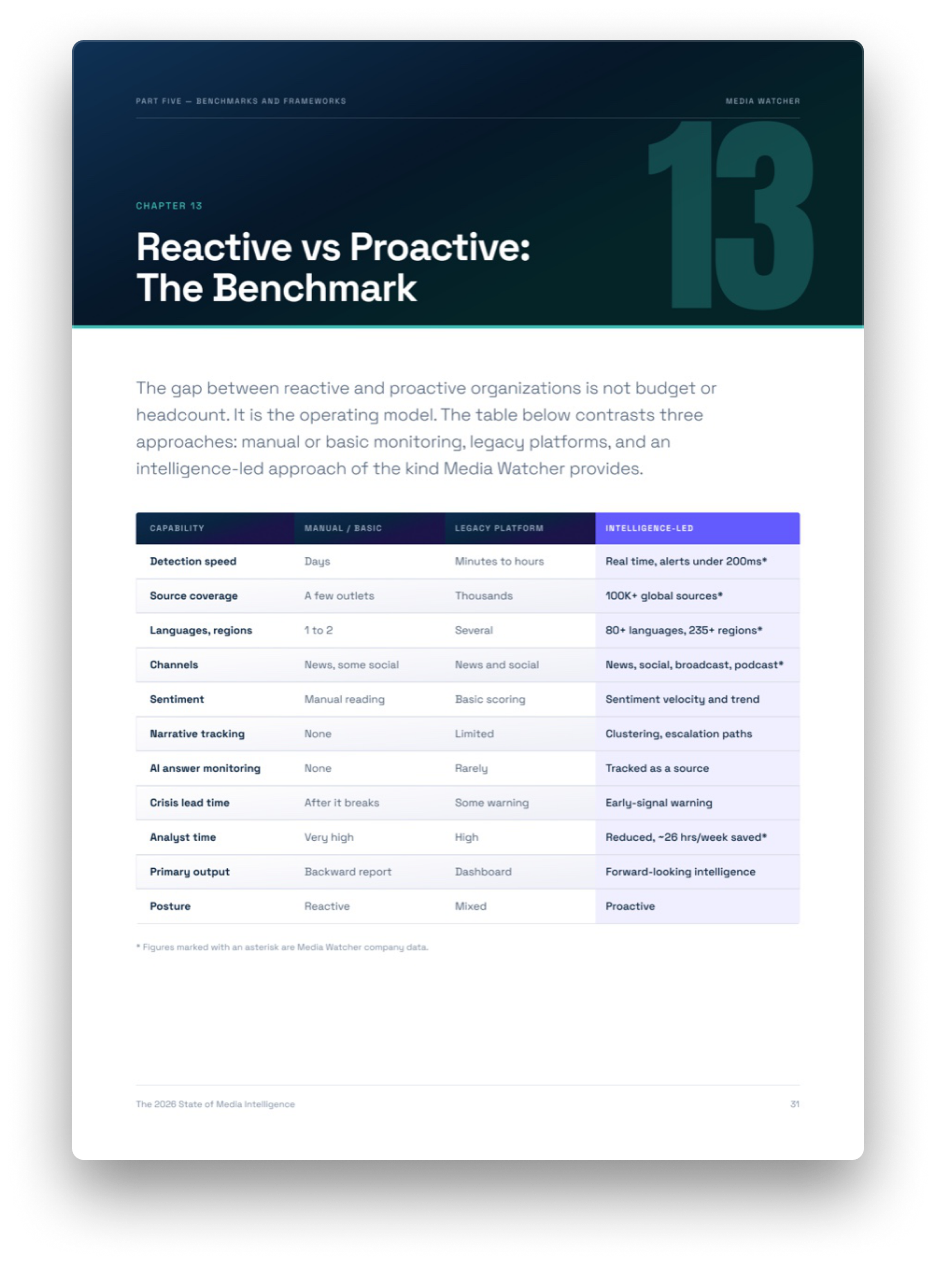
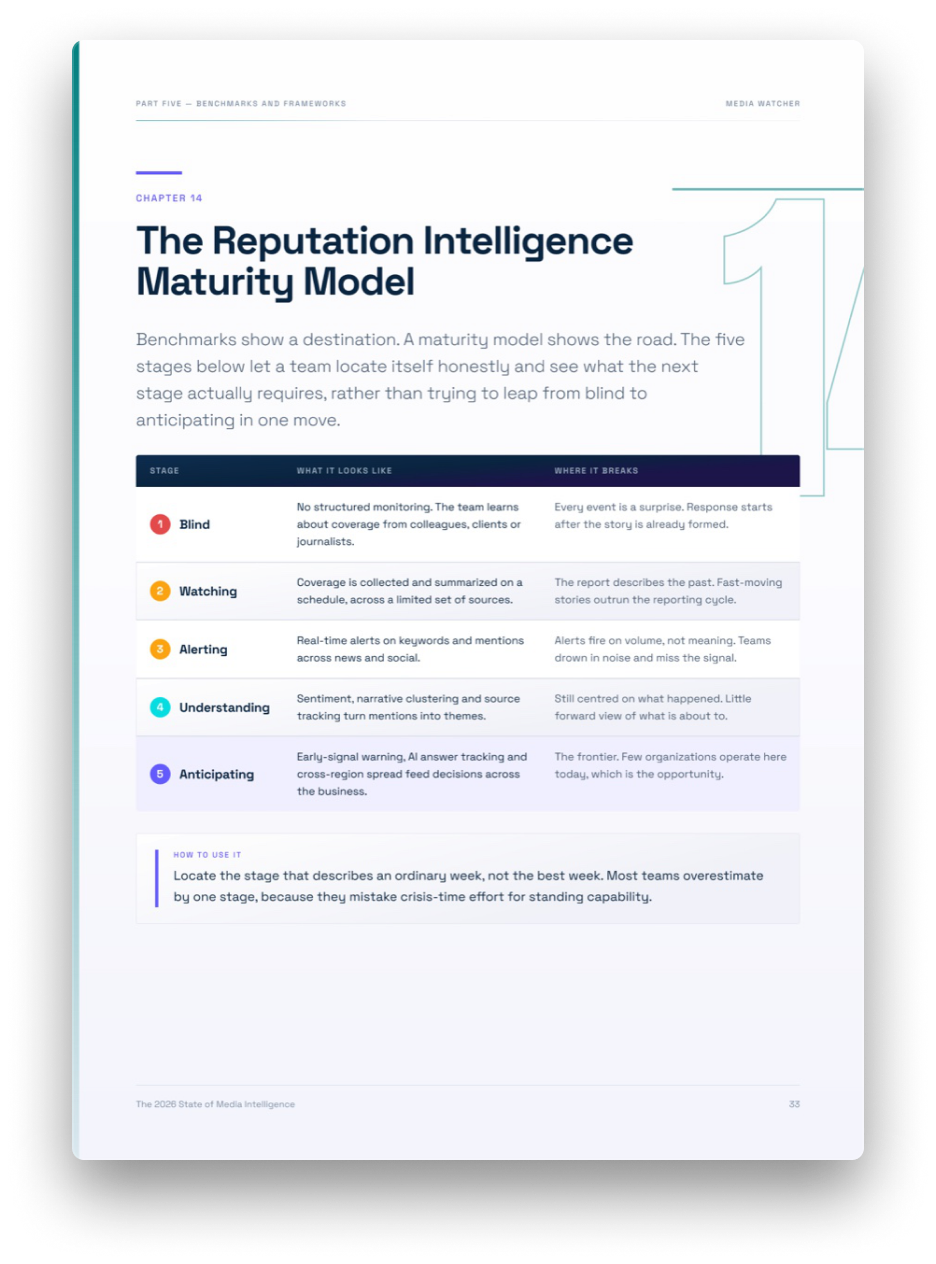
A reactive-vs-proactive benchmark, and a five-stage maturity model to locate your team honestly.
Part 06
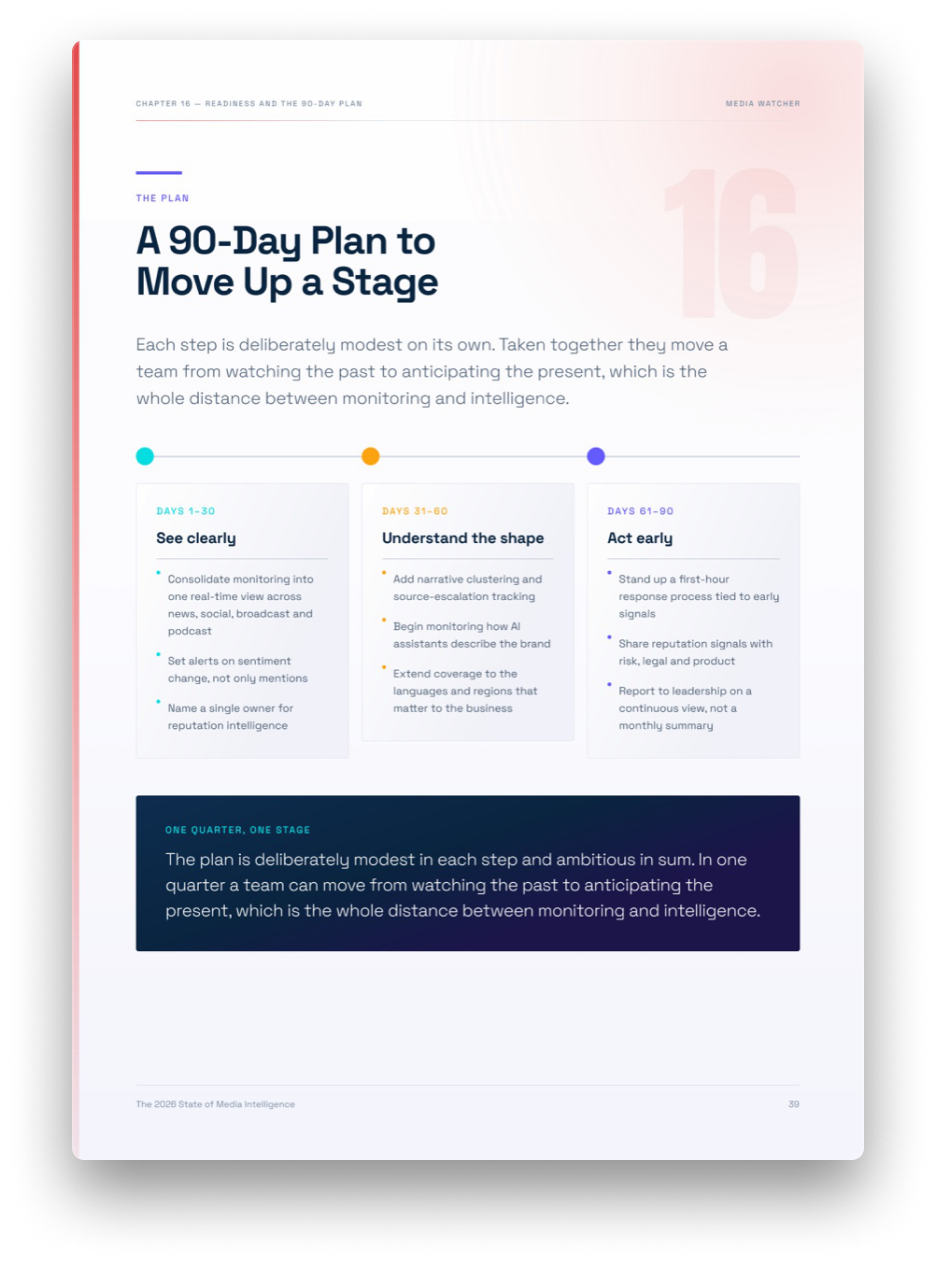
Seven forces shaping the next three years, a readiness checklist and a 90-day plan.
Who it's for
The exposure is not abstract. For each leader who owns part of a brand’s reputation, it shows up as a specific gap between when something happens and when they find out.
Campaign performance is shaped by sentiment the dashboard does not show. A launch can be on-plan while the narrative turns against it.
The defining risk is finding out from the outside, when a journalist calls before the alert arrives.
Coverage is a live map of who is saying what, and which thread is about to cross from a niche forum into national press.
Brand perception is being written in places the brand does not control: AI answers, review platforms, creator content.
A regional or policy narrative can shift opinion, or become a compliance matter, before a response is drafted.
Key statistics
Twelve figures from the report, each attributed to its original source. Free to cite with attribution to The 2026 State of Media Intelligence.
$13.8 trillion
of S&P 500 shareholder value was tied to corporate reputation in 2025
Echo Research, 2025
26%
of total S&P 500 market capitalisation is attributable to reputation
Echo Research, 2025
402 million TB
of data is created, captured and copied worldwide every day
Exploding Topics / IDC, 2024
5.66 billion
people use social media worldwide, each one a potential publisher
DataReportal, 2026
70%
more likely that false stories are shared than true ones
MIT, Science, 2018
84%
of the citations AI models draw on come from earned media
Muck Rack, 2026
68%
of Google searches now end without a click
SparkToro / Similarweb, 2026
96%
of journalists use social media for their work
Cision, 2025
62%
of organisations reported a deepfake attack in the prior year
Gartner, 2025
156 billion
impressions generated by brand and reputation deepfakes in 2025
Resemble AI, 2025
6%
of global turnover is the maximum penalty under the EU Digital Services Act
European Commission
$17–19 billion
projected size of the media monitoring market by 2034
Fortune Business Insights; Polaris, 2026
How it was made
Every factual claim is attributed to a named third party, cited in the text and listed in full at the end.
Where research firms disagree (on market size, for example), we publish the range rather than the number that flatters us.
Figures describing our own platform are marked as Media Watcher data, not presented as neutral industry research.
No proprietary survey. No fabricated case studies. No quotes attributed to people who did not say them.
Some widely circulated figures could not be traced to a primary source and were left out, including a popular claim about how much faster social crises spread than traditional news.
Inside the report
Three media intelligence frameworks: a benchmark, a five-stage maturity model and a 90-day plan. Not just analysis.
Every figure traced to a named source. No sales call. It goes straight to your inbox.
Frequently asked questions
Media intelligence is the practice of turning media and sentiment data into forward-looking insight and decisions. It differs from media monitoring, which records what was said. Monitoring collects mentions; intelligence interprets them into narratives, risk and recommended action.
Monitoring answers what was said. Intelligence answers what it means, what is likely to happen next, and what to do about it. Monitoring’s unit of value is the mention and its output is a report. Intelligence’s unit of value is the decision, and its output is a warning early enough to matter.
Corporate reputation accounted for roughly $13.8 trillion of shareholder value across the S&P 500 in 2025. That is about 26% of total market capitalisation, and close to $27 billion per company on average (Echo Research, 2025).
The machine layer is the automated and AI-driven channels, such as search answers and AI assistants, that describe and recommend brands with no human author. Around 84% of the citations those models draw on come from earned media (Muck Rack, 2026).
Sentiment velocity, source escalation paths, narrative clustering, anomaly and spike detection, cross-language and cross-region spread, and AI answer drift. Most tools cover two or three of them; an intelligence approach covers all six.
The Public Relations Society of America identifies the first hour as the best opportunity to establish facts and shape the narrative. False information spreads roughly 70% more readily than the truth (MIT, Science, 2018).
CMOs, Heads of Communications, PR Directors, Brand Managers and Corporate Affairs leaders, or anyone who owns part of a brand’s reputation. Chapter 11 covers each role’s specific exposure; Chapter 12 covers how the stakes change by sector.
Yes. The full 46-page report is free to download. Every figure is attributed to a named third-party source and listed in the appendix, and figures describing Media Watcher’s own platform are labelled as company data.