

Social media discussions are fast-paced and often happen across multiple platforms. It can start on Tiktok, then be seen in a Reddit thread, noted in an X thread, and then seen in online news outlets.
The challenge for the brands is no longer just about locating mentions. The true challenge is who to talk to, how these conversations are going, and what information needs to go to whom, before the situation evolves.
It is here that social media monitoring tools come in handy. Effective tools make it easy to bring meaningful discussion together, remove distracting clutter, and enable teams to reply with context. However, platforms vary considerably in their coverage, alerting capabilities, reporting depth, and suitability for different teams.
Here, we’ll take a look at some of the top tools you can use in 2026 and what factors you should consider when selecting a social media monitoring platform.
Why Social Media Monitoring Matters in 2026
Social conversations are now getting divided. Brands are discussed on platforms like Facebook, Instagram, YouTube, and X, as well as on communities like Reddit, TikTok, Threads, blogs, forums, and review sites.
A brand can be tagged directly in one conversation and indirectly in another. Customers can also use abbreviations, misspellings, product names, campaign hashtags, or executive names as alternatives to the official brand handle.
It is unlikely that all these variations will be detected with manual searches.
Effective social media tracking allows teams to monitor relevant terms across multiple sources without checking each platform separately. It can help organizations:
- Detect customer complaints earlier
- Monitor brand and product mentions
- Track campaign hashtags
- Identify unusual increases in conversation
- Understand changes in audience sentiment
- Discover emerging industry discussions
- Monitor competitors and market developments
- Support crisis and reputation management
- Maintain records of relevant online activity
The main objective is not to collect every available mention. It is to surface the conversations that may affect customer relationships, marketing performance, reputation, or business decisions.
What to Look for in Social Media Monitoring Tools
Feature lists can make many platforms appear similar. The practical difference often becomes clearer when the tool is used during a busy campaign, product issue, or reputation concern. The following areas are particularly important when comparing social media monitoring tools.
Platform and Source Coverage
A platform should cover the channels where the organization and its audience are most active. This may include:
- X
- TikTok
- YouTube
- Threads
- Bluesky
- Online forums
- Blogs
- Review websites
- News publications
Some platforms focus mainly on social networks. Others combine social conversations with news, broadcast, blogs, and online forums.
Wider coverage is useful for PR and reputation teams because important conversations often move between social and traditional media.
Alert Speed
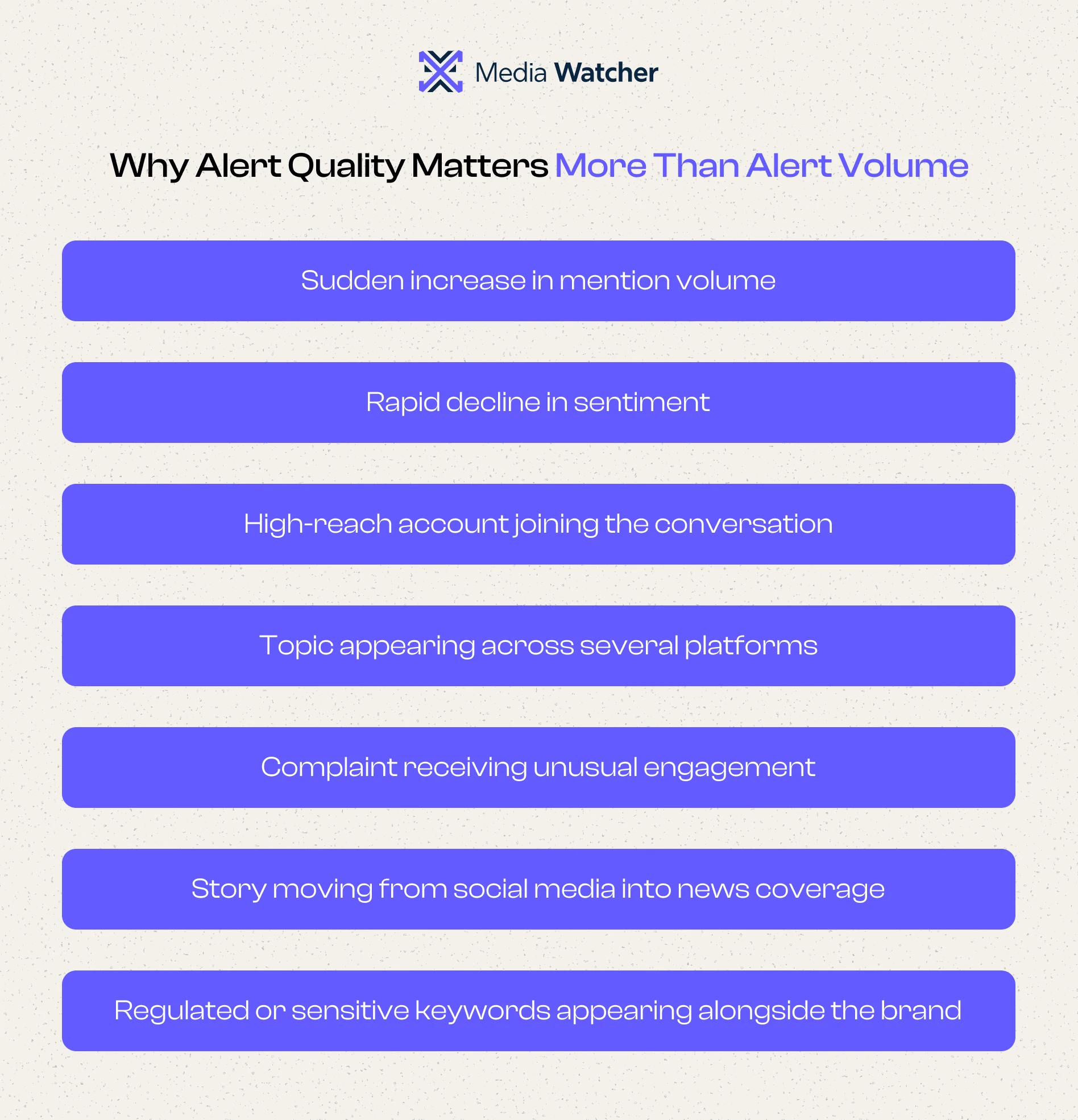
Fast detection can be valuable when a complaint, misleading claim, or negative story begins gaining attention. However, speed alone is not enough. Poorly configured alerts may overwhelm teams with low-value notifications.
Strong social media monitoring alerts should allow users to define conditions based on factors such as:
- Keywords
- Mention volume
- Sentiment
- Source
- Location
- Language
- Influencer reach
- Unusual activity
The aim is to deliver timely alerts without turning every mention into an emergency.
Sentiment Analysis
Basic sentiment tools generally classify content as positive, negative, or neutral. More advanced platforms may provide additional context around emotions or tone.
Sentiment analysis can help teams identify changes across large volumes of conversation. It should not, however, be treated as a perfect substitute for human interpretation.
Sarcasm, humor, cultural context, slang, and mixed-language posts can still be difficult for automated systems to interpret accurately. The most useful platforms allow teams to review the content behind a sentiment score rather than relying only on an automated label.
Language and Regional Support
Global monitoring requires more than translating individual words.
A useful social media monitoring platform should be able to recognize regional expressions, spelling variations, transliterated names, and local sources. This is particularly important for organizations operating across multiple markets.
A platform that performs well in English may provide limited visibility in other languages or regions. Teams should therefore test monitoring queries using realistic local terms before selecting a tool.
Noise Reduction
More data does not always produce better insight. A common brand name, industry term, or abbreviation can generate thousands of irrelevant results. Effective platforms allow users to refine queries through:
- Include and exclude keywords
- Phrase matching
- Source filters
- Language filters
- Geographic filters
- Author filters
- Boolean search
- Sentiment thresholds
- Volume thresholds
Noise reduction is one of the most important elements of useful monitoring. If teams repeatedly receive irrelevant results, they are likely to stop trusting the alerts.
Workflow Integrations
Monitoring becomes more useful when relevant information reaches the team where work already happens. Depending on the organization, this may include:
- Slack
- Microsoft Teams
- Customer support systems
- Project management tools
- Dashboards
- Webhooks
- Mobile notifications
A strong workflow should also clarify who owns each type of alert. A customer complaint may go to support, while a rapidly growing negative discussion may need to reach PR, legal, or compliance.
Reporting and Historical Analysis
Live monitoring helps teams understand what is happening now. Historical reporting helps them explain what changed over time. Useful reporting capabilities may include:
- Mention volume
- Sentiment trends
- Share of voice
- Source distribution
- Geographic distribution
- Campaign performance
- Influential authors
- Topic analysis
- Response times
- Exportable records
Regulated or highly scrutinized industries may require reporting to include support for audit trails and internal documentation.
The Best Social Media Monitoring Tools for 2026
There is not a single platform that will suit all organizations. The tools below are tailored for the needs of various teams, budgets, and monitoring needs.
Specific product features and plans are subject to change, and teams should verify specific capabilities directly with each provider.
- Brandwatch
Larger enterprises are typically the ones that use Brandwatch for consumer intelligence, trend analysis, and custom reporting.
It offers a wide range of analytics for market research, audience understanding, campaign measurement, and reputation monitoring. Teams can create dashboards based on product, market, competitor, or conversation topics.
The platform may be most suitable for organizations with dedicated analysts or social intelligence teams. Smaller teams may find that implementation, training, and pricing exceed what is required for straightforward mention monitoring.
Meltwater
Meltwater brings together social monitoring, news coverage, media intelligence, and PR workflows.
This makes it relevant for communications teams that need to understand how a story is moving across both social media and established publications. It can also support journalist research, media reporting, and campaign analysis.
While those interested only in social tracking may not require the full functionality, the greater benefits can be helpful to established PR teams.
Talkwalker
Talkwalker is designed for companies that want to monitor across a wide range of areas, languages, and media types.
Its capabilities can support brand intelligence, reputation monitoring, campaign analysis, and visual recognition. Visual monitoring may be particularly useful when a logo or product appears in an image without being named in the accompanying text.
The platform is generally more relevant for large or global teams with complex monitoring requirements.
Sprout Social
This platform integrates social publishing, engagement, analytics, and monitoring all into a relatively user-friendly interface.
For marketing teams, it can be convenient to have all content and audience interactions in one place. Additionally, it can also offer teams reporting and collaboration tools that aid in coordinating social activity across departments.
Organizations requiring deeper market intelligence or highly specialized social listening should review which capabilities are available within each plan.
Hootsuite
Hootsuite is a popular social media scheduling and account management platform that offers monitoring and listening capabilities.
It’s useful for teams who wish to monitor conversations while publishing, engage with users, and monitor account activity from a single platform.
For organizations with advanced sentiment, multilingual, or media intelligence requirements, a dedicated monitoring platform may provide greater analytical depth.
Brand24
Brand24 provides brand mention monitoring, sentiment analysis, and alerts through a relatively straightforward interface.
It may suit startups, agencies, and smaller marketing teams that need visibility without a lengthy implementation process. Users can track brand names, campaign terms, competitors, and industry topics across social and online sources.
As monitoring requirements grow, teams should review mention limits, data retention, reporting capabilities, and collaboration options.
Mention
Mention focuses on accessible monitoring across social networks, blogs, forums, and online publications. Its simple setup may appeal to smaller organizations that want to begin monitoring brand conversations without building highly complex queries or dashboards.
Larger teams may eventually require more advanced analytics, workflow controls, or reporting than a lighter monitoring platform provides.
BrandMentions
BrandMentions is centered on discovering brand references across social and online sources. It may be useful for teams that primarily need real-time awareness of mentions, backlinks, reviews, or competitor conversations.
Organizations looking for publishing, advanced collaboration, compliance reporting, or broader media intelligence should assess whether additional platforms would still be required.
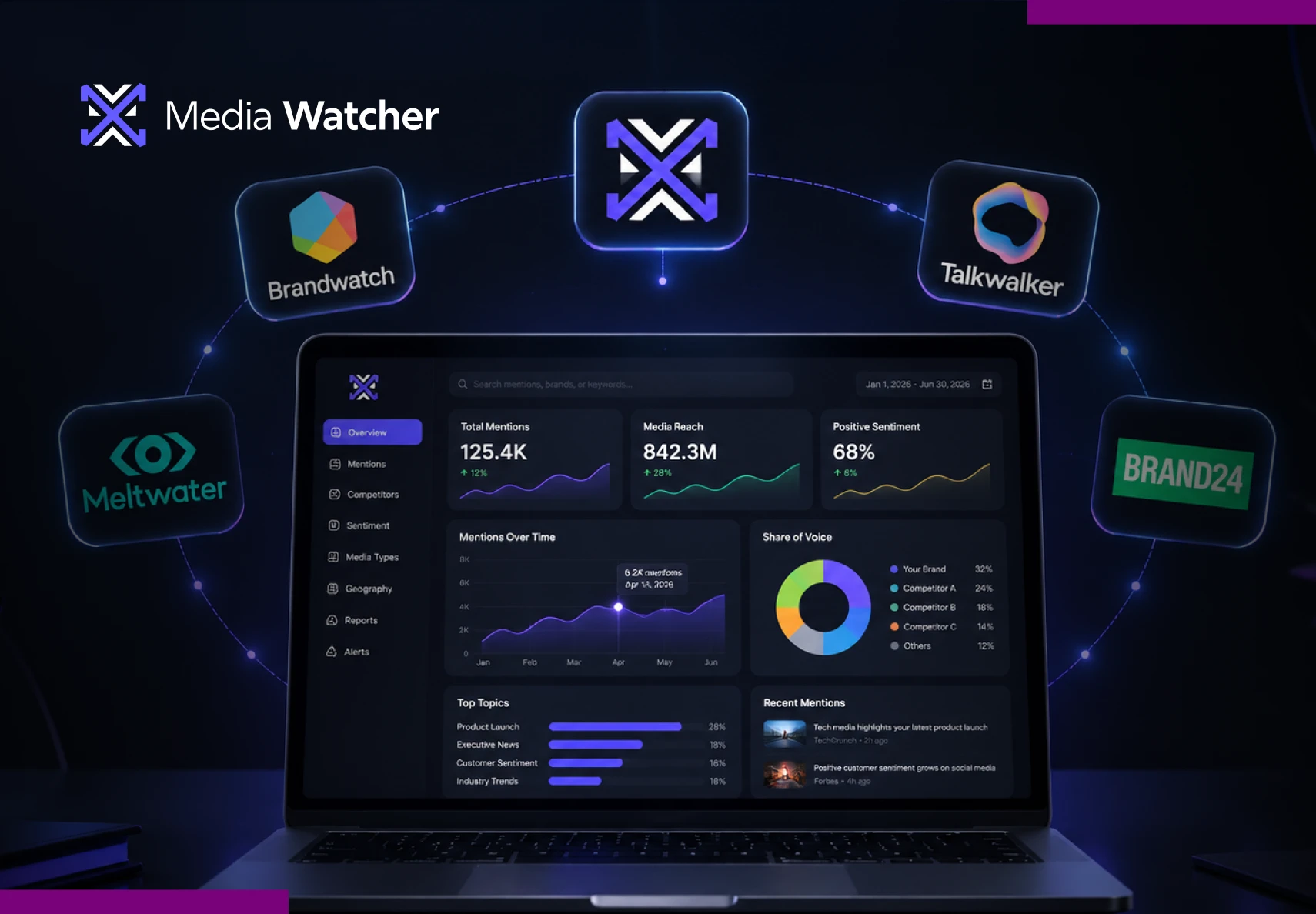
Media Watcher
Media Watcher combines social monitoring and wider media intelligence from news outlets, forums, blogs, and broadcast media.
Rather than a focus on direct brand tags, teams can establish monitoring cases for products, campaigns, competitors, executives, industry topics, emerging risks, etc. Its capabilities include:
- Keyword and entity monitoring
- Social and wider media coverage
- Sentiment analysis
- Language and country filters
- Include and exclude keywords
- Historical analysis
- Threshold-based alerts
- Email, Slack, mobile, and webhook notifications
- Reporting for marketing, PR, intelligence, and compliance workflows
This broader structure may be useful for teams that need to understand how conversations move beyond individual social platforms.
For example, a social post may initially appear to be an isolated customer issue. If the same topic begins appearing in forums, news publications, or high-reach accounts, the level of response may need to change.
Media Watcher can help teams view those developments within one monitoring workflow while keeping alerts focused on the conditions they consider important.
How to Choose the Right Social Media Monitoring Tool
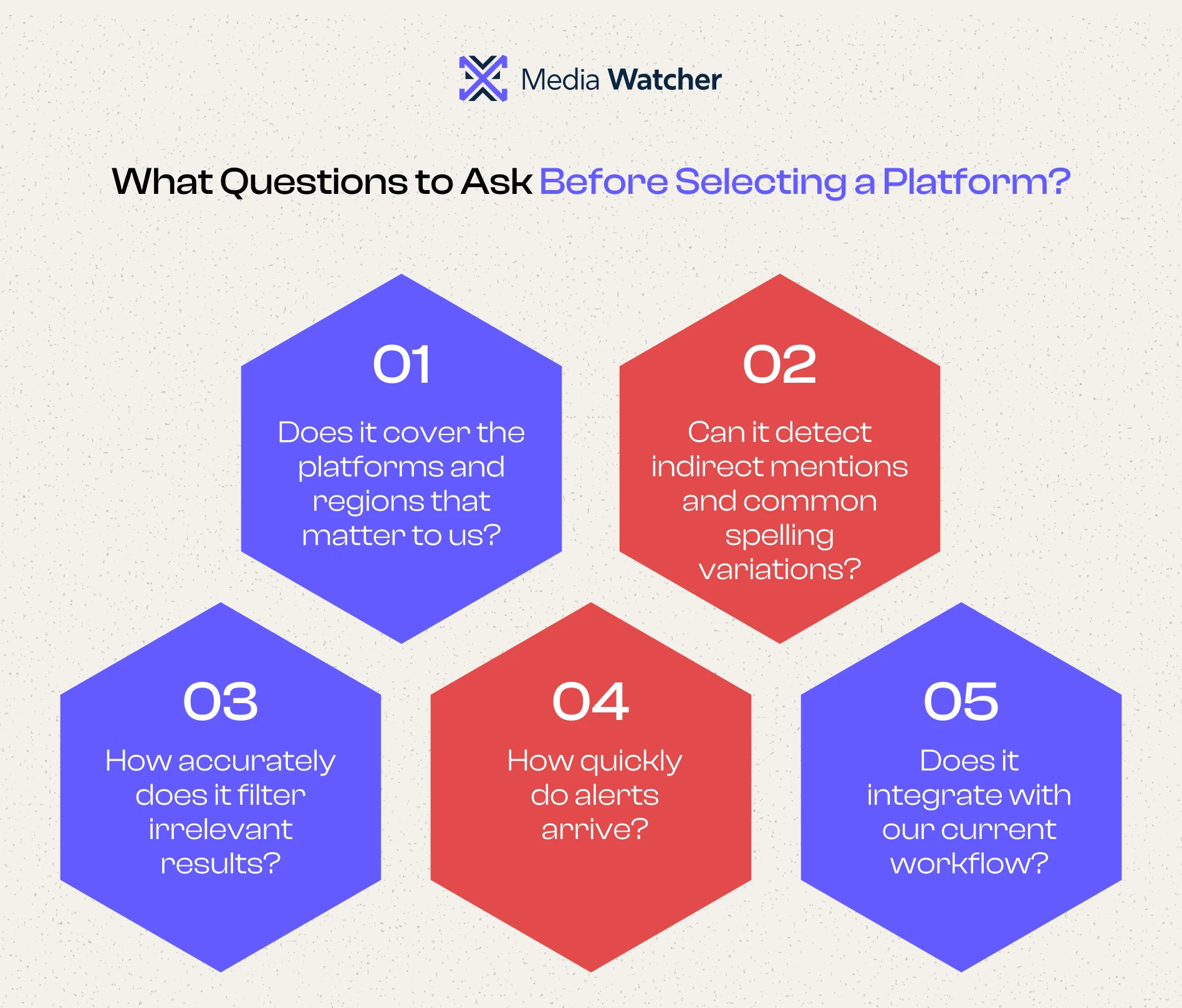
The right choice depends on what the team is expected to detect, analyze, and report.
PR and Reputation Teams
PR teams usually benefit from:
- Fast alerts
- News and social coverage
- Sentiment changes
- Influencer identification
- Volume spike detection
- Clear escalation workflows
The ability to see a discussion moving from social media into online news can be particularly valuable.
Marketing Teams
Marketing teams may place greater emphasis on:
- Campaign hashtags
- Audience sentiment
- Share of voice
- Competitor activity
- Engagement trends
- Topic discovery
- Historical campaign comparison
For these teams, analytical depth may matter more than receiving an alert for every individual mention.
Customer Support Teams
Support teams often need:
- Direct and indirect complaint detection
- Product and service keywords
- Real-time notifications
- Conversation context
- Integration with support workflows
- Clear ownership of responses
Monitoring should complement existing customer service channels rather than create another disconnected inbox.
Compliance and Risk Teams
Compliance teams may prioritize:
- Defensible reporting
- Historical records
- Source traceability
- Regional coverage
- Custom risk topics
- Escalation rules
- Exportable monitoring results
These teams may need broader web and news monitoring in addition to social media tracking.
Global Organisations
Global brands should examine:
- Language support
- Regional source coverage
- Local platform coverage
- Transliteration handling
- Market-specific dashboards
- Cross-region reporting
A tool should be tested using the languages, terms, and channels that matter in each operating market.
How to Choose the Best Social Media Monitoring Tool
The best social media monitoring tools are not necessarily the platforms with the longest feature lists. They are the ones that match the organization’s sources, markets, workflows, and response requirements.
A small marketing team may value a simple setup and campaign tracking. A global PR team may require multilingual coverage and early crisis alerts. A compliance team may care more about source records and reporting than publishing features.
Start by defining what the organization needs to detect and what should happen after a relevant mention is found. Then compare platforms based on coverage, alert quality, filtering, analysis, and workflow fit.
The right social media monitoring tool should reduce the effort required to understand online conversations. It should not create another dashboard that teams must remember to check.
For organizations looking to connect social conversations with wider media coverage, sentiment, and configurable alerts, Media Watcher provides a unified environment for monitoring developing stories and emerging brand signals.
Book a demo to explore how Media Watcher can support your monitoring workflow.