

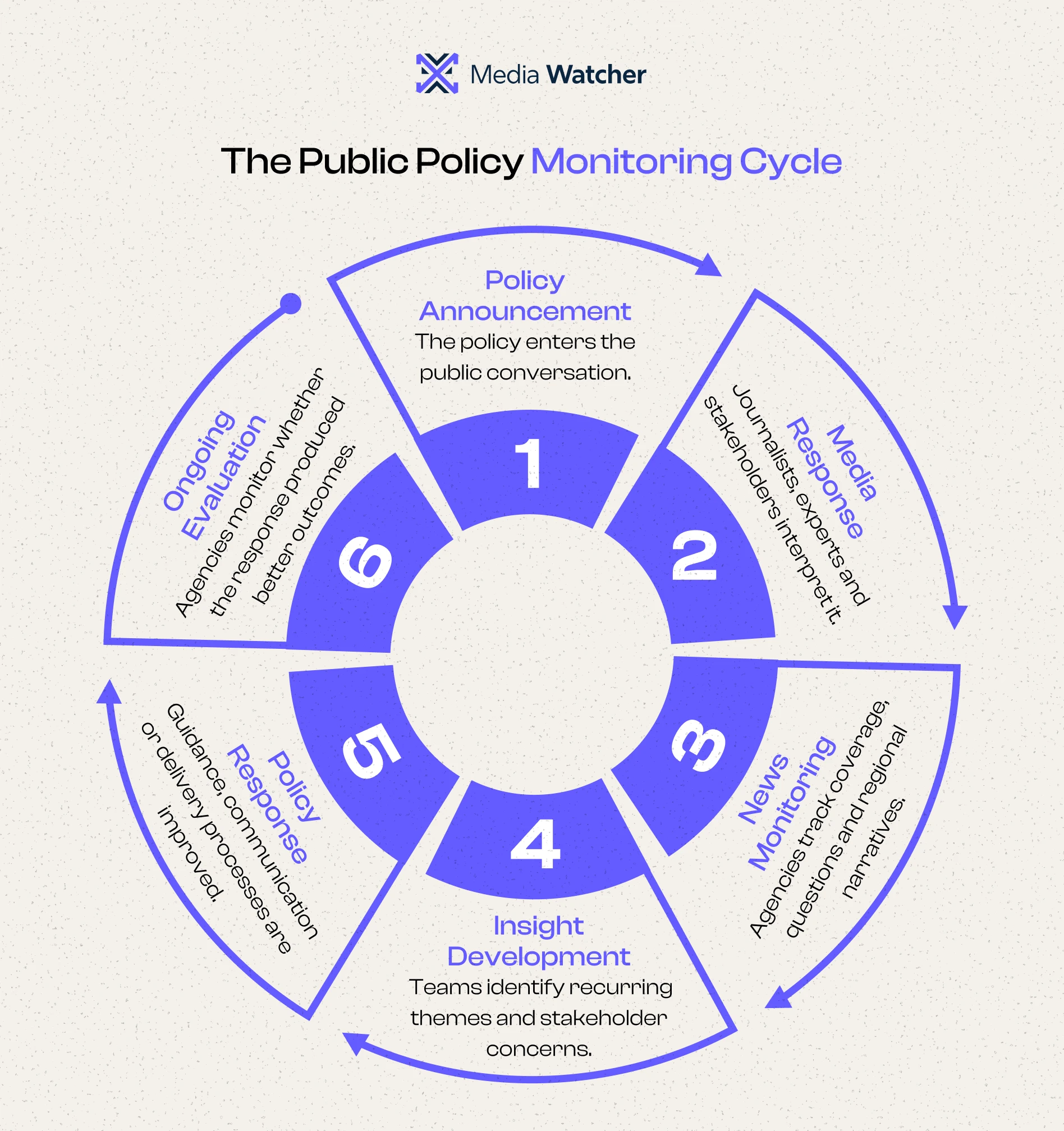
Public policy does not stop at approval. After a policy is declared, government agencies are supposed to clarify the policy, roll it out in different regions, answer questions from the public, and determine if the policy is achieving the desired results.
Official reports, surveys, and administrative data continue to be key in that process. They tend to be delayed in their collection and analysis, however. Government news monitoring gives policy teams a faster view of what is happening between formal evaluation cycles.
Utilizing online news monitoring as well as stakeholder and public opinions, agencies can determine information gaps, enhance communications, and deliver policies in response to public needs.
Here is how government agencies can use news monitoring as a practical tool for policy intelligence.
1. Build a Real-Time View of Policy Conversations
Policies create conversations within national media, regional press, industry, radio, and on the web. If there’s no formal monitoring system, important coverage may become scattered across departments and channels.
Real-time monitoring helps agencies bring these conversations into one view. Teams can follow:
- How frequently a policy is being discussed
- Which topics are receiving the most attention
- Which journalists and organizations are shaping the conversation
- How coverage differs across regions
- Which questions continue to appear
- Whether the overall narrative is changing
This lets policy teams learn what’s happening with the issue, beyond the official communication.
Also, trying to respond to every headline is not the goal. It is to maintain an informed view of the wider information environment surrounding the policy.
2. Improve Public Communication
A policy may be technically correct but fail because people do not understand what it means to them.
Poor communication often shows in news coverage. Journalists may keep asking about eligibility, timelines, costs, responsibilities, or application procedures.
Government agencies can use online news monitoring to identify those recurring questions and improve public guidance.
For instance, monitoring might find that individuals are aware of the program’s goal but are unclear about how to participate. Agencies can then post more explicit and clearer instructions, revise common questions, or target their messages to specific communities that may be impacted.
This turns media monitoring into a feedback loop. The agency communicates. The public and media respond. The agency studies that response and improves the next round of communication.
The UK Government Communication Service recommends monitoring relevant news, online, and specialist channels while evaluating how communication contributes to policy outcomes.
3. Compare National and Regional Experiences
A policy rarely produces the same experience everywhere. Differences in infrastructure, staffing, language, and local administration can influence how a policy is implemented across regions.
National news coverage may focus on overall progress. Local outlets are often better positioned to report practical experiences within individual cities, districts, or communities.
Public sector media monitoring helps agencies compare those perspectives. Policy teams can examine whether certain regions are reporting:
- Slower access to services
- Different interpretations of guidance
- Limited public awareness
- Local capacity constraints
- Higher levels of support or resistance
- Unique concerns among particular communities
These insights can help government departments direct resources, communication or operational support toward areas that need greater attention.
Regional coverage should not be treated as a substitute for local performance data. It can help teams decide where deeper analysis is required.
4. Strengthen Stakeholder Engagement
Public policy affects more than the general public. Businesses, professional bodies, local authorities, charities, community organizations, and frontline workers may all experience a policy differently.
Through public policy news monitoring, government agencies can track how these groups are responding and identify the issues they consider most important.
This creates opportunities for more focused stakeholder engagement. Instead of beginning a consultation with a broad question, agencies can approach stakeholders with a clearer understanding of the concerns already being discussed.
For example, monitoring may show that small businesses are less concerned about the policy objective and more concerned about the reporting process. A government department can then organize discussions around practical implementation rather than reopening the entire policy debate.
News tracking does not replace direct consultation. It helps make consultations more informed and productive.
5. Support Faster Policy Adjustments
Formal evaluations provide important evidence about whether a policy is achieving its goals. Media monitoring can complement that process by identifying emerging issues between formal review periods.
For example, coverage may reveal that applicants are struggling with a digital portal, local offices are interpreting rules differently, or frontline workers need additional guidance.
These signals can support smaller and faster improvements, such as:
- Updating public instructions
- Revising application forms
- Clarifying responsibilities
- Providing additional training
- Extending support to a specific region
- Improving coordination between departments
This makes news coverage for policy makers useful during implementation, not only after a policy has concluded.
Media coverage alone should never determine a policy change. Agencies should compare monitoring insights with administrative data, stakeholder feedback, and operational evidence.
The value lies in knowing where to look sooner.
6. Prepare More Useful Policy Briefings
Government leaders often receive large volumes of news coverage. A collection of links is rarely enough to support a decision. Effective government news monitoring turns coverage into structured intelligence.
A useful policy briefing should explain:
- What changed
- Which issues are gaining attention
- Which stakeholders are involved
- Where the conversation is happening
- Whether the issue is growing or declining
- What may require further investigation
This helps in informing senior officials about the policy and how it is being talked about and experienced.
Briefings on a daily or weekly basis can also assist the communication, policy and operational teams to have the same information. Rather than each department having its own conception of the story that is developing, they can have a shared perspective.
7. Measure Whether Communication Is Working
A lot of time is dedicated to public information campaigns, press briefings, speeches, and stakeholder communication within government agencies.
Tracking news and online media assists teams in determining if those messages are being absorbed and repeated correctly. Agencies can assess:
- Whether key policy messages appear in coverage
- Which explanations do journalists use
- Whether public questions are changing
- Which spokespeople are receiving attention
- Whether incorrect claims are declining
- How communication performs across regions
This moves evaluation beyond simple mention counts.
A policy may generate substantial coverage while the most important message remains absent. Another policy may receive less attention but achieve a strong understanding among the intended audience.
Effective public sector media monitoring focuses on the quality and meaning of coverage rather than volume alone.
8. Make Policy Monitoring More Collaborative
Online news coverage is most valuable when insights are shared across departments. Communication teams may understand the media narrative. Policy teams may understand the legislation. Operational teams may understand delivery challenges. Regional offices may understand local conditions.
Bringing these perspectives together creates a more complete view. Agencies can establish a workflow in which:
- Monitoring teams identify an emerging theme.
- Policy teams assess its relevance.
- Operational teams compare it with delivery data.
- Communication teams determine whether clarification is needed.
- Senior leaders receive a concise recommendation.
This prevents monitoring from becoming a passive reporting exercise. It becomes part of a coordinated policy improvement process.
How Media Watcher Supports Government News Monitoring
Media Watcher is a platform that enables government and public sector organizations to track news, social media, radio, and TV news and podcasts from a single source.
Its real-time news monitoring features let agencies monitor policy discussions, analyze regional news coverage, and determine new stakeholder issues.
Teams can use Media Watcher to:
- Track policies, departments and public institutions
- Monitor regional and multilingual coverage
- Follow journalists, experts and stakeholder groups
- Detect sudden changes in attention
- Analyze sentiment and recurring narratives
- Receive alerts when important issues begin gaining momentum
- Create structured reports for policy and communication teams
Media Watcher integrates digital news monitoring with narrative and stakeholder intelligence to go beyond headlines.
Teams will understand better what the public is saying, what stakeholders are saying, and where to add support to the communication or implementation. For further details, book a demo at Media Watcher and explore more.