

Alpha often hides in the gap between what the market has heard and what it has understood.
The earnings report is the same for all investors. All read the same news. Economic calendars, SEC filings, analyst notes, and breaking news are just a matter of seconds from the fingertips of virtually anyone in the market.
However, institutional investors always find opportunities before they are there. It’s not that they don’t have information; it’s that this is not the kind of information that they have access to.
It is the ability to recognize when scattered pieces of information begin forming a meaningful narrative.
A single regulatory announcement may not move a stock. One customer complaint may seem insignificant. An isolated executive interview may be ignored. However, when these signals begin appearing together across financial news API, regional publications, analyst commentary, and industry media, they often reveal a change that traditional market indicators have not yet reflected.
This is where media intelligence for investors has become one of the most valuable forms of alternative data in modern investing.
Instead of asking “What happened today?,” institutional investors are more frequently asking the question, “What story is beginning to emerge? That’s the small change that is turning into a competitive edge.
Media Intelligence as Alternative Data for Investing
Alternative data for investing is no longer an experimental resource reserved for hedge funds.
According to Lowenstein Sandler’s 2025 Alternative Data Report, 90% of investment firms now incorporate alternative data into their research process, making it one of the fastest growing categories in institutional investing.
At the same time, more reports state that 89% of investment organizations expect their alternative data budgets to remain stable or increase, while AI adoption across investment research continues to accelerate.
These numbers reveal something important. Institutional investors are no longer competing on who has access to more data. They are competing on who can extract better signals from that data.
Media intelligence sits at the center of this evolution because markets are increasingly driven by information that never appears inside financial statements.
- Executive interviews.
- Regulatory discussions.
- Social sentiment.
- Industry publications.
- Political developments.
- ESG controversies.
- Patent announcements.
- Customer feedback.
- Competitor launches.
Individually, these events may appear insignificant. Together, they often explain why prices move before traditional financial models can.
Why Price Charts Only Tell Half the Story
Every price chart answers one question.
What has already happened? Very few explain why it happened.
Institutional investors spend considerable time answering the second question because understanding why allows them to estimate what happens next. Imagine two companies reporting nearly identical quarterly earnings.
Company A sees its stock rally. Company B declines despite similar financial performance. Looking only at financial data offers little explanation. Financial news intelligence provides the context needed to understand why similar financial results can produce very different market reactions.
Perhaps analysts praised Company A’s forward guidance. Perhaps journalists highlighted new customer partnerships. Perhaps regulators announced favorable policy changes for the industry.
Meanwhile, Company B may have experienced increasing negative media coverage regarding supply chain delays, executive turnover, or growing competitive pressure.
None of these factors alone may justify a major valuation change.
Together, they shape market expectations.
Institutional investors understand that markets often price expectations more aggressively than historical performance.
Alpha Comes From Understanding Narrative Momentum
One misconception about media intelligence is that it simply measures positive or negative sentiment.
Professional investors know it goes much deeper. Markets rarely react to a single headline. They react to changing narratives.
Narrative momentum refers to the speed, consistency, and direction of market conversations surrounding a company, industry, or investment theme. Consider how institutional teams evaluate media signals.
Instead of asking, “Is today’s article positive?”
they ask,
- Has coverage volume increased dramatically?
- Are multiple trusted publications discussing the same issue?
- Is executive language becoming more cautious?
- Are analysts adjusting expectations?
- Are regulators receiving increased attention?
- Has sentiment shifted across different regions simultaneously?
These questions reveal whether a story is developing into something capable of influencing future market behavior.
In many cases, the market does not move because one article exists. It moves because hundreds of related signals begin pointing in the same direction. The shift from events to story is the value-added aspect of media intelligence.
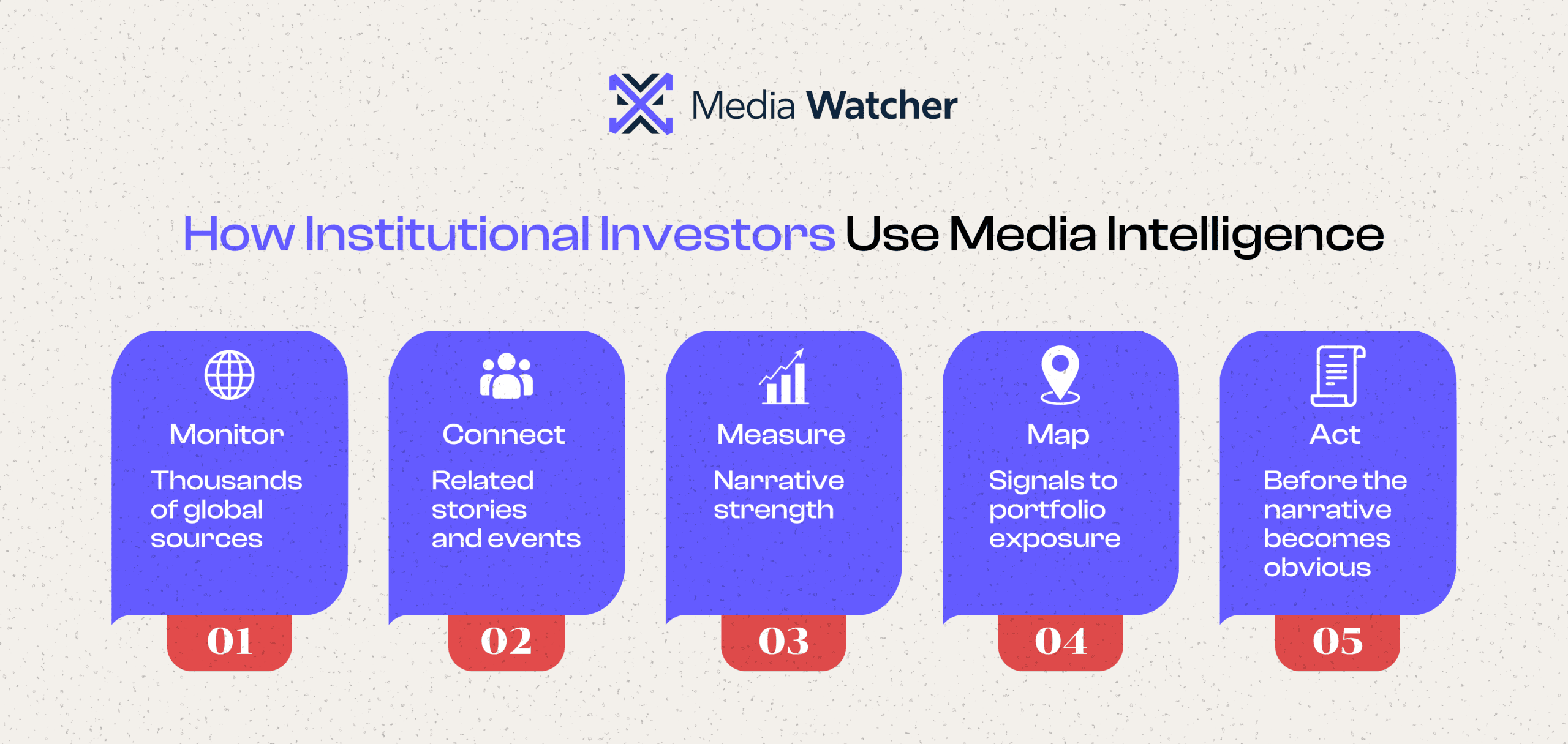
How Institutional Investors Turn Media Intelligence Into Investment Decisions
Institutional investors do not make decisions in light of a single news story. Rather, media intelligence is a step in the larger process of investment research.
A standard workflow looks something like this:
1. Monitor the Entire Information Landscape
Effective investor news monitoring starts with constantly tracking thousands of sources, including financial publications, regional media, regulatory updates, company news releases, earnings call transcripts, analyst notes, industry publications, and trusted online news sources.
The aim isn’t just to grab headlines. Its role is to create a complete narrative of the market’s development.
2. Identify Emerging Themes
Once the data is gathered, AI can be used to categorize it into larger themes.
Instead of viewing hundreds of unrelated articles about semiconductor supply chains, export restrictions, and production delays, investors will start to see one emerging story.
This transition from data to intelligent information enables research teams to identify trends before they become apparent in the broader market.
3. Measure Narrative Strength
Not every story deserves attention.
Institutional investors evaluate questions such as:
- Is coverage increasing over time?
- Which publications are reporting it?
- Are competitors experiencing similar issues?
- Has analyst language become more cautious?
- Are regulators becoming more active?
The more compelling the story, the more it will shape and influence future expectations.
4. Assess Portfolio Exposure
The final step is to connect these stories to real-world portfolio risk.
A company could look healthy on the surface and then be a part of the same emerging narrative with suppliers, regulators, competitors, and customers.
That is where media intelligence is not just a monitor but a system for making investment decisions.
Why AI Has Changed the Game
Modern news intelligence for investors uses AI to organize enormous volumes of unstructured information, connect related developments, and surface signals that analysts may otherwise overlook.
Ten years ago, analysts could manually monitor a handful of publications. Today, that approach is impossible.
Every day generates millions of articles, blog posts, interviews, regulatory updates, earnings transcripts, podcasts, and financial discussions. No research team can process that volume manually.
Artificial intelligence has fundamentally changed how institutional investors approach information. Instead of replacing analysts, AI amplifies their ability to discover patterns hidden inside massive datasets.
According to Exabel’s 2026 Alternative Data Market Report, 94% of portfolio managers and analysts now use AI or machine learning as part of their alternative data research.
This reflects a broader shift in the industry. The competitive advantage is no longer speed alone. It is the ability to identify relationships between seemingly unrelated events.
For example:
- A government consultation in Europe.
- An executive interview in Asia.
- A supplier warning in North America.
- A rise in customer complaints across social platforms.
Individually, these events may appear insignificant.
Together, they can reveal a developing investment risk that traditional financial models have yet to capture.
This is why institutional investors increasingly rely on AI to surface weak signals before they become strong market narratives.
Common Mistakes Investors Make With Media Intelligence
Media intelligence is great, but only when used correctly. Common mistakes may include using market sentiment analysis as a buy or sell signal.
Positive sentiment does not necessarily indicate a good investment, and vice versa. If you are a professional investor, you know that sentiment is just one factor.
Another mistake often made is overpaying attention to headline loudness. If a company is garnering several thousand mentions, it could just be making the news without having any investment impact.
Institutional investors, on the other hand, consider the standard of coverage, the credibility of sources, the coherence of stories, and the prospects for affecting business fundamentals.
Additionally, many investors are only interested in the conventional financial press.
Regional and industry publications, industry news, regulatory announcements, or supply chain reporting can be important signals.
When a story breaks in the global financial press, a lot of the information edge may have been lost.
The Future of Alpha Generation Will Be Narrative Driven
It’s a new era in the investment industry, where financial statements will always be important. Economic indicators will always matter. The importance of valuation models will not change.
But markets now respond to information that is disseminated well in advance of the quarterly report.
That’s why media intelligence is now an integral part of the institutional research process, not an add-on feature.
The firms generating alpha over the next decade are unlikely to be those consuming the most information.
They will be the ones who can read the narratives that are changing more quickly, hear the voice of the information above the background noise, and grasp what it means in terms of market expectations before it is priced into the market.
In a world where everyone receives the same news, the real advantage lies in understanding what the news actually means.
How Investment Watcher Supports Institutional Research
Investment Watcher is tailored for institutional investors, asset managers, hedge funds, research teams, and financial analysts who want to go beyond headline monitoring.
It brings media intelligence for investors into one platform, helping research teams identify meaningful signals across companies, industries, markets, and regions.
The platform constantly processes millions of articles from thousands of sources, providing trustworthy information worldwide and enabling teams to discover new trends, monitor companies and sectors, gauge sentiment, track regulatory changes, and be notified instantly when important events occur.
Not just more news, Investment Watcher turns a massive quantity of public information into actionable investment intelligence, enabling research teams to spend less time finding information and more time figuring out what to do with it for their investment portfolios.