

Financial reports tell investors what a company achieved during the previous quarter. Media signals can show what is happening around that company right now.
A regulatory announcement, investigative report, executive post, or sudden rise in public attention can change market expectations long before the financial impact appears in an earnings statement.
This is why investors increasingly treat media intelligence as a form of alternative data.
Traditional alternative data examples include payment transactions, app activity, and location information. Media based alternative data comes from news coverage, public discussions, regulatory reports, executive statements, and changes in sentiment around a company or industry.
Used correctly, these signals can help investors identify emerging risks, changing narratives, and unusual levels of market attention. They can also produce media sentiment investment signals that support research, portfolio oversight, and investment decision-making.
The following examples of alternative data show how media signals have influenced real investment decisions and market movements.
What Is Media Alternative Data?
Media alternative data is information extracted from public media sources that sits outside conventional company filings and financial statements.
It can include:
- Changes in news and media sentiment
- Sudden increases in company mentions
- Executive announcements and public statements
- Regulatory and legal coverage
- Investigative journalism
- Reputation related stories
- Geopolitical developments
- Public discussions around stocks or sectors
- Changes in how a narrative spreads across countries
Investors can analyze and review these signals to explore whether market perception is improving, deteriorating, or becoming unusually volatile.
Research using four million Reuters articles found that news sentiment could predict future daily equity returns across international markets. The research also found that global news sentiment had a more lasting effect than local news sentiment and influenced prices mainly through the decisions of foreign investors.
Media data is therefore not simply background reading. In certain situations, it can become part of the investment thesis.
For firms exploring alternative data investing, the challenge is not accessing more information. It is identifying which signals are credible, timely, and relevant enough to influence portfolio decisions.
1. A Tesla Tweet Became an Immediate Investment Event
On August 7, 2018, Elon Musk posted that he was considering taking Tesla private at $420 per share and that funding had been secured.
Investors, analysts, and journalists immediately sought more information. Tesla trading was halted during the session. After trading resumed, the company’s share price closed more than 6 percent above where it had been when the first post appeared, according to the SEC’s complaint.
The message was only a few words long, but it created several signals at once:
- A possible ownership change
- A proposed valuation
- Questions about financing
- Regulatory uncertainty
- Rapid media amplification
- A direct response in the company’s share price
This case shows why executive communication must be treated as investment-relevant data.
Investors can no longer monitor only official press releases and scheduled earnings calls. Statements from founders, chief executives, and other influential individuals can change expectations before formal clarification becomes available.
The investment value does not come from labeling every statement as positive or negative. It comes from understanding the context, the credibility of the source, the scale of media amplification, and the potential effect on the company’s valuation or governance risk.
A financial media monitoring platform can help investors identify such statements quickly and track how journalists, regulators, analysts, and market participants respond to them.
2. Cambridge Analytica Changed Meta’s Risk Narrative
In March 2018, reports revealed that Cambridge Analytica had improperly obtained data connected with millions of Facebook users.
The story quickly expanded beyond a privacy incident. It raised questions about Facebook’s governance, data controls, regulatory exposure, and long-term relationship with users.
Facebook shares closed nearly 7% lower on the first trading day after the Cambridge Analytica revelations, wiping almost $40 billion from the company’s market value.
Reuters later reported that the stock lost around 18 percent over the seven trading days following the outbreak of the scandal.
Several different media signals developed simultaneously:
- Negative media sentiment accelerated
- Privacy concerns moved into mainstream discussion
- Political and regulatory attention increased
- The company’s response became part of the story
- The narrative spread across multiple countries
- Calls to delete the platform gained visibility
For investors, this was a reputation story that evolved into a governance and regulatory risk story.
That distinction matters. Consumer frustration may be temporary. A narrative that begins affecting regulation, business practices, and investor confidence has a greater chance of influencing long term valuation.
Media intelligence can help investors observe that transition by tracking how topics, media sentiment, and risk categories change as a story develops.
3. Wirecard Showed the Investment Value of Investigative Reporting
Wirecard offers a different type of media alternative data example.
For years, journalists, analysts, and short sellers raised questions about the German payment company’s accounts and overseas operations. Reports based on whistleblower information highlighted potential accounting inconsistencies well before the company’s collapse in 2020.
A 2016 research report accusing Wirecard of fraud and money laundering caused its shares to fall by more than one fifth in a single day. Several short sellers had already positioned themselves for a decline.
Investigative reporting continued. The Financial Times published further findings related to Wirecard’s reported sales and profits. A later forensic investigation by KPMG was unable to verify substantial parts of the company’s reported business.
After Wirecard collapsed, European authorities identified serious weaknesses in the supervision and enforcement of its financial reporting.
The case demonstrates why investors should not evaluate a report in isolation. More useful questions include:
- Is the reporting supported by documents or named sources?
- Are similar allegations appearing repeatedly?
- Is the company answering the central questions?
- Are regulators beginning to respond?
- Is the story spreading to more authoritative publications?
- Does the company’s media response resolve or deepen uncertainty?
Wirecard also highlights an uncomfortable truth. A media signal can be important even when regulators or the broader market initially dismiss it.
How Investors Can Turn Media Coverage Into Alternative Data
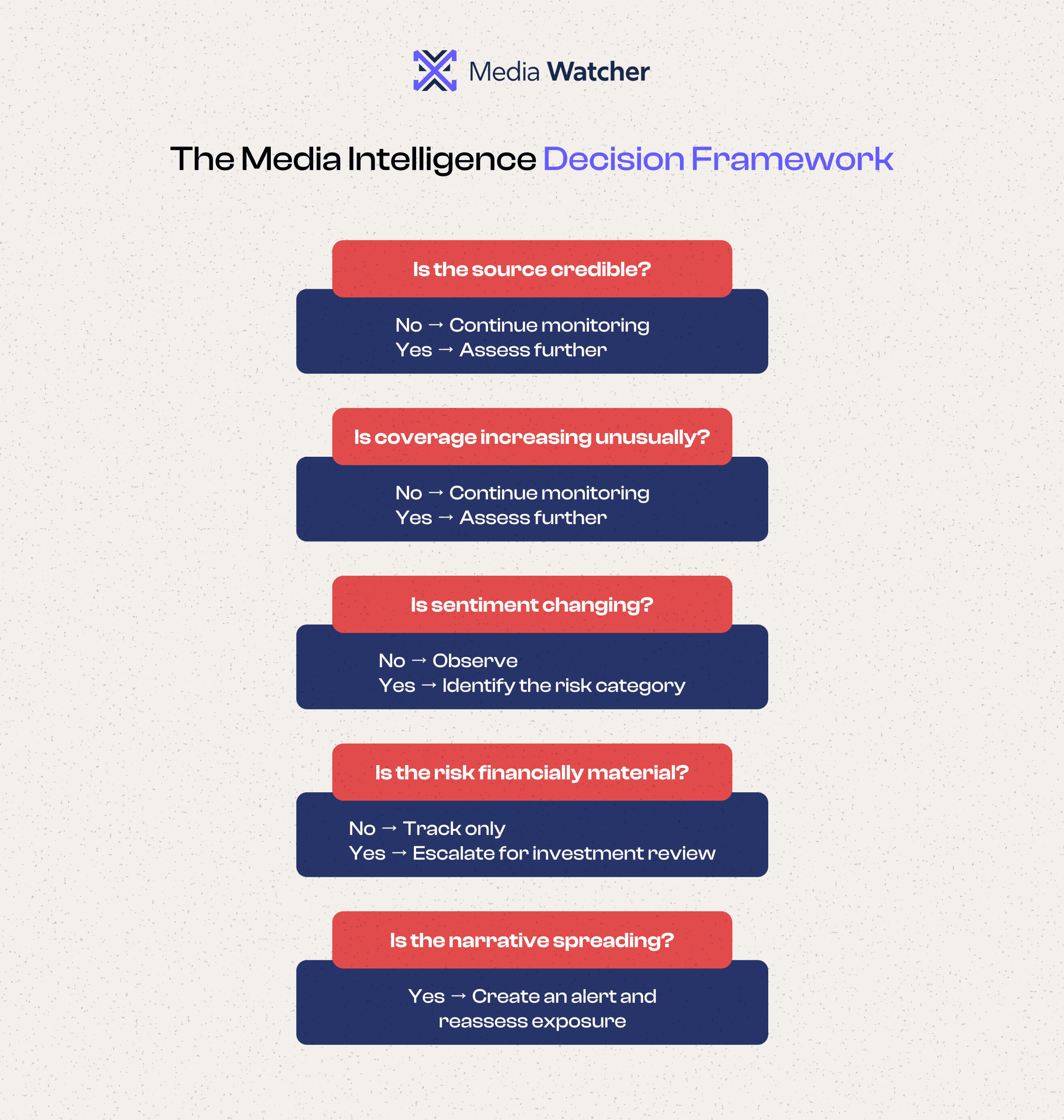
The objective is not to react to every headline. That approach would produce more noise than insight. Investors need a structured process for evaluating media sentiment investment signals and determining whether a development deserves further investigation.
Monitor attention against a baseline
A sudden increase in coverage matters more when compared with the company’s normal level of attention.
Ten articles may be routine for a global technology company but highly unusual for a small listed business.
Measure how sentiment is changing
An isolated negative story may have limited importance. A consistent deterioration in sentiment across credible sources can indicate a deeper shift in market perception.
Track the underlying risk theme
The distinction between operational issues, legal action, sanctions, governance issues, consumer backlash, and general geopolitical risk should be made by the investors.
Two companies can have the same amount of adverse coverage and have vastly different financial risks.
Identify where the story started
The original source can affect credibility and market impact. A claim from an anonymous account should not be treated like a regulatory notice, court document, or investigation from a trusted financial publication.
Watch how the narrative spreads
A story can move from a specialist publication to national news, international media, and finally regulatory discussion. That progression may be more meaningful than the initial sentiment score.
Connect companies with sectors and events
A major development rarely affects only one organization. Regulatory action against one bank may change expectations for its peers. A geopolitical conflict can simultaneously affect airlines, energy companies, defense businesses, and commodity markets.
Effective portfolio monitoring tools should help investors connect company-specific stories with broader sectors, countries, supply chains, and investment themes.
Where Investment Watcher Fits
Investment Watcher can convert a vast amount of media coverage into structured signals that investors can dig into. As a financial media monitoring platform, it allows users to track companies, executives, sectors, countries, and investment themes across global media sources.
Users can track companies, executives, sectors, countries, and investment themes in global media sources. They can filter results by country and language, analyze sentiment, review historical coverage, and set alerts for significant developments.
This supports several investment use cases:
- Identifying unusual increases in company coverage
- Detecting changes in sentiment before scheduled reporting
- Monitoring reputation and governance risks
- Following regulatory and legal developments
- Tracking geopolitical events across exposed sectors
- Comparing narratives across countries and languages
- Investigating the sources driving a market story
- Creating alerts around portfolio companies and watchlists
Investment Watcher does not replace financial analysis, and it does not turn every headline into a trading recommendation.
Its value lies in helping investors see which narratives are emerging, why they matter, and where further investigation may be required.
Media Signals Need Context, Not Blind Trust
Alternative data is powerful because it can appear earlier than traditional financial information. That speed also creates risk.
Media coverage can contain errors, duplicated stories, rumors, biased commentary, and temporary public reactions. Sentiment may reflect emotion rather than a lasting change in company fundamentals.
Investors should therefore combine media signals with:
- Financial performance
- Valuation analysis
- Regulatory documents
- Company disclosures
- Source credibility
- Historical context
- Portfolio exposure
The goal is not to trade every change in public mood. It is to detect developments that conventional datasets may not yet reflect.
From Headlines to Investment Intelligence
Tesla, that demonstrated the immediate influence of executive communication, while Wirecard proved that investigative reporting can expose risks long before a company’s official collapse. However, these alternative data examples share one lesson.
Media is no longer just where investors read about the market. It is part of the data that shapes the market.
By analyzing sentiment, attention, risk, and the development of narratives across media worldwide, Investment Watcher empowers investors to go beyond the headlines. This makes it easier to learn when the story is regular information and when it could possibly be a starting point for a substance investment signal. Book a demo or visit the website to explore more