

A malfunctioning CrowdStrike software update caused the shutdown of 8.5 million Windows devices worldwide on a random day of July, 2024. In a few hours, news of the operation’s failure was spreading across the web, including digital communities, financial media, and social platforms.
CrowdStrike’s stock dropped 11% that day, then another 13.7% in the days that followed. Equity analysts who followed that media story as it unfolded had a time to make up for in hours.
Those who depend solely on the pricing data provided by their terminals had already seen the damage done and incorporated it into the prices.
Thus, every guide to building your own Bloomberg Terminal alternative will advise you on where to find structured data. However, no one will tell you what is still missing once you buy them.
What is the Bloomberg Terminal?
Institutional finance has used the Bloomberg Terminal, a proprietary software platform, as the default data and analytics platform since 1981.
It is an all-inclusive solution for traders, portfolio managers, and analysts that combines real-time pricing, company fundamentals, earnings estimates, sell-side analysis, economic data, and a proprietary messaging system.
It is used by over 350,000 professionals each day, including investment banks, hedge fund managers, and asset management firms.
The richness of structured financial data, the velocity of proprietary news, coverage of fixed income not available on numerous platforms, and an internal chat network built into institutional workflows are all part of Bloomberg Terminal’s real assets.
Those capabilities are the standard for high-frequency execution desks and deep fixed-income strategies.
Why Do Analysts Need a Bloomberg Terminal Alternative?
The following are the three factors that drive the shift. Let’s explore:
Cost
At upwards of $24,000 per user per year, Bloomberg Terminal is priced for large institutional desks. A two-seat desk with a minimum two-year contract obligates more than $96000 prior to performing even one query.
Interface
The use of command codes in the Bloomberg platform reflects its 1980s heritage. It requires months to master and is not compatible with today’s data flows, API systems, and Python programming for research.
Data Gaps
At full cost, Bloomberg does not include the narrative developed by the media that would be created around a ticker until it gets to institutional pricing.
That is a structural gap. To equity analysts who are interested in what the market is telling them about a holding, rather than what its price is telling them, no extra money on Bloomberg can get them through.
Thus, these are the three bases why rebuilding the stack has become commonplace.
The “Pick and Mix” Works, But It’s Not Enough
The case for building your own Bloomberg Terminal alternative is well established. The consensus among financial analysts who have rebuilt their stacks is clear: most desks need two or three specialized tools that handle specific jobs better than a single all-in-one terminal can.
That logic is sound. The problem is what those guides tell analysts to buy, and what they consistently leave out.
The Layer Every Guide Forgets
In normal build-your-own terminal instructions, a row is designated for media narrative intelligence. The category is optional or uncovered and is assumed to be found in a standard market data terminal news feed. It is neither.
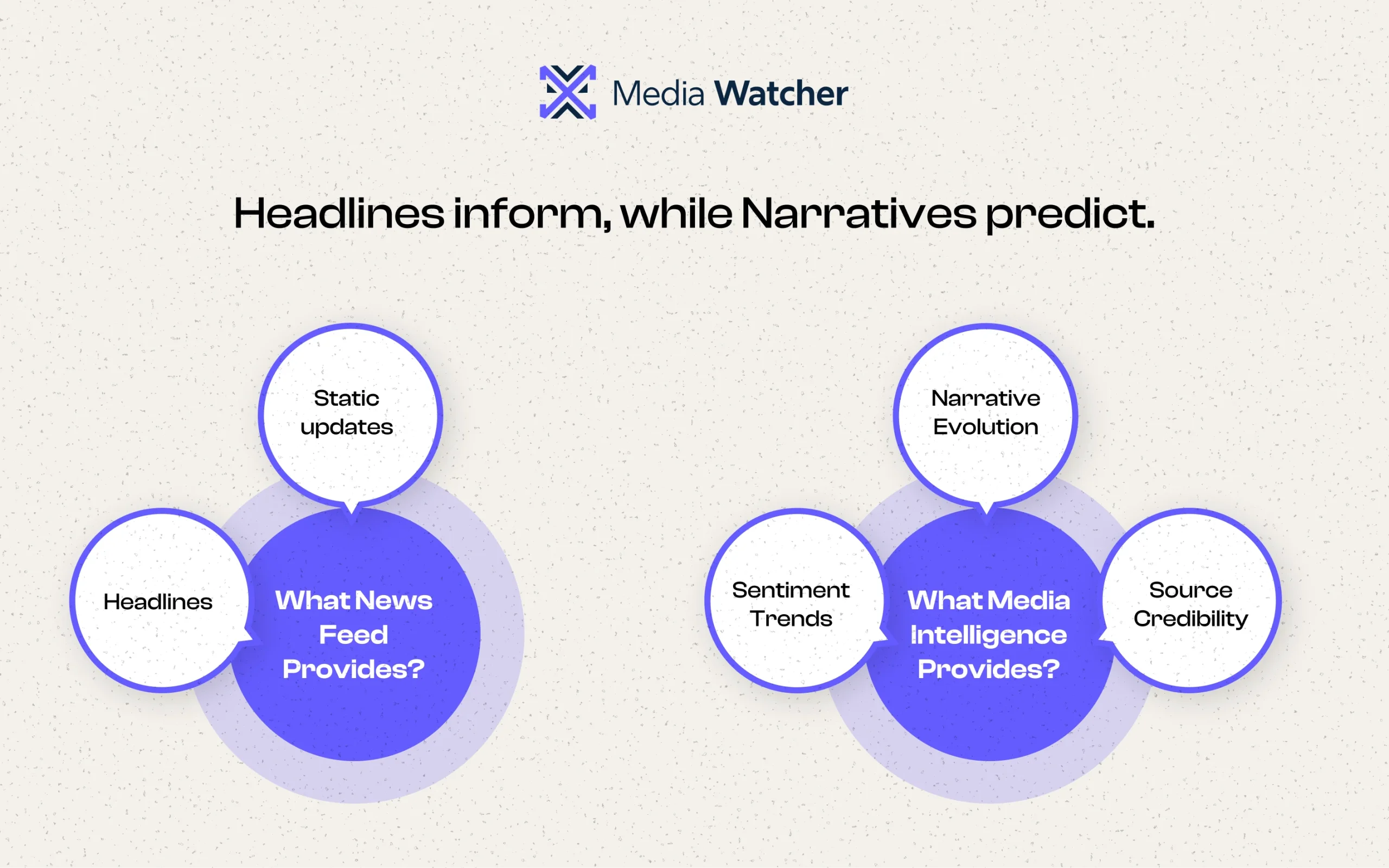
A news feed surfaces headlines. Media intelligence will tell the narrative unfolding around a ticker, the trend of opinion, the source’s credibility, and the surge in volume compared to normalcy that precedes the release of that story on the second media outlet.
They are not similar, and the difference between them is in the line, where positions change against analysts who do not follow it.
In the initial study by Baker and Wurgler in the Journal of Finance (2006), the results show that investor sentiment predicts the subsequent cross-sectional stock returns. It is a process whereby media forms create narratives; investors follow them; prices change at the end.
Conventional financial data providers provide price movements for all alternative products available on the Bloomberg Terminal. Such data sources never disclose narratives that lead up to prices.
Given that, in 2024, there was a 33 percent increase in the number of alternative data purchases made, and investment management firms have already committed at least $2.5 billion to purchasing alternative data, and 95 percent of respondents who plan to purchase alternative data indicated they will spend more of their budget, media sentiment is not to be overlooked.
Reasons Why Narrative Moves Before Price
Three documented cases show the same pattern.
A recent example from 2024 is the CrowdStrike outage in July. The story of the operational failure was leaked and disseminated across financial media and tech websites within the first two hours of the incident.
By the time most of the formal analyst notes were released, the stock had plummeted 11% before the day was over.
The cumulative reduction in stock between the equivalent days in the day before the outage and in August was over 36%. The media discourse was created initially. The price followed.
“In the case of GameStop’s short squeeze in early 2021 on Reddit’s WallStreetBets, the stock price went from around $20 to $483. It was before many institutions’ trading desks even understood what was going on, with the narrative driving the price once again.”
And in the case of Bud Light in the first half of 2023, the same exact process took place: the social media story plummeted sales by 25%+ over several weeks, and brand sentiment versus fundamentals in the press prior to disclosed earnings.
In both instances, the media discourse was created and propagated. Following the price data.
“The narrative precedes price. The question for any analyst is whether their current stack surfaces that narrative in time.”
In a study conducted back in 2022, the hedge funds that utilized and researched social media data enhanced their ability to forecast short-term with a maximum of 15%.
A standard Bloomberg Terminal alternative stack, however well assembled, does not include this layer. That is the gap a research desk carries forward when it rebuilds its stack without it.
How Investment Watcher Completes the Stack
Investment Watcher is not a replacement for any tool in the standard stack. It is the row that the stack is missing. It sits on top of whatever fundamental and technical platforms an analyst already uses, adding the media narrative layer those platforms do not provide.
The solution is designed on Media Watcher’s infrastructure: 100,000+ sources monitored in real time, media alerts delivered within 200 milliseconds of publication, coverage across more than 80 languages and 235+ regions.
That latency figure is not a marketing claim. It is the difference between receiving a narrative signal before a story reaches a second outlet versus after the desk across the street has already read it.
For equity analysts, the workflow is direct:
Portfolio Builder
Add up to 15 tickers. The Investment Watcher monitors media coverage, change of sentiment, and interest for each stock in real time. Pricing and fundamentals remain in the current terminal. Narrative signals emerge from this space.
With Influence Weighting
Not all coverage carries the same signal weight. A story breaking on a tier-1 financial services outlet carries a different weight than the same story picked up by aggregators.
Investment Watcher’s Influence Score distinguishes between the two automatically, so analysts are not reacting to volume noise.
Fear And Greed Index
A live composite of US market-wide sentiment on a 0 to 100 scale (Extreme Fear to Extreme Greed), with historical comparison against one week, one month, and one year ago.
When the macro reading diverges from ticker-level narrative signals in a portfolio, that divergence is a context layer no standard stack currently provides.
Stock Screener With Narrative Overlay
The Fundamental, Technical, Descriptive, and ETF tabs operate much like any other screening tool. The key distinction is what sits above them: live media-narrative context provided by Investment Watcher for each and every ticker a portfolio manager selects.
Integration with APIs and RSS means Investment Watcher connects directly to your data flow without disrupting it. Quantitative workflows can also leverage the narrative context in their programming.
Therefore, if your investment process does not provide media narrative context before getting to institutional pricing levels, it is not a deficiency of the software. It is in the layer above it. Book a Demo to see how Investment Watcher adds that layer to your existing stack.