

Every morning, thousands of traders sit down to the same overwhelming reality: a flood of headlines, analyst commentary, social media alerts, and breaking news stories all competing for attention before the opening bell. For anyone involved in day trading news is not optional; it’s the oxygen of every trade. But here’s the uncomfortable truth most trading guides skip: the vast majority of that information doesn’t matter at all.
The real skill is not consuming more market sentiment news. It’s knowing which 5% of the news cycle actually has the power to move prices and filtering out the rest before it wastes your time or, worse, triggers a bad trade.
Why Most Financial News Is Background Static?
Market news comes in cycles. There is news about earnings releases, central bank statements, geopolitics, industry analyst upgrades, management commentaries, and macroeconomic data releases, and the list goes on. But experienced traders understand that the market doesn’t react equally to all of it.
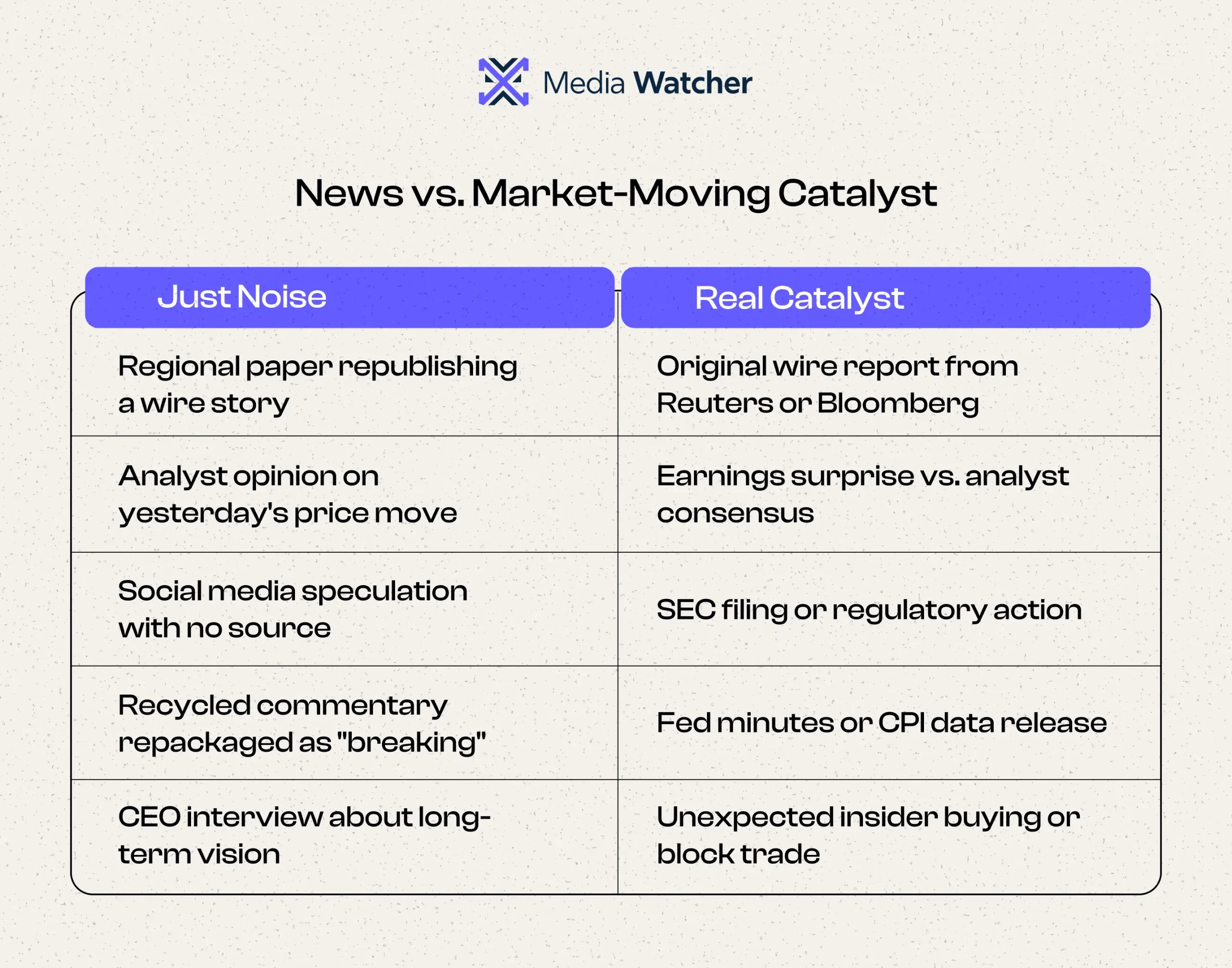
A price move needs two elements to operate together: a piece of news that takes the market by surprise, and enough number of traders to act upon the news simultaneously. News confirming the market’s expectation? It’s noise. The one contradicting the market’s expectations? It’s a catalyst.
The problem is, noise and signal are almost indistinguishable. A CNN headliner at 9:15AM and an SEC filing at the same hour can be on your screen simultaneously – the first being potentially a 4% mover, while the latter not having anything whatsoever to do with the stock price. With no framework and the proper instruments, the average trader will rely solely on his gut feeling, thus making a mistake.
What Kind of News Actually Moves the Market
Understanding what qualifies as high-impact information is step one. In practical terms, real-time trading news that consistently moves markets falls into a few categories.
Earnings surprises are the most reliable price movers. When a company beats or misses analyst consensus by a meaningful margin, especially revenue guidance versus backward-looking profit numbers, markets reprice fast. Traders who wait for the headline to process miss the first wave entirely.
News about macroeconomic data, inflation numbers, payrolls, GDP changes, and Federal Open Market Committee minutes has the power to turn an entire industry on its head within moments. This news is periodic and very important.
Regulatory actions and legal developments often catch retail traders off guard. An FDA approval, a DOJ investigation, a surprise tariff announcement, these are the wildcards that generate outsized intraday moves precisely because they’re harder to anticipate.
Insider purchases, bulk transactions, and option activity should not be considered news, perhaps, because they are signals of trade. However, the smart money always makes tracks, and interpreting those tracks requires its own special skill set.
What unites all of these? They all represent a genuine shift in the information landscape, a reason for participants to re-evaluate their positions. Noise, by contrast, is commentary: analysis of what already happened, predictions about what might happen, opinion dressed up as insight.
Why You Can’t Keep Up With Market News Manually Anymore
Here’s where modern-day trading news analysis gets complicated. Even if you understand exactly what kind of news moves markets, reading and categorizing every story by hand is humanly impossible at the speed markets move today.
Algorithmic trading systems and institutional desks have been using financial news API integrations for years, pulling structured data, applying natural language processing, and acting on news events before most retail traders have finished reading the headline. The latency gap between “headline published” and “price moves” is now measured in milliseconds for high-frequency players and in seconds for anyone using a modern news sentiment analysis API in finance applications.
This is why the infrastructure behind your news consumption matters just as much as the news itself. A trader relying on a browser tab and a Twitter feed is structurally disadvantaged compared to one using a platform that delivers pre-filtered, sentiment-scored, ticker-tagged news in real time.
What Effective News Filtering Actually Looks Like
Good filtering is not about reading less but reading more intelligently. What experienced day traders use, consciously or unconsciously, boils down to some principles of good filtering.
Source hierarchy: Some sources have more weight in the market than others. Stories coming from wire services like Reuters, Bloomberg, and Dow Jones can trigger a move. A story that gets published in some regional paper but was originally published by Reuters does not. Source-based filtering alone will reduce noise significantly.
Ticker relevance: Any piece of news that does not mention the ticker(s) on your watchlist, its suppliers, its competitors, and the regulatory environment they operate in counts as background. News services that do tagging by ticker and industry sector do much of the filtering already.
Sentiment velocity: One bad story about a stock market news is not enough for a decision. Several bad stories about a stock appearing within half an hour time window, preferably by different media companies, is a different story altogether. This is where the news sentiment API comes in handy. These tools can see something you would have otherwise missed.
Relative timing in relation to catalysts: Morning news is treated differently from afternoon news.
How to Build a News Filter That Actually Works for You
Though one might have the proper tools, it can take time for individuals to build a discipline of personal filters. Some tips that expert traders follow:
Always perform a news check before beginning the session. It should be a check for news categories, such as catalysts, earnings, economic indicators, and regulatory news. Determine whether the news is really fresh information or opinion.
Use tickers on your feed. All good feeds of news or financial news API offer filters based on tickers. You don’t have to go through all the market news if your portfolio includes only five tickers.
Social media should be used as a tool for gauging public sentiment. While discussions among retail investors on financial discussion forums and social media sites show market sentiment news, this is actually a lagging indicator of how smart money has already behaved.
Finally, track your news-to-trade correlation. After every session, log which news items you acted on and whether the anticipated price move materialized. Over time, patterns emerge in certain source types, story categories, or sentiment scores that consistently translate into real movement for the stocks you trade.
How Does Investment Watcher Help You Make Sense of Day Trading News?
This is exactly the problem that Investment Watcher is built to solve. Rather than asking traders to manually sift through hundreds of daily stories, Investment Watcher functions as an intelligent layer between the raw news feed and your decision-making process.
As a platform designed around real-time trading news delivery and market sentiment news analysis, it aggregates content from across financial media, applies AI-driven sentiment scoring, and surfaces only what’s genuinely relevant to the assets you’re watching. Think of it as the signal-to-noise filter that runs before the story ever reaches your screen.
For traders who rely on a financial news API to power their strategies, whether they’re building systematic approaches or refining discretionary decision-making, Investment Watcher provides structured, actionable data rather than raw information. The platform’s news sentiment analysis capabilities let users gauge whether coverage of a specific stock is trending positive or negative, how quickly sentiment is shifting, and whether institutional commentary is diverging from retail-facing headlines.
In a trading environment where being three seconds early or three seconds late to a catalyst can mean the difference between a profitable entry and chasing a move, that kind of pre-filtered, scored intelligence isn’t a luxury; it’s table stakes.