

Every PR person will have a time when they open up their inbox in the morning, only to get a forwarded clip sent by a colleague telling them, Did you see this? It was broadcast last night. It spoke of your brand. And you had no idea.
That is precisely what broadcast monitoring services are designed to address. But like any tool, they come with real capabilities and limits. This breakdown will enable you to see both sides of the coin when assessing the alternatives or attempting to squeeze more out of your existing configuration.
What are Broadcast Monitoring Services?
Broadcast monitoring is the scientific procedure of tracing, recording, transcribing, and analyzing the content that is being aired on television, radio, and on digital streaming platforms. A broadcast monitoring system records airtime in real time, adds a keyword or entity index, and provides appropriate clips, transcripts, and analytics to end users.
The modern broadcast monitoring software usually includes:
- Live and archived television news (national and local)
- Radio broadcasts on AM, FM, and digital stations.
- On-demand audio and podcasts.
- Online video streams from broadcast affiliates
- Online simulcasts of conventional broadcast material.
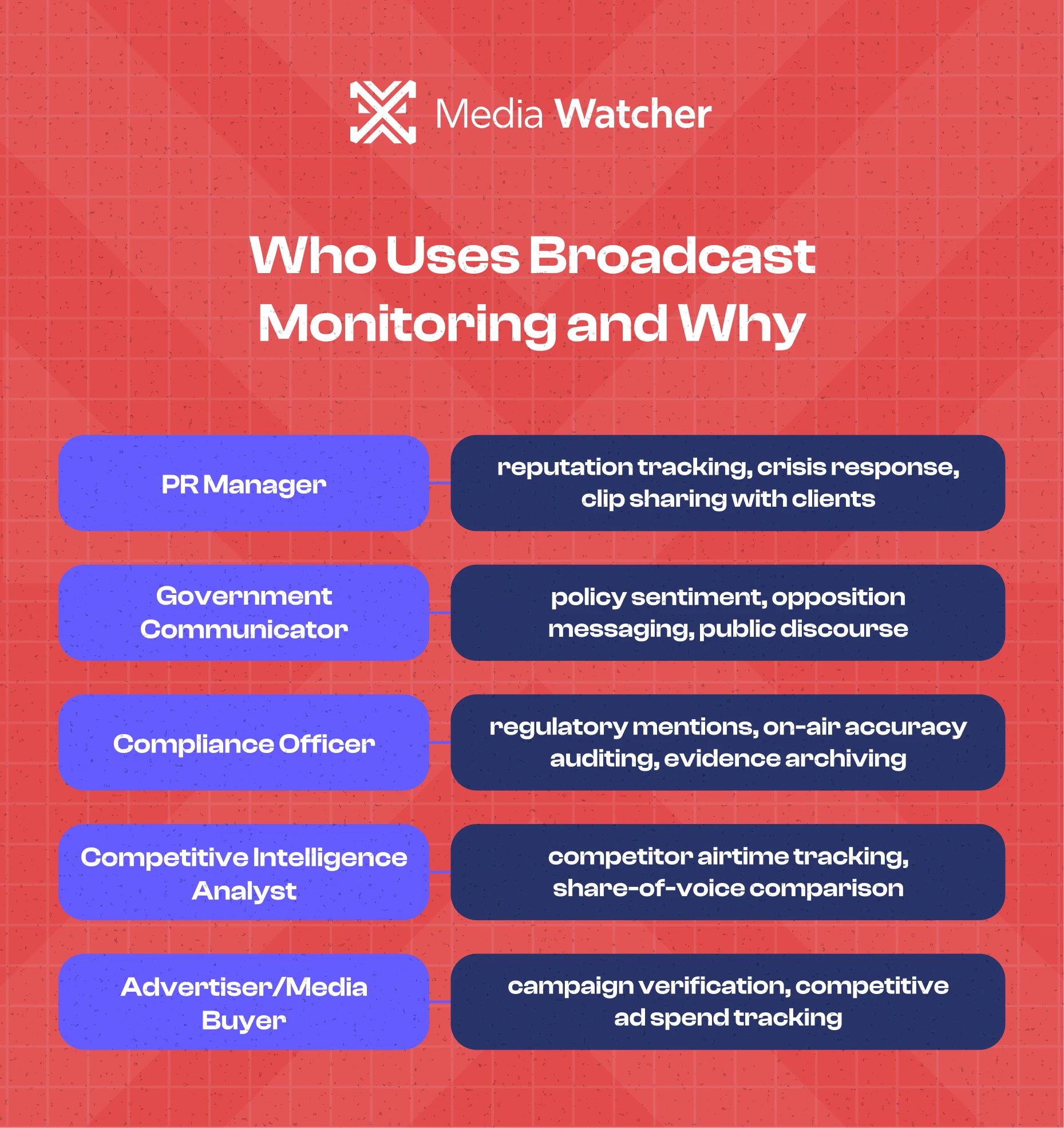
The spectrum of the use cases is broad. Broadcast monitoring is used by PR firms to gauge client coverage and deal with reputation crises. It is utilized by government agencies to track their policies and to understand the opinion of the population. The advertisers are keeping a check on their campaigns in terms of competitive intelligence. It is used by compliance teams to check regulatory compliance on-air.
What Broadcast Monitoring Services Cover
Real-Time TV and Radio Tracking
Missing a live mention used to mean waiting for someone to tip you off. Today, broadcast monitoring services capture content the moment it airs across thousands of TV and radio channels, local and international, simultaneously. The better platforms don’t just flag a mention; they deliver the full transcript, timestamp it, and tell you exactly who said it.
AI Transcripts and Speaker Attribution
This is where things have changed dramatically. Older systems leaned heavily on closed captions, which sounds fine until you realize how often captions are inaccurate, delayed, or missing entirely on regional channels. Modern broadcast monitoring software uses speech-to-text AI that works directly from the audio, producing searchable transcripts that are far more reliable. Speaker attribution takes it a step further, separating individual voices even in fast-moving panel discussions. For compliance unit and competitive analysts, that attention to detail makes a real difference.
Topic and Sentiment Classification
A mention is not just a mention. The same brand name can appear in a glowing feature or a crisis investigation, and those two things could not be more different. Broadcast monitoring tools with built-in sentiment analysis make that distinction automatically, tagging coverage as neutral and favorable in real time. Topic classification adds another layer, sorting content by theme: finance, health, politics, corporate news, so your team is not wading through unrelated clips to find what actually matters.
Media reach and Podcast Coverage
Knowing a mention happened is one thing. Knowing it reached three million viewers during primetime is another. Solid global broadcast media monitoring platforms attach audience reach data, viewership figures, market ratings, and AVE directly to each clip, so you can quantify impact without running separate calculations.
Podcasts have acquired their position in this conversation, too. Long-form audio is now a serious channel for news, opinion, and industry discourse. Any broadcast monitoring tool worth consideration in 2026 should be indexing podcasts alongside traditional broadcast, not treating them as a second thought.
Historical Search and Multi-Channel Reporting
Not everything is about today. Regulatory reviews, litigation support, and campaign audits all need access to archived content. The strongest platforms hold months, sometimes years, of searchable broadcast history, and pull it all into a unified dashboard alongside news, social, and print. One view, all channels, no switching between tools.
What Broadcast Monitoring Services Miss
No broadcast monitoring tool has flawless coverage, even though it has made tremendous progress. These gaps are important to understand and to help design a monitoring strategy that will not leave you blind when it counts the most.
1. Non-Captioned and Regional Channels
Most broadcast monitoring systems are built on closed-captioning data and speech-to-text transcription. There is a longstanding blind spot in channels that fail to offer reliable captions, especially regional, community, and international channels in less widely-spoken languages. Although this gap has been decreased with AI-based transcription, coverage of hyper-local or low-resource language broadcasts is still uneven.
Companies that have a huge stake in emerging markets or non-English speaking countries should particularly examine the coverage of a platform in the respective geographies to commit.
2. Non-Verbal and Visual Content
Broadcast monitoring services track the spoken word and on-screen text, but most still struggle with purely visual brand exposure. A product placement, a logo visible in the background of a set, a sponsored graphic on a sports broadcast, these forms of coverage are largely invisible to keyword-based monitoring systems.
Some platforms are beginning to integrate visual AI (logo recognition, object detection) into their monitoring stacks, but this capability remains nascent for most providers. If visual brand exposure is a key measurement need, supplementary image and video analytics tools may be required.
3. Pay-TV and Encrypted Streams
Content behind paywalls, subscription packages, or encrypted broadcast streams is frequently excluded from standard monitoring coverage. Premium cable channels, regional sports networks, and certain international satellite broadcasts may not be indexed by even the largest platforms. Organizations that know their coverage skews toward premium or niche pay-TV content should verify specific channel availability with any provider before purchase.
4. Real-Time Gaps in Rapidly Evolving News Events
While broadcast monitoring platforms strive for real-time delivery, there is always a processing latency between when content airs and when it appears in a platform’s search results. For most routine monitoring, this gap is acceptable. In fast-moving crisis situations where every minute of response time counts, even a 5–15 minute indexing delay can be significant.
5. Context Without Human Judgment
AI-powered sentiment analysis and topic classification are powerful but imperfect. Sarcasm, irony, cultural nuance, and complex narrative context can trip up automated systems that assign sentiment scores based on surface-level language patterns. A story that is technically “positive” in tone may carry implicit reputational risk that an algorithm misses entirely.
The most effective media teams treat broadcast monitoring data as a starting point, not a conclusion, combining automated alerts with editorial judgment, especially for crisis and compliance use cases.
How to Choose the Best Broadcast Monitoring Services
The right choice in broadcast monitoring software can be made based on matching its capabilities with the requirements of the organization. Among other things, the following factors should be considered:
Coverage range: In what countries and in how many languages is the broadcasting monitored? The provider should confirm its capability of indexing broadcasts in your priority markets, especially considering the need for global media monitoring.
Transcription accuracy: Test the ability to transcribe speech into text in your priority languages and formats. Pay particular attention to the difference between AI and caption-driven transcription.
Mention alerting delay: How soon after an airing does the software send alerts? An extremely important consideration for organizations sensitive to crises, with a sub-minute delay making a huge difference.
Speaker detection: Does the tool detect individuals speaking? Crucial for analysis of earned media, competitive intelligence, and executive profiling.
Sentiment and classification capability: Can the tool discern sentiment towards issues in different languages and contexts? Is it able to classify issues that affect your organization?
Workflow compatibility: Does the tool integrate with your CRM, reporting, and collaboration solutions? Can reporting be done automatically?
What Makes Media Watcher the Right Broadcast Monitoring Tool for the AI Era?
Media Watcher provides an attractive solution to organizations that require a broadcast monitoring solution that extends across all of these dimensions without the discontinuity of integrating multiple tools.
Media Watcher’s broadcast monitoring capability delivers real-time tracking of global TV networks, local channels, live events, and online streams. Its AI-driven transcription engine generates searchable, speaker-attributed transcripts with timecodes for every monitored segment. Sentiment analysis can operate in 80+ languages and 235+ countries, which is why it is one of the truly global broadcast media monitoring platforms on the market.
It is not a broadcast-only platform. Media Watcher integrates broadcast intelligence with monitoring across 100,000+ global sources, including social media, online news, podcasts, and forums, all within a unified dashboard that supports real-time alerts, AI executive summaries, and role-based reporting.
For PR teams managing brand narratives across markets, compliance teams tracking regulatory exposure, government communicators monitoring policy coverage, or enterprises needing a full-spectrum media intelligence command center, Media Watcher’s broadcast monitoring suite is designed to close the gaps that legacy tools leave open.