

The earnings release is out at 4:05 PM. Fifteen minutes later, Bloomberg has a lede filed, the finance Twitter world has taken a stance on a take, and the article is half-written before people even open the PDF to read the release.
By the time your research note comes out in the morning, the trade has already happened. Everyone gets the same release at the same time, no exceptions or early access. So the edge has never been about who gets the data first. It’s always been about who reads it better and faster.
The analysts who respond accurately within minutes aren’t lucky; they’ve trained themselves to cut through the noise and find the number that actually matters, before the crowd figures out which number that is.
That’s the real skill: knowing how a specific figure will land with the market before the market has reacted to it. Not just reading earnings, but reading what investors will do with those earnings through the market sentiment analysis platform.
“FactSet’s Q1 2026 Earnings Insight revealed that S&P 500 earnings increased 13.0% year-over-year, marking the sixth consecutive quarter of double-digit growth. That’s a great backdrop, and a great backdrop does not hurt stock prices.”
A beat doesn’t move a stock on its own, not when expectations were already priced in. What moves it is the conversation that forms around the beat: the guidance management gave, the segment that quietly missed, the CFO’s tone on the call.
Whoever frames that conversation first tends to be right about where the stock goes next.
What Does Earnings Season Monitoring Mean?
The tracking, evaluation, and reaction to publicly traded companies’ quarterly financial reports is called earnings season monitoring.
This is usually the time, in January, April, July, and October, when key parameters such as sales and earnings per share are evaluated. Earnings season sentiment analysis assesses the financial position and growth prospects of companies, and, as a result, stock market volatility is significant.
Why Tone Moves Markets More Than Numbers
“Alexandria Technology used more than 15 years of earnings call transcript data to find that companies that communicated in a neutral to positive way did better than the S&P 500 by at least five percentage points per quarter on average.
When companies used more negative language, their performance dropped by the same amount, even when the results were better than expected.
You should know that even if you beat EPS expectations, the stock price could still go down. The spreadsheet may not show how the market will react to the call.
A 2025 Financial Review paper took this further, examining what researchers called “Tone Distance”, the degree of variance in tone between different managers on the same call.
Greater divergence in tone between executives was negatively associated with post-earnings returns. When a CFO and CEO sound like they are describing distinct companies, markets notice.
The earnings call is not only the transfer of data; it is also a sentiment analysis event, and the market processes it faster than most teams can manually track.
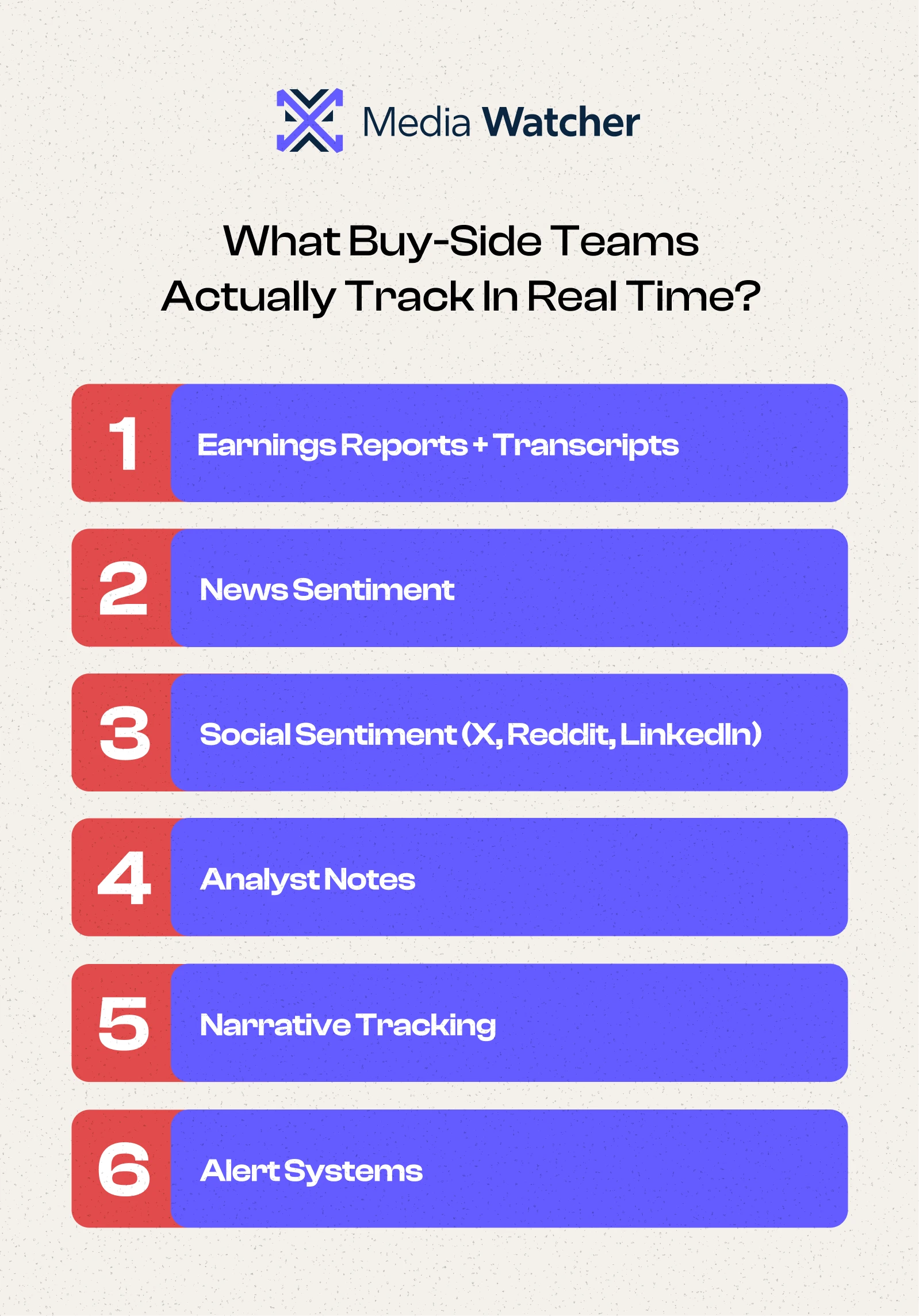
What Buy-Side Teams Are Actually Monitoring
During earnings season, four streams of information run at the same time, each with a different speed and type of signal.
For example, how an executive talks on an earnings call can tell you a lot. If they hedge, avoid questions, or sound unsure, that’s a sign. Teams using real-time media sentiment tracking to catch these signals during the live call, not in a recap the next morning, have a real timing advantage.
Financial media monitoring tools shape news outcomes through their framing. The same earnings release can read as a guidance cut, shrinking profits, or a confident AI bet, whichever angle major outlets run with drives sentiment for hours.
Therefore, recognize that framing as it forms, not after it spreads, and you will have a genuine advantage.
Sell-side notes combine to form a complete visual representation. The research houses show different results through two separate upgrade and downgrade assessment methods, which show their reaction to the same risk element. The market price movements follow the commentary patterns which precede them.
Social signals and broadcast signals hold importance for research work for scientists. Institutional investors begin to analyze smaller companies after retail investors express their opinions on X and Reddit platforms.
The financial television broadcasts create viewing spikes, which lead to increased trading volume for a limited time. The two channels do not substitute for essential market research. The two factors will impact the market prices in the upcoming period.
A company can receive positive initial news framing while social sentiment is already deteriorating. The market shows unusual price movement patterns when different channels display their price movements at different times. Teams monitoring only one channel miss it entirely.
Why Manual Monitoring Fails at This Speed
Usually, throughout the peak earnings week, an upward of 150 S&P 500 companies can report. One sector analyst might directly track 15 to 20 of those while keeping an eye on another 30 whose results color the macro picture.
No team can manually scan 100,000-plus sources across news, social, broadcast, and podcast channels in the minutes following a major release on the internet.
By the time human-generated summaries are assembled, algorithmic traders have already acted on the sentiment signals. The window has closed.
Real-time monitoring software does not replace analyst judgment. It delivers the information analysts need to use that judgment while it still matters.
Sub-200ms alerts with sentiment classification already applied turn raw media vo lume into something actionable at market speed.
How Media Watcher Fits Into This
By the time a market summary hits your inbox, earning season sentiment has already shifted, and prices have already moved. The analysts who acted on that first wave had tools running before the release even landed.
That is not luck. That is infrastructure.
Media Watcher gives buy-side teams 100,000-plus sources, 80-plus languages, and sub-200ms alerts, before consensus forms, before the herd lands, before the position moves without you.
Book a demo to see how Media Watcher supports earnings-season intelligence for buy-side teams.