



As oil prices edged lower while traders assessed potential supply risks linked to U.S.–Iran tensions, the market appeared steady on the surface, even as online discussions grew more divided. Some observers see the dip as routine repositioning. Others witness a vulnerable market about to encounter a geopolitical shock. As the relations between Washington and Tehran approach a nascent feud, they have produced a severe split in the popular debate: is it a simple transient jitter, or the early signs of a greater supply convulsion?
What Media Watcher’s Dashboard Reveals About Oil Markets and U.S.–Iran Tensions
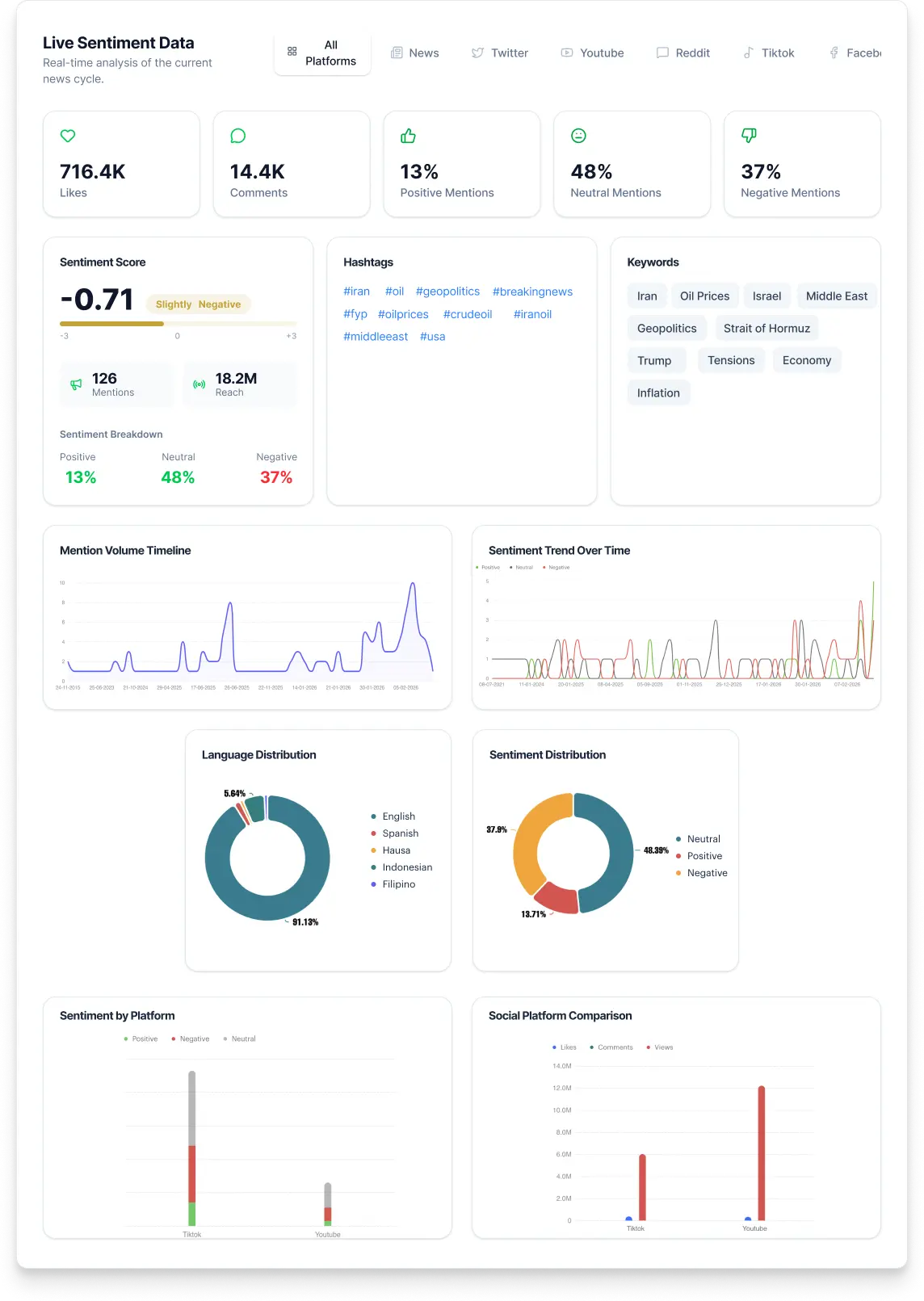
The sentiment score showed by Media Watcher’s media monitoring platform around the news, oil markets, and U.S.-Iran tensions is negative (-0.71), which is a clear indication that anxiety has more weight than optimism. With 18.2M reach and 126 mentions, 13% are positive, with 37% negative and 48% neutral.
The statistics indicate that there is a cautious, observational attitude, and not necessarily panic, as the neutral mentions prevail, signifying that many observers remain in the weighing risks pool instead of leaping to conclusions. However, the negative share is almost thrice the positive one, which is a measure of the sensitivity of energy markets to geopolitical friction.
On the platform, the discourse is loudest on YouTube and X (previously Twitter), where YouTube has more view volumes, and X generates more spikes of negative commentary. This trendline shows a series of abrupt sentiment, especially negative, that relate to Strait of Hormuz and supply chain risks discussions.
The spikes of keywords like Iran Oil Prices, Strait of Hormuz, Trump, Inflation, and Middle East Tensions reveal how fast energy talk turns into a wider economic panic. This media monitoring information showed by Media Watcher, indicates that oil is no longer simply a commodities issue; it directly relates to inflation fears and domestic political arguments.
Traders vs. Inflation-Weary Consumers: A Divided Reaction
In energy market circles, especially in the financial side of the U.S. and some parts of Europe, the dip is being framed as a technical adjustment. To them, volatility is in the cycle. Their voices are analytical and somewhat detached.
Meanwhile, consumers, particularly in inflation-sensitive economies, are responding to it differently. Even the implication of supply disruption is alarming in areas that are already struggling to cope with high living expenses. Infrastructure continues to be affected by memories of previous Middle East wars.
In the case of oil-importing nations, the threat is simple and direct because any increase in the Strait of Hormuz would constrain supply and drive prices up once again. To the commentators of the U.S., the debate is more partisan, between energy-independency discourses and the fact of interdependence across the world.
Energy traders and financial analysts pay attention to market indicators and changing risk premiums, whereas households and small businesses feel this more directly as a result of higher fuel and grocery prices.
Is the Strait of Hormuz the Next Market Shock?
Almost one-fifth of the world’s oil production is transited through the Strait of Hormuz. Any Iranian act there has both symbolic and practical significance. The history of how it works reveals that regional tensions can rapidly transform into price spirals and infrastructure threats. Layer inflation into that equation, and oil becomes a political issue overnight. The market can go down today, yet the general feeling in the market is rooted in risk.
Energy markets respond within seconds, and the opinion of people changes as rapidly. Media Watcher puts them both into perspective, with real-time sentiment shifts, local differences, and platform-specific mood swings before they become apparent. When volatility meets public perception, informed awareness becomes a real advantage.
Suggested Read: