



Britain’s newest asylum overhaul has triggered an immediate and intense response across the public conversation. The government’s push to shorten refugee status to temporary stays has drawn a sharp divide almost instantly. Proponents introduce it as a feasible measure to prevent the unsafe crossings and relieve the strained services. To its critics, it represents an abrogation of human rights and endangers those who pursue safety. The split isn’t subtle; two worlds are reacting to the same policy with entirely different emotional registers.
How Media Watcher Interprets the UK’s Refugee Policy Move?
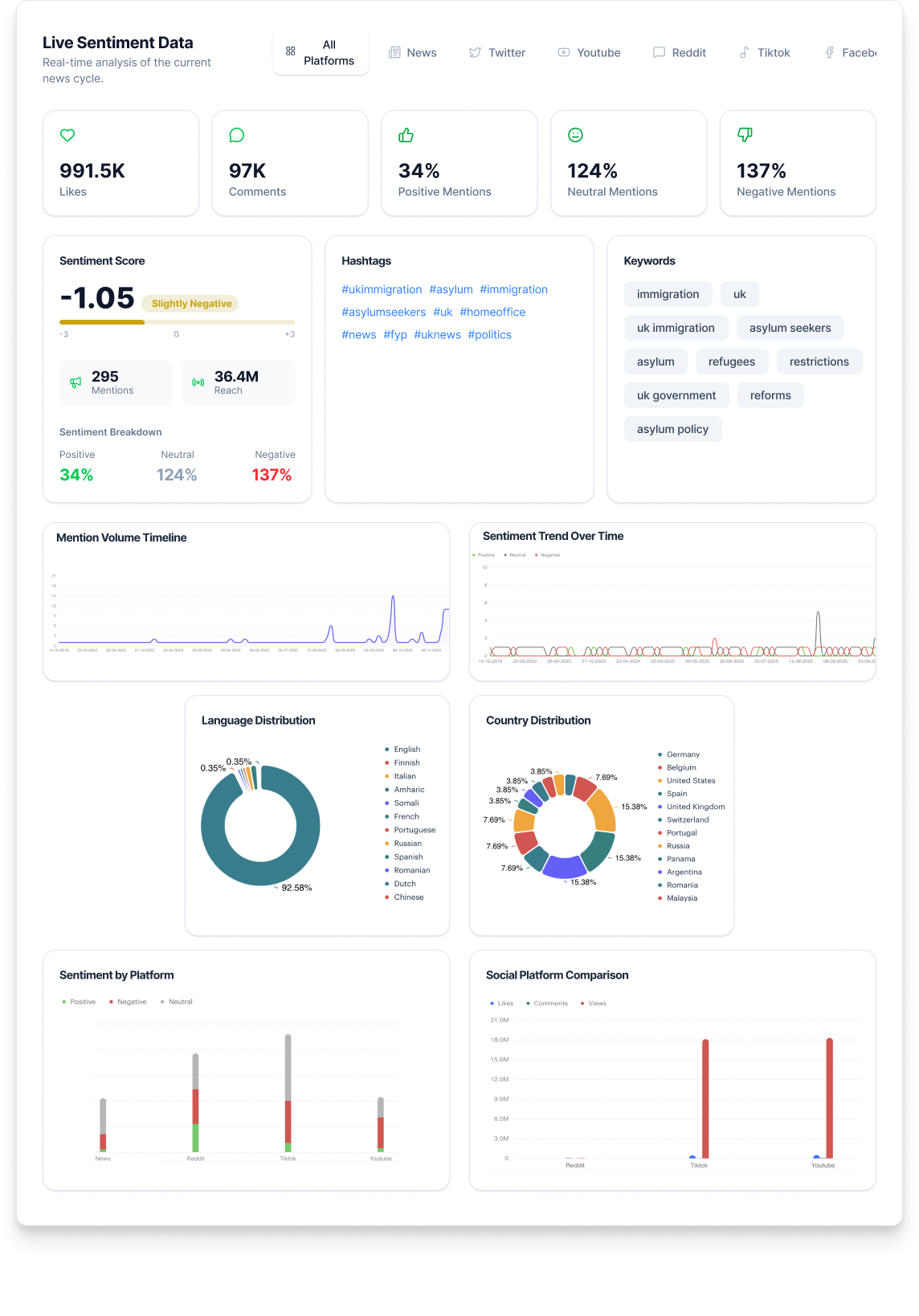
Media Watcher sentiment dashboard represents this gap in real-time, displaying a sentiment-laden conversation. A sentiment score of -1.05 indicates a weakly negative mood, because it is not a crisis, but a definite inclination toward skepticism. Among all mentions, negative reactions (137%) rank higher than positive (34%) and neutral (124%), indicating that negative impressions prevail.
The importance of volume matters in this case as the news has already reached 36.4 million people, got 992K likes, and 97K comments, which are signs of abnormally high population engagement. The dashboard shows that discussion spiked at key announcement moments, especially around proposals like ending guaranteed housing support and tightening appeals processes. These spikes indicate that a particular policy detail, rather than the general concept of reform, is what elicits the most intense emotional reactions.
Metrics patterns on the media monitoring platform show another layer. The most acute sentiments are discussed on Twitter and Reddit, particularly through hashtags such as #ukimmigration, #asylum, and #asylumseekers. These platforms skew more confrontational and amplify both moral arguments and economic frustrations. In the meantime, there is a tendency toward a cluster of sentiment regionally, with urban areas containing stronger negative sentiment, and rural/economically strained constituencies containing more neutral or guardedly positive sentiments.
The dashboards reveal the divide of two distinct publics, constituted by geography, economic circumstance, and experience, apprehending the same headline but experiencing absolutely different things.
Why are Reactions to the UK’s Asylum Reforms So Polarized?
The divide has roots that go deeper than the reforms themselves. Those supporting tougher rules often live in communities where migration pressures are felt daily, strained housing markets, limited local budgets, and repeated public debates on border control. A transitional status of refugees in their case is a kind of correctional measure, a way of using the resources without necessarily closing the door.
Conversely, cities like London, Edinburgh, and Manchester interpret the policy in moral and legal terms. Human rights activists warn that this will probably keep the vulnerable individuals in the traps of uncertainty by cutting down the protection period. These communities have a greater likelihood of attracting the historical promise of asylum in the UK and provoking a humanitarian standard. The conflict becomes a national battle that is well known: transactional governance against principled responsibility.
The change is noticeable depending on the cultural layer: the former is more focused on stability and control; the latter on dignity and adherence to the international standards. These inspirations are not just political but are pointers to lived experiences, locality, and degrees of emotional risk-taking and responsibility.
Europe’s New Deterrence Trend and the UK’s Leap
The reforms echo Denmark’s temporary status model, hinting at a growing European appetite for deterrence-based approaches. The UK government frames the policy as a way to curb illegal crossings and accelerate claims processing. However, according to critics, temporary protections fail to deal with displacement drivers, conflict, climate disruption, or collapsing state structures.
Another layer adding tension is the government’s signal that it may consider withdrawing from the European Convention on Human Rights if courts block the reforms. Such a possibility adds doubt to a whole new level to the refugee policy and points to the possible constitutional friction. To most people, the argument ends up being a proxy of larger points: What is modern Britain trying to represent? What is the emotional compromise level? And what is the emotional threshold for compromise?
National debates like the UK’s asylum overhaul move fast, fracture quickly, and rarely follow a single emotional arc. Headlines only show the surface-level sentiments. The organizations operating within these arguments, like regulators, ministries, policy groups, and oversight agencies, require something to read through the underlay, and Media Watcher provides such a view of visibility.
When one policy triggers two completely different national conversations, Media Watcher brings the context into focus. It reveals who is fueling the response, factors that are increasing the separation, and where the story is going next. In policy reform, crisis monitoring, or surveys of public trust, Media Watcher’s media monitoring platform can convert fragmented responses into formal wisdom capable of guiding action, rather than merely recording them.