



President Trump’s newly proposed executive order, part of the ambitious Genesis Mission, has landed right at the center of America’s ongoing AI tug-of-war. The plan aims to centralize federal AI research, merge vast government datasets, and supercharge public-private invention. Debate intensified as soon as the option to preempt state-level AI laws came out.
Technology enthusiasts say that a national approach to AI is long overdue, and privacy and policy experts point out that it may turn into a menacing federal takeover of Big Tech at the expense of ordinary people. This is a sharp divide in people’s sentiments, highly charged and only growing by the hour.
Media Watcher Dashboard Insights and Interpretation on Trump’s AI Policy
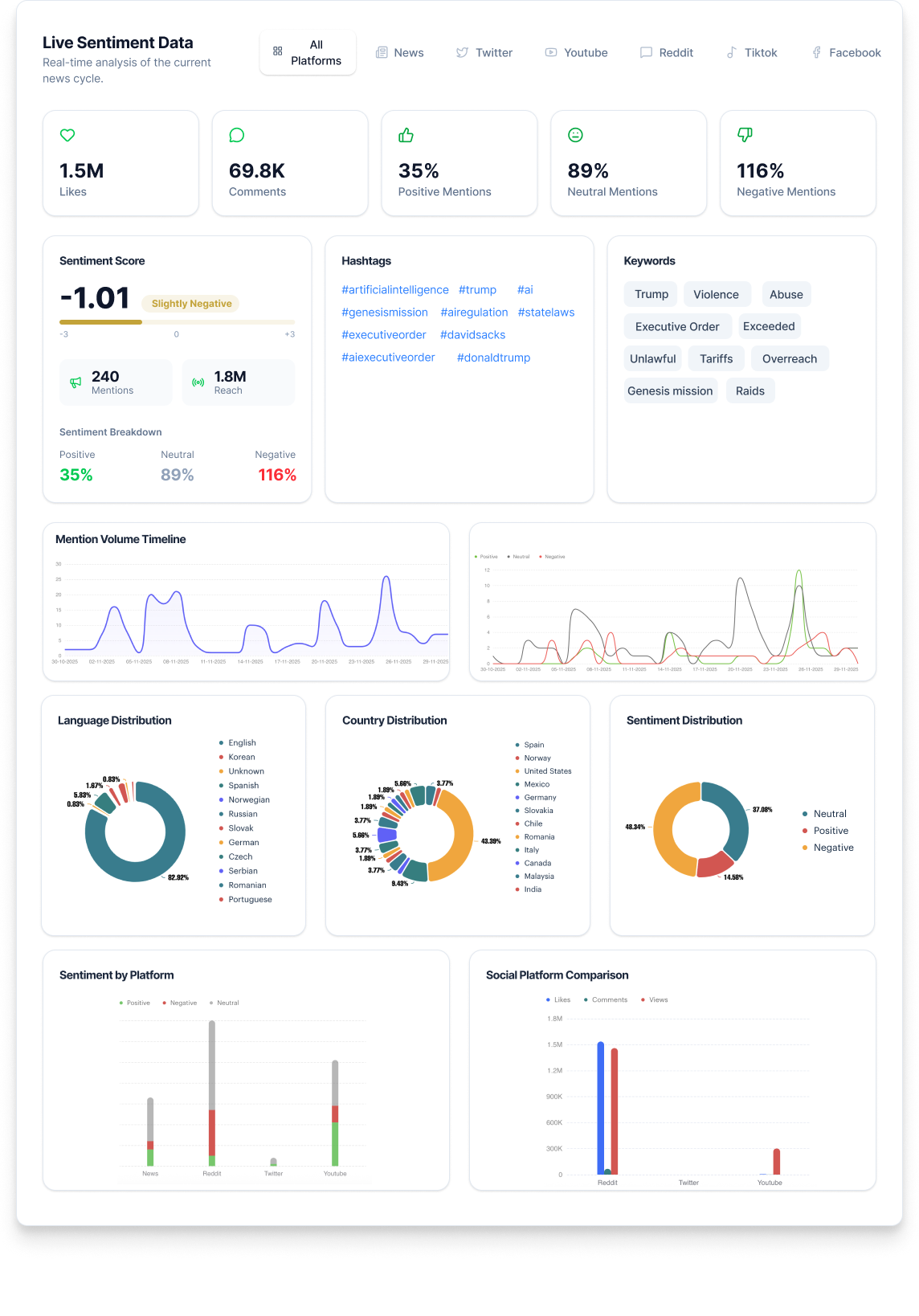
Following the mixed reactions surrounding the disputed regulations around Trump’s executive order to override state AI regulations, Media Watcher analyzed the sentiments across several platforms, revealing the distinct patterns. The overall sentiment score is pegged at -1.01, which means that the nationwide reaction is a little negative. The 48% negative shares are what cause that negativity, as that is a definite majority; positive shares only reached 14%, with 37% being neutral.
Engagement was unusually high for a policy discussion, which often signals strong public polarization. The sentiment trend graph shows a prominent spike of negativity immediately after the clause on overriding state laws circulated, followed by a smaller but sharp wave of positive sentiment from business-aligned communities.
The distribution of languages has 82.92% English, which corresponds to the dominant language in the U.S., yet almost 6% coverage of Spanish and Korean shows the increasing cross-community interaction. The spread of multilingualism in policy news is not frequent and is usually an indication of the lack of understanding or anxiety of the populace.
The country distribution depicts the United States of America at 43.3%, with Spain, Norway, Germany, and Mexico recording significant participation. European mentions were predominantly negative, frequently citing issues of U.S. over-regulation and the probability of increasing transatlantic AI policy differences.
The bifurcation is verified by the sentiment division:
- Platforms and regions with lean business lean toward the positive.
- Regions that were public-policy-oriented were strongly negative.
- Academic and policy institutions are the largest contributors to neutral coverage.
Even the hashtags (#GenesisMission, #AIRegulation, #ExecutiveOrder) are characterized by mixed clustering, one group of which is the optimism about innovation, and another is the fear of regulations.
Such patterns at the platform level reflect cultural divisions that grow regionally.
Regional Perspectives That Reveal the Real Fault Lines
On a cultural level, state-level AI regulations can be seen as a marker of identity to the coastal tech hubs, such as California, an effort to balance out the power of Silicon Valley with regulation based on local cultural norms. The promise of the executive order to cancel those laws is a top-down intrusion. In this case, the sentiment trends are not beneficial as residents are afraid of losing privacy and giving increased power to Big Tech companies that already control their daily lives.
Heading to Texas, though, you will discover the opposite response. A state that tends to be non-compliant with regulations embraces the federal standardization push. Local AI startups have found fragmented rules to be a challenge; a single federal solution seems like a smoother ride to invention. Their mood is positive since the order is considered an economic accelerant and not a threat.
The situation is framed differently in New York City. The order is approached with caution by NYC, which is constructed upon the immigrant-based opportunity and regulatory pluralism. Similar to how the city had previously advocated for AI-in-hiring transparency legislation, locals respond adversely to anything that marginalizes local oversight.
Meanwhile, competition with China is debated in sections of the Midwest, and in this case, it is increasingly supported by those focused on national acceleration, rather than state experimentation.
The Federal Power vs. State Rights
These regional contradictions, in fact, give rise to a larger, more fundamental conflict at the heart of the argument. This kind of emotional contrast is not common in AI policy, and the cause appears obvious: people are not responding to AI; they are responding to control and are worried about the subsequent:
- Who sets the rules?
- Who gets to override them?
- And who is the beneficiary of federal supremacy in a place that is connected with labour, privacy, education, and civil liberties?
The Trump order aims to make the U.S. a leader in AI on an international level, but in the process, it restores the old struggle between state power and federal authority.
Arguments in the mass media are unstable, and one should follow not only polarizing opinions but also the causes of these polarities. This is the only way that governments can formulate effective policy decisions that will consider the interests of all the stakeholders. That is where Media Watcher comes in handy. It helps in real-time trend detection, sentiment analysis across platforms, provides region-specific insights, and helps track rising divides before they grow. For policymakers and policy informers seeking real-time public reaction, Media Watcher provides clarity by showing shifts in sentiment, highlighting polarized audiences, and enabling precise, timely responses as conversations unfold.