



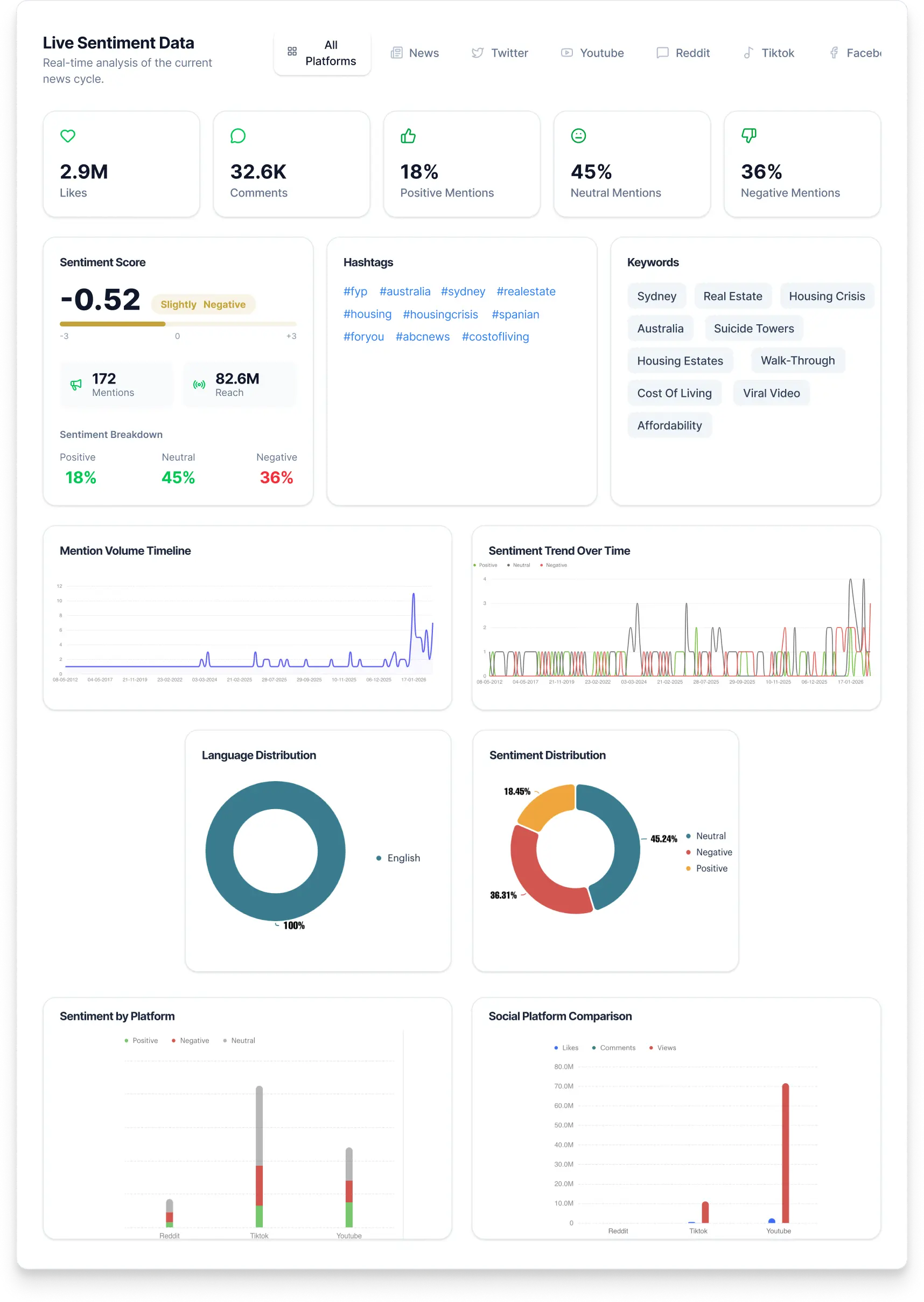
Sydney is once again at the center of a heated debate over housing. A recently passed city council decision to construct a plan of 31,000 new homes has caused a discernible rift on the Internet. Some citizens embrace this move as a much-anticipated solution to the skyrocketing prices and limited availability. Others are afraid of the social and infrastructural impacts of such fast urbanization. The debate is heated, and the social media discourse shows the strong division between optimism and fear.
What Media Watcher’s Dashboard Reveals About Sydney’s Housing Debate
The media monitoring information of Media Watcher gives a clear picture of how the residents of Sydney are responding. In 172 mentions with a reach of above 82 million, the sentiment is slightly negative with a sentiment score of -0.52. The ratio of positive mentions is 18%, neutral 45%, and negative 36%. This demonstrates that although almost half of the discussion is quantitative, much of it is concerned with or even categorically against.
The use of hashtags such as #sydney, #housingcrisis, and #realestate takes the centre stage, indicating the emphasis on local affordability and the general issue of real estate. The statistics also demonstrate the differences in platforms: TikTok has the most substantial volume of conversations, yet YouTube receives more views, indicating that the visual narrative, such as a walkthrough or explainer video, is affecting the perception more than the short-form discussion.
Supporters vs. Opponents: Public Reaction Analysis on Sydney’s Housing Debate
The proponents claim that these 31,000 homes are essential to alleviating the housing crunch in Sydney. High-density apartments have become a viable solution to price pressures, according to many younger urban residents and renters. Their optimistic attitude is a realistic acceptance of increased height and new construction.
The opponents, such as long-term homeowners and community organizations, fear gentrification and overstretched infrastructure. Negative sentiment peaks in regard to fears of Suicide Towers and the escalation in costs of living, as mentioned in the keyword distribution. In terms of geography, inner-city suburbs are more opposing, and outer areas are more accepting, as priorities and real-life needs vary.
Urban Planning, Affordability, and Migration Pressures
The controversy is connected to the larger socio-economic environment of Sydney. The median house prices are above 1.5 million dollars, and the pressure associated with immigration raises demand. New gun control and hate crime bills introduced by the government as safety and social welfare issues also influence the perception of urban policy. Housing density is not only a construction problem, but it also overlaps with quality of life, community building, and overall economic policies.
Media Watcher comes in handy in such cases. Live sentiment analysis, local mapping, and platform-specific insights indicate how people are divided at a glance before debates get out of hand. Understanding the noise in a polarized discussion, smart filtering, and cultural sensibility detection enable teams to track controversy, detect emergent issues, and respond strategically.
Suggested Read:
European Union and U.S. at Odds Over Visa Bans and Digital Regulation
Hungary’s Pride Parade Ban Triggers Nationwide Debate on LGBTQ Rights