



 Pacific Islands forum leaders have publicly supported the involvement of Taiwan in global talks, shrugging off the increasing pressure exerted by China. The societal reaction shows a sharp dichotomy; as some rejoice in the validation of democratic principles and regional peace, others worry about diplomatic conflict and economic consequences with Beijing. The Internet buzz has increased significantly during the last month, which is an indication of the breaking point in terms of popular involvement in the internationalization of Taiwan.
What Media Watcher’s Dashboard Tells About the Taiwan Participation Debate?
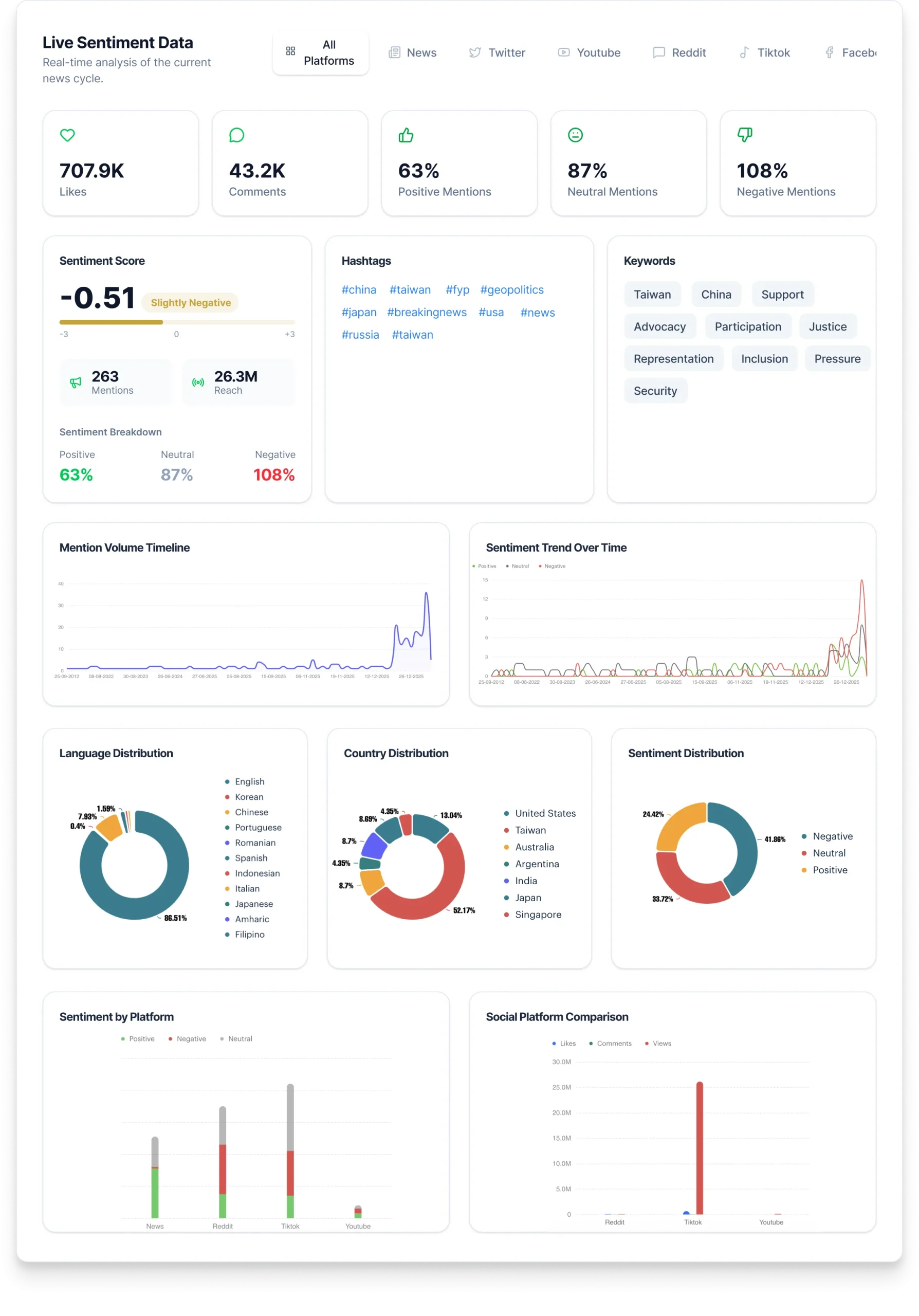
Media Watcher’s dashboard highlights that mentions of Taiwan’s participation spiked dramatically in late December 2025, reaching over 35% daily mentions from a previously steady baseline. Although the overall sentiment score is slightly negative (-0.51), there are high engagement levels, with 26.3 million users reached across the platforms. The sentiment split records 24% positive, 33% neutral, and 41% negative, indicating that the people have split opinions.
Language and local information disclose subtle boundary lines. English prevails in the discussion (86.5), and there is a slight presence of Korean, Chinese, and other languages. The country distribution shows that Taiwan is the epicenter with more than 52 percent of mentions, followed by the United States (13%), Australia (8.7%), and India (8.7%). The dashboard indicates regional variations in perception; Western countries tend to speak in favor, but the comments of China and its allied regions are strongly negative. Such figures are indicative of actual strains between domestic pressure to support Taiwan and fears of geopolitical reprisals.
Public Contrast on Taiwan’s Participation in International Discussions
Taiwanese have been applauded by supporters, especially Japan, Australia, and New Zealand, as an acknowledgement of a democratic government and a promise of inclusive regional forums. They focus on the aspects of security and justice and the involvement of Taiwan as a moral and strategic decision. On the other hand, critics who speak Chinese in their countries consider this a form of provocation, which could lead to diplomatic and economic repercussions. The metrics indicate that the posts of supporters are about inclusion and representation, whereas those against it are about pressure and security threats, the classic East vs. West geopolitical conflict.
How Taiwan’s Debate Impacts Regional Relations?
The Taiwan discussion cannot be isolated from the bigger cross-strait relations. This exclusion insistence of China is in contrast to the recognition-seeking of Taiwan, which leaves minor Pacific countries in the limelight as key intermediaries. This situation is an example of a broader trend; the world powers are increasingly balancing democratic ideals with economic relationships, and social media reinforces these separations, where popular opinion becomes a tangible variable in foreign policy.
The recent outburst of controversy regarding the participation of Taiwan has highlighted the significance of tracking the popular opinion in real time. Monitoring sentiment patterns, the occurrence of sudden spikes, and regional variations allows the analyst to recognize where the opinion of the people is in agreement or in disagreement. Live alerts, cross-platform sentiment detection, and detecting cultural nuances enable policy makers, journalists, and researchers to respond more intelligently, meaning they can have a better view of how the world reacts in very contentious debates, such as the global involvement of Taiwan.