



 In the aftermath of the Bondi Beach mass shooting, New South Wales has enacted comprehensive gun control and protest legislation. The steps, intended to stop violence and improve the security of the population, have provoked a sharp reaction in people. The advocates celebrate the laws as necessary protective mechanisms, and the critics argue that these laws are dangerous to civil liberties and the right to protest. The discussion demonstrates a distinct separation, where safety concerns are related to one side, and liberty issues pertain to the other, showing a negotiating society over fear, trust, and government.
What Media Watcher’s Dashboard Tells About NSW Gun and Protest Laws?
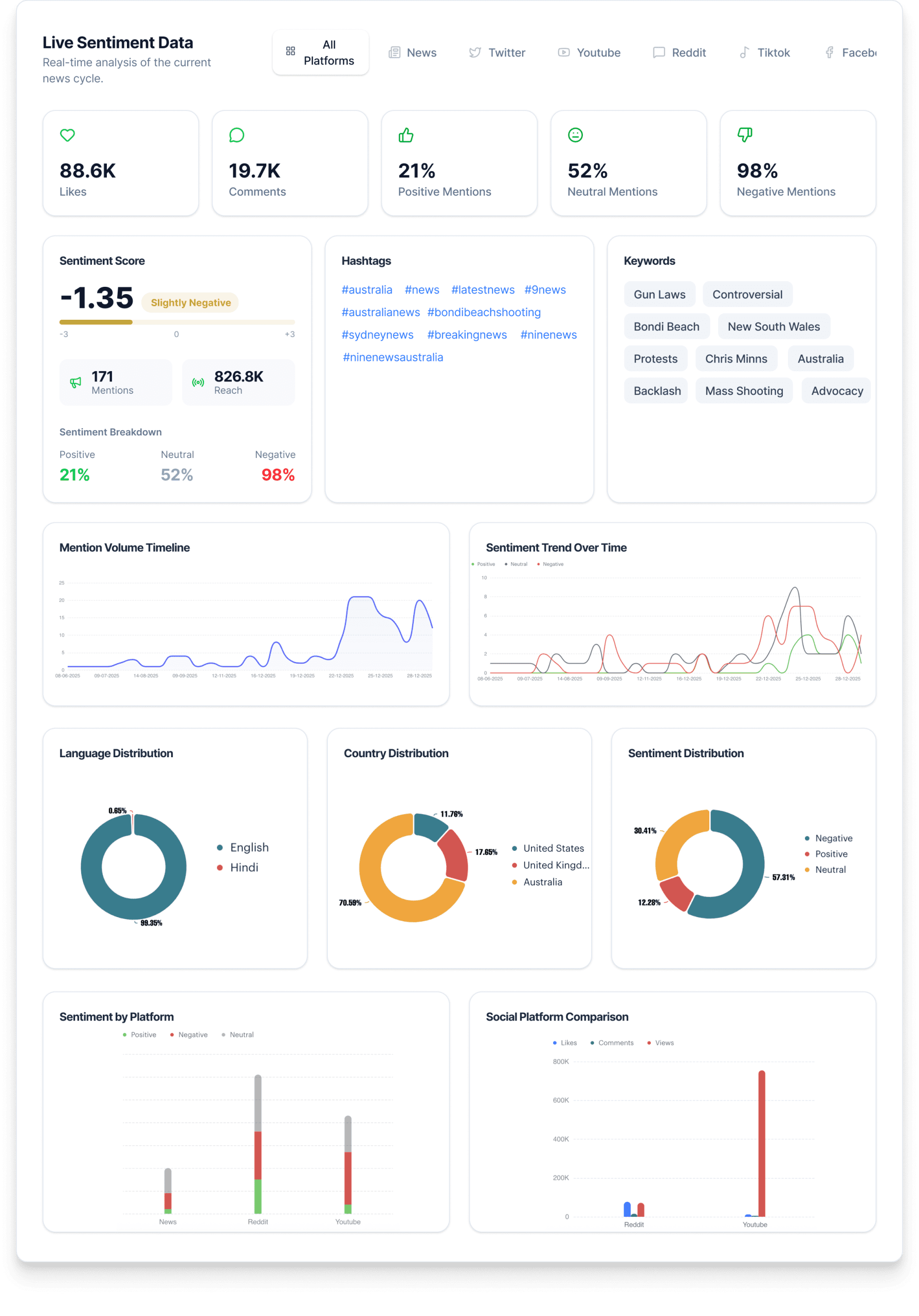
The media monitoring dashboard of Media Watcher shows that the general sentiment score is somewhat negative (-1.35), pointing to the polarizing view of the population. The number of mentions is high, being 826.8K, which can be taken as evidence of a large number of interactions. Among these mentions, a negative percentage of 57 is recorded, but this is contrasted by 30% neutral and 12% positivity. This implies that issues of civil liberties prevail over the defense of actions in online debates.
Local information gives additional detail. The U.S. has 11.76% of mentions, the United Kingdom has 17.65%, and Australia leads with 70.59%, indicating that domestic markets are the most interested. The language analysis supports the view that 99.35% of discussions are made in English, which substantiates the visibility of this debate to a global audience. Mentions peaks in late December 23-29 are linked to large-scale media coverage, indicating the effect of media coverage on public talk. The facts indicate that proponents are concerned with the short-term safety returns, whereas critics are exaggerating the issue of liberty and control.
Public Reactions to NSW Gun and Protest Laws on Safety and Civil Liberties
According to those who support the new legislation, the tragic incidents at Bondi Beach have revealed the weaknesses in enforcing the safety of the people. The necessity to avoid such incidents is highlighted by many urban residents and law enforcement activists. The mood in Sydney and other metropolises is towards prioritization of security over protest rights. Hashtags, such as bondibeachshooting and gunlaws, on social media highlight the fear of recurring tragedies and the urge to take immediate action.
On the other hand, civil rights groups and civil rights activists have been very apprehensive, especially those in more politically progressive regions like Melbourne and Brisbane. They worry that increased police authority may suffocate legitimate protests and legalize obtrusive government monitoring. Negative sentiment peaks indicate concerns over disproportional imposition and loss of democratic freedoms. The distrust of these groups is also generated by the existing discussion on extremism, integration, and rights to protest publicly in Australia. Their advocacy is an expression of the values of personal liberties, openness, and an aversion to excess.
The monitoring of the public response to the gun and protest legislation in NSW indicates the degree of polarization of the opinion. Media Watcher helps policy-makers, law enforcement, and advocacy groups to gather real-time opinion, track regional variations, and identify opposing viewpoints. These insights can be used to make accurate communication, measure policy impact, and carry out adjustments to the data, which are responsive to the issues raised by the people.