



The argument about House of Lords reform has rekindled a historic division in British politics between reformers who believe the House of Lords is an outdated symbol of privilege and those who believe it is about to be used to destabilize an already shaky political structure. This rift is not categorical; it is emotional, cultural, and based on very different notions of what modern democracy is supposed to be. And with the re-emergence of constitutional aspirations of Labour, opinion is dividing sharply, with the internet response displaying a mixture of exasperation and wary anticipation.
What Media Watcher’s Dashboard Reveals About Sentiment on House of Lords Reform?
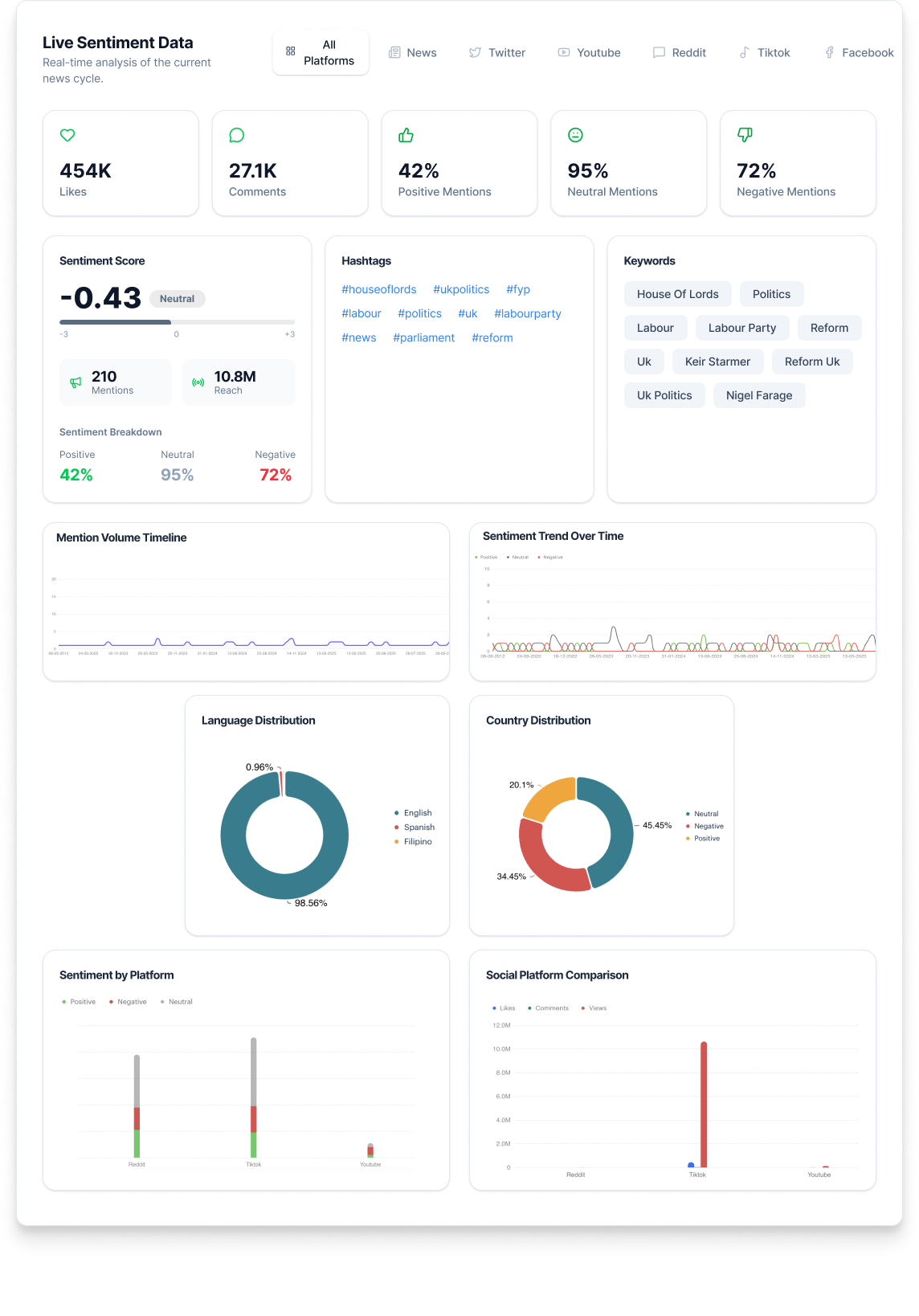
The sentiment figures narrate a story that no words can describe. The total sentiment score is -0.43, indicating a slightly negative popular mood, not outraged, but uncomfortable. With 210% mentions generating a 10.8M reach, the conversation may be relatively contained, yet extremely high visibility is shaping perceptions across platforms.
The dashboard shows 42% positive mentions, but here’s the twist that negative mentions reach 72%, and neutral sits at an unusually high 95%. This mismatch suggests fragmented conversations, people talking about the reform without emotionally committing, while those who are committed lean strongly negative. In other words, the public is watching closely but has not fully chosen a side.
The trend of sentimentality over time shows that there are periodic bursts of negativity, which tend to coincide with references to the keywords of Keir Starmer, Reform UK, or Nigel Farage, which are lightning rods of political emotion. Hashtags such as House of Lords, UK politics, and reform prevail, demonstrating how snugly the discussion fits within political Twitter/TikTok feeds instead of leaking into lifestyle or culture channels.
Local impressions are even more informative. The country distribution reveals that sentiment is evenly divided, with 45.45% being neutral, 34.45% negative, and 20.1% positive, which further confirms that the most prevalent mood is one of hesitation. Meanwhile, the language data demonstrates overwhelmingly high output of English, 98.56%, which proves that this debate is very localised and culturally specific as opposed to global debates of democratic reform.
The data suggests one thing clearly: the public is alert, polarized, and waiting to see what direction labour takes before forming firmer opinions.
Why Two Groups See the Same Reform So Differently?
Proponents of reform are younger, urban, and already distrustful of institutions. In their view, the Lords appear to be a relic that slows down the pace of development and protects political elites. They are impatient, which explains why national policy continues to be influenced by an unelected chamber.
Across the table lies a less vocal though equally entrenched group of people that cherishes stability, continuity, and constitutional restraint. Many come from regions historically wary of sweeping political experiments. For them, the fear isn’t the Lords themselves, but the pace and scope of change. Their concern is simple: what if it could break if the system is changed too quickly?
This tension mirrors the broader UK split; London and university towns pushing modernisation, while parts of the Midlands and shires prioritise predictability. Labour’s reform agenda lands right in the middle of these competing instincts.
The Broader Political Context Behind Labour’s House of Lords Reform Push
The policy of Labour about constitution reform has never been anything but a balancing act, to modernise without destabilising. Behind the House of Lords debate, there are other underlying strains, such as mistrust of Westminster, the call to grant the regions more power, and a post-Brexit craving to understand the institutions better. Most voters desire change, but they are fearful of unintended consequences. This is what makes Lords reform symbolic; it is not necessarily a chamber, but a type of political future the UK wishes to create.
The constitutional change process is highly dynamic, and to understand any changes, one should not focus on headlines. To policy teams, political strategists, journalists, and research analysts who must follow the rapid reaction of the people, Media Watcher brings the clarity that is needed immediately. The platform tracks sentiment changes on a real-time basis across geographic areas, platforms, and cultural backgrounds in order to enable teams to see precisely where support is increasing, resistance is rising, and new points of pressure are being created. Media Watcher’s media monitoring insights provide a more grounded perspective on the formation and polarisation of public mood, with contrast detection, smart filtering, and multilingual coverage across the globe, offering a viewpoint to decision-makers.