



 The recent conflict between the United States and the European Union is no longer about visas but about values. The announcement of visa bans on European digital policy officials by Washington has resulted in a strong backlash among European leaders, reviving an old debate about the freedom of speech, the regulation of platforms, and political leverage. On the one hand, U.S. voices present the move as an expression of defense. Conversely, European leaders interpret it as an encroachment on sovereignty and digital rule-making.
What Media Watcher’s Dashboard Reveals About the EU–U.S. Visa Ban Dispute?
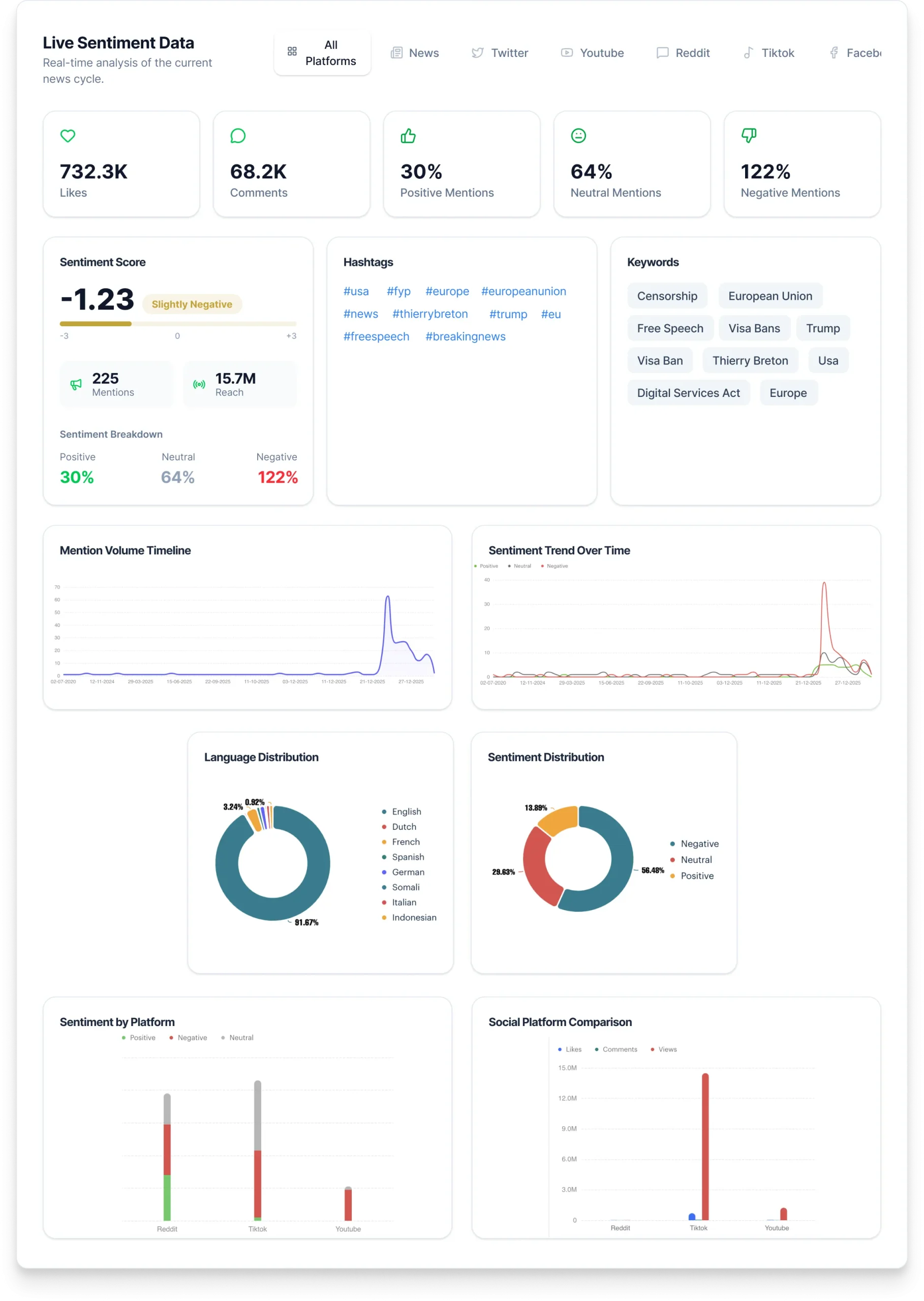
The media monitoring insights of Media Watcher reveal the speed with which the European Union and the U.S. intensified on the internet. The discussion earned 225% mentions, reaching an estimated 15.7 million users, and the engagement of 732.3K likes and 68.2K comments, indicating that the debate went well beyond policy communities.
The total sentiment score of -1.23 puts public reaction slightly on the negative end. The dashboard indicates that 56% are negative, 29% are neutral, and 13% are positive. This imbalance indicates that the discussion is dominated by frustration and concern. The keywords that peak around censorship, freedom of speech, the Digital Services Act, and visa bans suggest that the users are looking at the move through an ideological prism, not a procedural one.
In the region, European discussions are more defensive and critical, whereas U.S. discussions are more polarized, with advocates of free speech and those concerned about the diplomatic consequences. The evidence indicates that the narrative served as a proxy conflict over bigger anxieties regarding the ownership of digital speech.
Why is Public Opinion Splitting So Sharply Around the E.U. and U.S. Visa Ban?
U.S. advocates, especially among American commentators and activists of free speech, present the visa bans as a retaliation against what they view as a growing control of Europe. The Digital Services Act has been framed in U.S. discourse, particularly in politically charged platforms, as a danger to open dialogue.
Critics, who have been based in EU member states such as France and Germany, perceive the bans as retaliatory and symbolic. Europeans prioritize democratic legitimacy and state that the regulation of platforms safeguards citizens. The question of sovereignty is of concern to many, Washington being pushed around by an external power appears to be an effort to impose European standards of digital behavior.
The conflict itself is, in its essence, a more profound division on the issue of digital governance. Europe has taken years to develop a regulatory framework that gives priority to accountability and safety on the internet. The U.S, influenced by the tradition of free speech in the Constitution and strong technological interests, is still cautious of the regulation that will restrict expression. Both sides perceive danger in the other one, that is, censorship versus anarchy.
As debates like this move from policy rooms into public discourse, the real impact emerges in how narratives form and spread online. Media Watcher allows seeing these shifts early by exposing sentiment divisions in real time, tracing regional differences, platform-specific responses, and cultural subtleties. Media monitoring helps analysts and policymakers make sense of the fragmented digital conversations, turning them into clear, actionable insights when they are needed most.