Facebook is not a social network. It is a public town hall that serves as a marketplace, a customer support desk, and a group chat with 1.8 billion people on a monthly basis. This is the reason social listening on Facebook feels different from sentiment analysis.
The concept of sentiment analysis answers only one question. How do people feel? But Facebook social listening answers the questions that move the business, like:
- What are people talking about?
- Why is it spreading?
- Who is shaping the narrative?
- What should the team do next?
Even a small shift in a Facebook conversation can ripple fast because the platform sits at a massive scale. Facebook has been reported to have about 3.07 billion monthly active users in 2025.
A big company like Coca-Cola is a clean example of how social listening becomes a strategy input, not a dashboard. California Management Review notes Coca-Cola tracks brand mentions across platforms like Twitter and Facebook to identify emerging trends, respond to feedback, and shape more relevant content.
What is Facebook Social Listening?
Facebook social listening is the process of tracking and analyzing public conversations about your brand, your competitors, and your category across Facebook surfaces. That includes posts, comments, pages, public groups, and reviews.
The goal is insight that leads to action, not just a report. But, you can think of it this way that a Facebook monitoring tool tells you what was said; however, a listening tool tells you what it means.
Why is Facebook Social Listening Important?
Facebook social listening matters because Facebook is still a platform on the internet where opinions get formed loudly and at scale. If you are not listening there, you are basically letting the market write your brand story in a room you are not in.
It helps you learn what customers say when they are not tagging you and identify content angles people already care about.
It understands the ‘why’ behind the numbers and compares the share of voices, recurring complaints, and what customers praise about alternatives. It is competitive intel without the spy movie soundtrack.
Moreover, listening can also reduce risk in industries related to financing as well. For example, it helps businesses stay updated and catch public signals early that can turn into compliance, fraud, or reputational problems if they snowball.
According to a FINRA report, it fined M1 Finance $850,000 for influencer communications and reported that the program involved about 1,700 influencers and more than 39,400 new accounts, illustrating how quickly social narratives can lead to compliance exposure.
Therefore, listening helps businesses identify the trigger post, understand what users are experiencing, and identify which misinformation is being repeated, so response teams can act with context rather than panic.
However, Facebook social listening is different from sentiment analysis. Let’s explore how.
Are Facebook Social Listening and Sentiment Analysis the Same?
No, the terms might sound the same; however, they have different purposes. By definition, Facebook sentiment analysis is a layer, while social listening is the system. Sentiment labels content as positive, negative, or neutral, and listening adds context like topic, intent, recurring complaints, emerging questions, rumor triggers, and which communities are amplifying the story.
Where The Real Conversations Happen on Facebook
When it comes to the Facebook social listening tool, access matters, which includes public pages, public groups, comments, and reviews that are visible. However, private groups and personal profiles remain off-limits due to privacy concerns.
You may have observed that most teams handling social platforms listen on their own page and call it a day, while Facebook laughs politely. Here are the surfaces and places that actually change perception.
Public Groups
Facebook public groups are where people ask for recommendations, complain without tagging brands, and compare alternatives in plain language.
Comments
The Comment section is where intent shows up like, ‘Is it worth it?’, or ‘Is it safe?’, or ‘ Does it work in the US, UAE, or any specific region? It is where people discuss stuff like ‘Is the new update breaking things or not?’
Reviews And Recommendations
Reviews on any topic, policy, or product release often contain the simplest roadmap in the world. It is written by customers, which is for free, and tells a lot about what the audience thinks regarding anything that is the talk of the town.
Ads Comments
Ad comments work as a truth serum. The message either resonates with the audience, or it doesn’t, and feedback is rarely subtle.
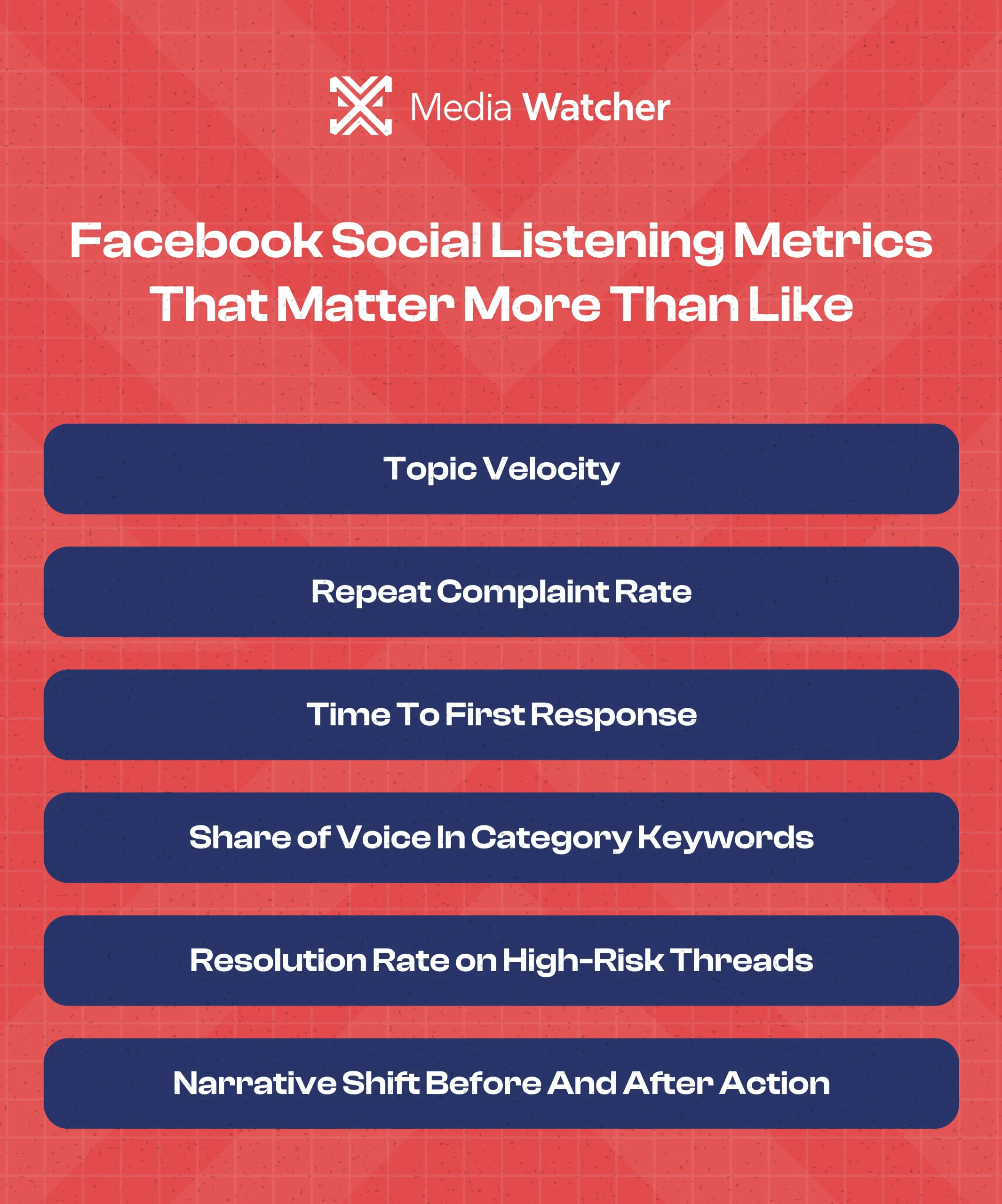
What To Listen to on Facebook
Brands should note that instead of listening to everything, they should listen for patterns that predict outcomes. It’s like filtering out the main information from a file bundle. Here are some of the key elements you should know.
| Customer Pain Patterns | Their recurring issues, confusing steps, broken expectations, and shipping drama tell alot about their sentiment. |
| Buyer Language | The exact phrases people use when they describe needs, become copy, creatives, and landing page language for brands. |
| Switching Triggers | People switching competitors include a lot of reasons, such as price, support, trust, bugs, and above all, the feeling of being ignored. |
| Risk Signals | These include impersonation, scam reports, misinformation, random rumors, and calls for boycotts. |
| Trend Velocity | A topic that is small but accelerating is often more important than a topic that is big but flat. |
A Weekly Facebook Listening Routine That Teams Can Actually Follow
A weekly Facebook social listening routine is a simple, repeatable check-in that keeps your team focused on patterns rather than random posts. Here is what brands should do:
Define Categories and Not Keywords
Keywords are messy on Facebook. People misspell names, use slang, talk in Urdu or Roman Urdu, and complain without naming the product exactly.
Instead of choosing keywords, you should pick 5 to 8 themes, which are categories that matter. It includes product issues, pricing, delivery, policy announcements, alternatives, trust, feature requests, or scam mentions, etc.
Build A Query List
Social listening on Facebook should include brand name variations, product names, common misspellings, and competitor comparisons.
Tag What Matters
Tagging means labeling each relevant mention, so it is sortable and actionable later. Every mention should be tagged by category and intent. Otherwise, it becomes noise with extra steps.
Set Alerts For Change and Not For Noise
If you set alerts for every mention, you will start ignoring them, which defeats the purpose. Set alerts for spikes in volume, velocity, or specific risk phrases. Do not alert on every mention unless the team hates peace.
Review And Act
Brands can create a weekly 30-minute review with owners, like marketing takes language insights, product takes feature pain, support takes recurring confusion, and communication takes rumor risks.
Measure Outcomes
Lastly, track what changed after the action, ‘Are there fewer complaints or a higher review score?” Observe fewer repetitive support questions and better ad comment quality.
These steps turn Facebook social listening into a steady feedback loop that creates decisions in real time, instead of turning into late-night scrolling with anxiety as the KPI.
How Media Watcher Fits In
Facebook social listening works best when it runs in the background like good air conditioning. Quiet. Constant. Saving the team from sweating through every comment thread.
Media Watcher helps you turn Facebook conversations into a daily system, not a monthly report.
Most brands only see what happens under their posts. We help businesses monitor brand mentions, product mentions, executive mentions, campaign phrases, plus category keywords that signal demand, doubt, or backlash.
One complaint is feedback. Fifty complaints in three hours is a fire alarm. Media Watcher helps you track topic spikes, trend velocity, and sudden changes in conversation patterns so the team sees what is accelerating, not just what exists.
If Facebook is where opinions form, listening should not be a monthly activity. It should be a daily advantage. Media Watcher turns listening into a routine the team can actually sustain.
Contact Media Watcher’s team and book a demo!
Frequently Asked Questions
Where Should We Focus First On Facebook?
Start with public groups and comments because they reveal unfiltered questions, comparisons, and recurring complaints.
How often Should A Team Review Facebook Listening Insights?
Weekly is the minimum for stable categories. Daily reviews are more effective during launches, crises, or fast-moving narratives.