

Most businesses believe growth happens quietly, when they build a product, run campaigns, or acquire users. But fame doesn’t work that way, as it usually starts with a sentence written by someone else.
A single news mention can introduce a brand to millions, while repeated mentions can turn it into a default choice. Not only this, but unchecked mentions can quietly reshape trust without a company realizing what changed.
This is the invisible power of news mentions, and businesses that ignore them are often reacting too late.
The First Headline Effect on Brands
There is a specific moment when a business crosses an invisible line and goes from operating in a market to entering the news cycle. This is when a brand or business is being mentioned in any statement on the internet.
That first mention, be it in local news, digital channel, or any new medium, matters more than most teams realize. This is not because of the reach, but because of how it is framed. For instance
- Is the company introduced as a solution?
- A disruptor?
- A warning?
- An example of what to copy or what to avoid?
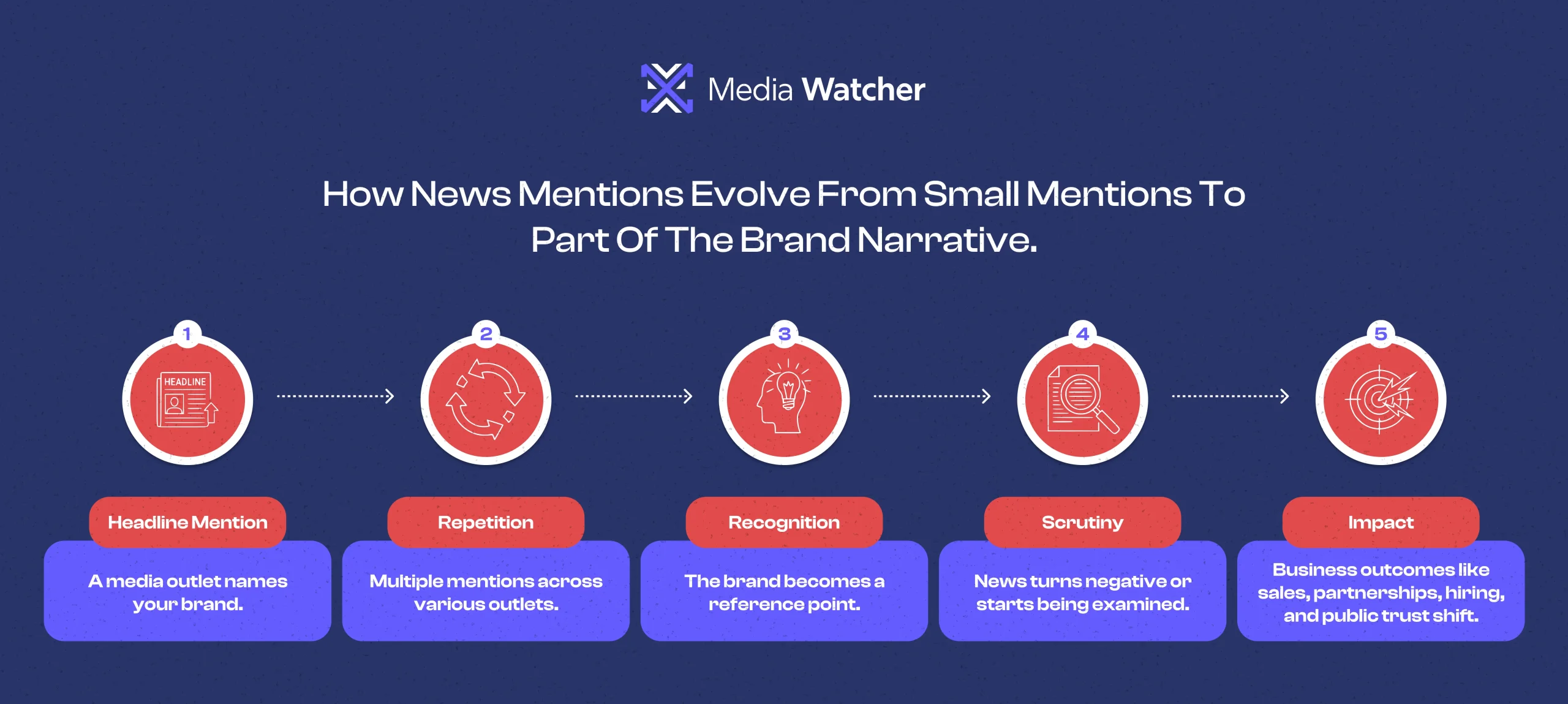
Once that frame is set, the future coverage of the business rarely starts from scratch, as Journalists build on what already exists, and this is how the narrative compounds.
Thus, the truth is that Brands do not go viral, but narratives do.
What are News Mentions?
At a surface level, a news mention is simply a business name appearing in an article, report, or broadcast on the internet or local media. However, in the fast-moving digital world, news mentions fall into diverse categories:
- A reference as an industry example
- A solution cited in a larger story
- A comparison point against competitors
- A risk, controversy, or regulatory case
- A market signal that investors and partners notice
Thus, it is important to know that the context of the mention matters far more than the volume.
For instance, one negative or skeptical mention in a high-trust publication can outweigh ten neutral mentions elsewhere. And one repeated positive association can quietly position a brand as the default without a single ad.
How Businesses End Up in the News Sources Without Trying
A large portion of media coverage happens without direct outreach. However, many companies assume news mentions are earned intentionally through press releases, media outreach, and PR campaigns. But in reality, most mentions are passive.
Here is a list of common triggers that make brands appear in the news:
- Market shifts that need a reference brand
- Industry crises where journalists seek examples
- Competitor failures that pull adjacent brands into coverage
- Regulatory or policy changes affecting a sector
- Sudden demand spikes that need explanation
In many cases, a business is mentioned before anyone internally notices. This means even a small incident can snowball into a major reputation event if it is picked up by influential voices or communities.
Thus, by the time teams or associated leadership see it, the narrative may already be forming elsewhere.
How News Mentions Turned Zoom App Into a Verb?
Do you remember the Zoom app, which became the go-to platform for education, work, and social life during the COVID days?
Until 2020, Zoom was a competent, yet relatively unknown, video conferencing platform. During the early 2020 lockdowns, Zoom became the tool of choice for remote work, education, and socialization.
The application was user-friendly, and with a frictionless interface, anyone could join it with one click.
This is where the world changed. As lockdowns spread globally, even journalists faced a challenge: they needed a simple way to describe working virtually, taking online classes, holding virtual family gatherings, and engaging in digital collaboration.
Thus, Zoom served as the best choice for everyone across the world. But headlines did not advertise the application; in fact, they normalized it. We saw,
- Schools move to Zoom.
- Offices adopt Zoom meetings.
- Weddings and birthdays happen on Zoom.
Repetition did the work, and Zoom became shorthand for virtual interaction. Within weeks, the product crossed from awareness into culture, and it was no longer one option among many. It was the reference point.
When Visibility Becomes Scrutiny
Fame does not stay neutral for long. Once Zoom became unavoidable in the news, coverage shifted. Security researchers, regulators, and journalists began examining the platform more closely.
Stories about Zoombombing, privacy concerns, and encryption claims gained traction.
Statements on News channels stated that “The Zoom company has faced criticism over a lack of privacy in its video conferencing app, even as it counts more users.”
The key insight is not that issues existed, but the news mentions that amplified them faster than internal teams could react.
The early signs of change can be subtle. You might notice some skeptical articles or a shift in how people talk about the brand. There may also be a new keyword appearing next to the brand name. Thus, teams that only track volume might overlook these signs.
How News Mentions Can Impact a Brand’s Outcomes?
News coverage impacts every level of decision-making. It goes beyond traditional media and influences various choices. Some of the common downstream effects include:
- Sales teams facing new objections rooted in headlines
- Partnerships are slowing down due to perceived risk
- Hiring challenges as candidates research the company
- Investor hesitation driven by sentiment, not numbers
- Customers questioning long-term trust
Thus, these are the butterfly effects of media coverage, where small narrative shifts can create large operational consequences, and ignoring news mentions does not protect a business from impact. Eventually, the brand’s visibility is affected.
Why Manual Media Monitoring Always Breaks
Even today, many teams rely on basic alerts, screenshots, or ad-hoc checks. This kind of manual monitoring works until the scale appears.
Here is what manual tracking fails:
- There is fragmented coverage across regions and languages.
- Tone and audience sentiments cannot be seen on the surface.
- There are patterns that occur among more than just one article.
- A timely reaction to an action is more important than discovery.
And by the time a trend is visible to anyone, it is already public, with an impact on the business. So, how can one stay ahead of everything in this modern time?
From Alerts to Intelligence With News Monitoring
This is where modern news monitoring changes the equation. Effective monitoring not only shows that a story exists in articles alone but also helps understand the direction the narrative is moving.
This is where media monitoring and intelligence tools like Media Watcher come into play. They provide in-depth analysis instead of surface-level alerts. Media Watcher helps businesses:
- Monitor and analyze brand mentions across global news sources in real time
- Understand sentiment shifts, not just spikes
- Detect early narrative changes before escalation
- Identify patterns that show risk warnings or opportunity
- Move from reactive PR to informed decision-making
How Media Watcher Helps With the Strategic Advantage of Listening Early
Businesses that monitor news effectively do something different, as they respond before narratives harden and give clear statements before assumptions spread.
Additionally, businesses can adapt messaging while there is still room to influence perception by using Media Watcher’s news monitoring.
Thus, News mentions will happen whether a company is ready or not, and the advantage lies in timing. They are not mere mirror images, but they are determinants of reality.
Media Watcher helps and empowers businesses in listening to the news on time. Contact our team and book a demo today!