

The global markets are no longer isolated. A policy statement in one country, an international change of direction, or escalating conflict in a trade route can impact investment decisions within hours. The World Economic Forum published the Global Risks Report, which revealed that geopolitical instability remained one of the greatest threats to economic development and financial systems internationally.
These advancements no longer exist as government briefings or official reports. They are happening on global news outlets, digital media, and local deliberations, creating the mood of investors in real-time. This increased complexity has made geopolitical risk tracking a critical practice, aided by sophisticated media intelligence that enables organizations to read signals early and take decisive action.
Why Financial Markets Can No Longer Ignore Geopolitical Signals
Financial markets are sensitive to uncertainty, and geopolitical events tend to be the catalyst. Changing trade policy abruptly or increasing pressures between two economies like the United States and China can affect supply chains, currency stability, and investor confidence almost instantly. In this setting, the use of conventional financial indicators alone generates a lag between the occurrence of an event and the response.
This is where geopolitical risk monitoring is not a choice but a must. Organizations are now relying on media intelligence to identify financial risk signs instead of waiting until reliable data is posted or quarterly reports are released. The sentiment of news, intensity of media coverage, and regional narratives are among the first to show changes before they are reflected in financial statistics.
Imagine a situation where the international media starts covering heightened diplomatic tension among the major economies. A distinct change in tone throughout financial news outlets can signal increasing uncertainty even before a full market reaction. Media intelligence can help investors and institutions to detect this trend at an early stage so that they can implement strategies in a timely manner.
In a world where markets are increasingly accelerating, judgment is less rooted in hindsight but rather in a real-time consciousness. Geopolitical risk monitoring fills that gap by converting rapid world developments into insight that can be acted upon.
Key Components of an Effective Geopolitical Risk Monitoring Strategy
An effective geopolitical risk monitoring strategy cannot be established by merely browsing headlines. An organized plan integrates various levels of understanding to make information relevant and actionable.
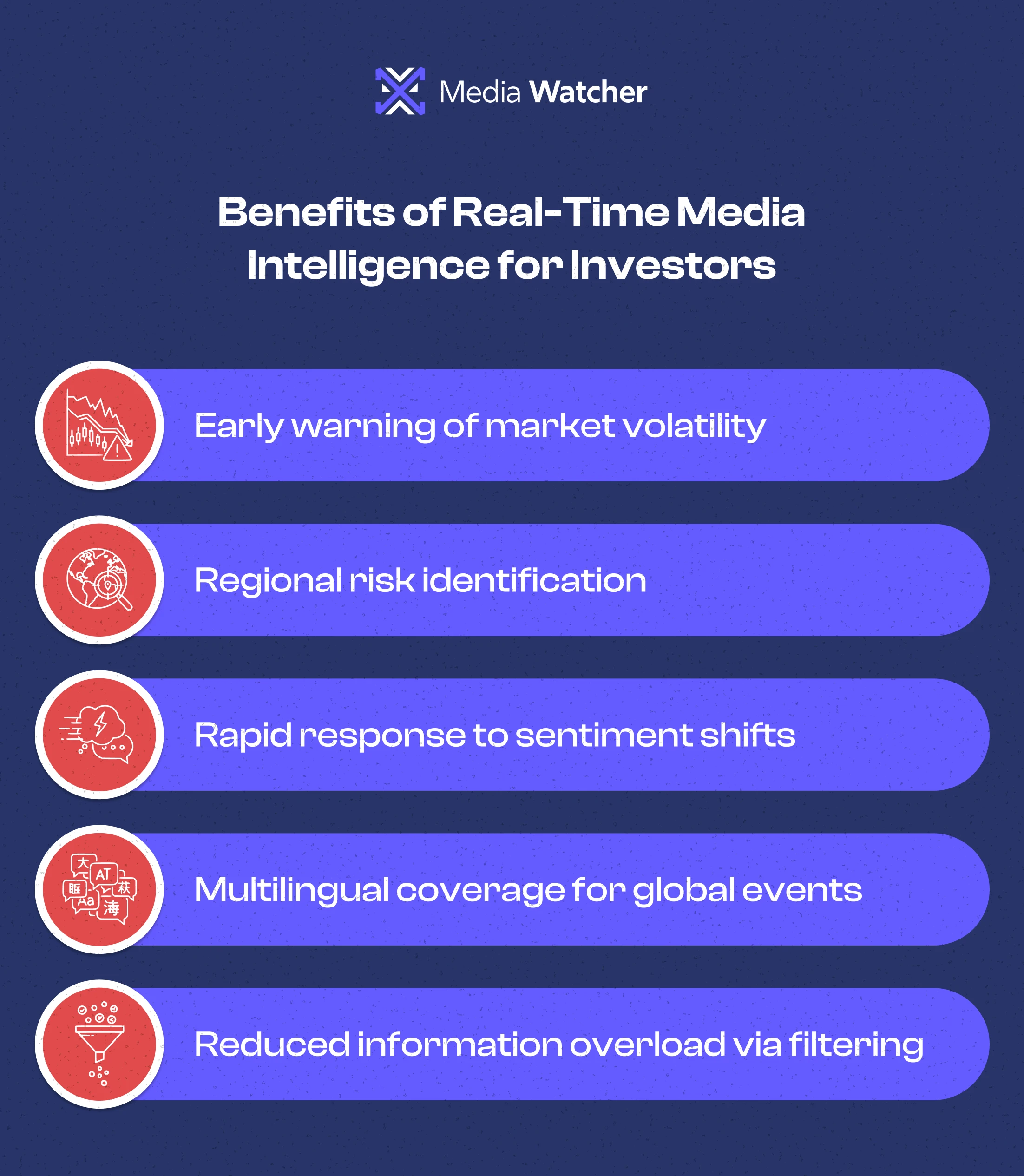
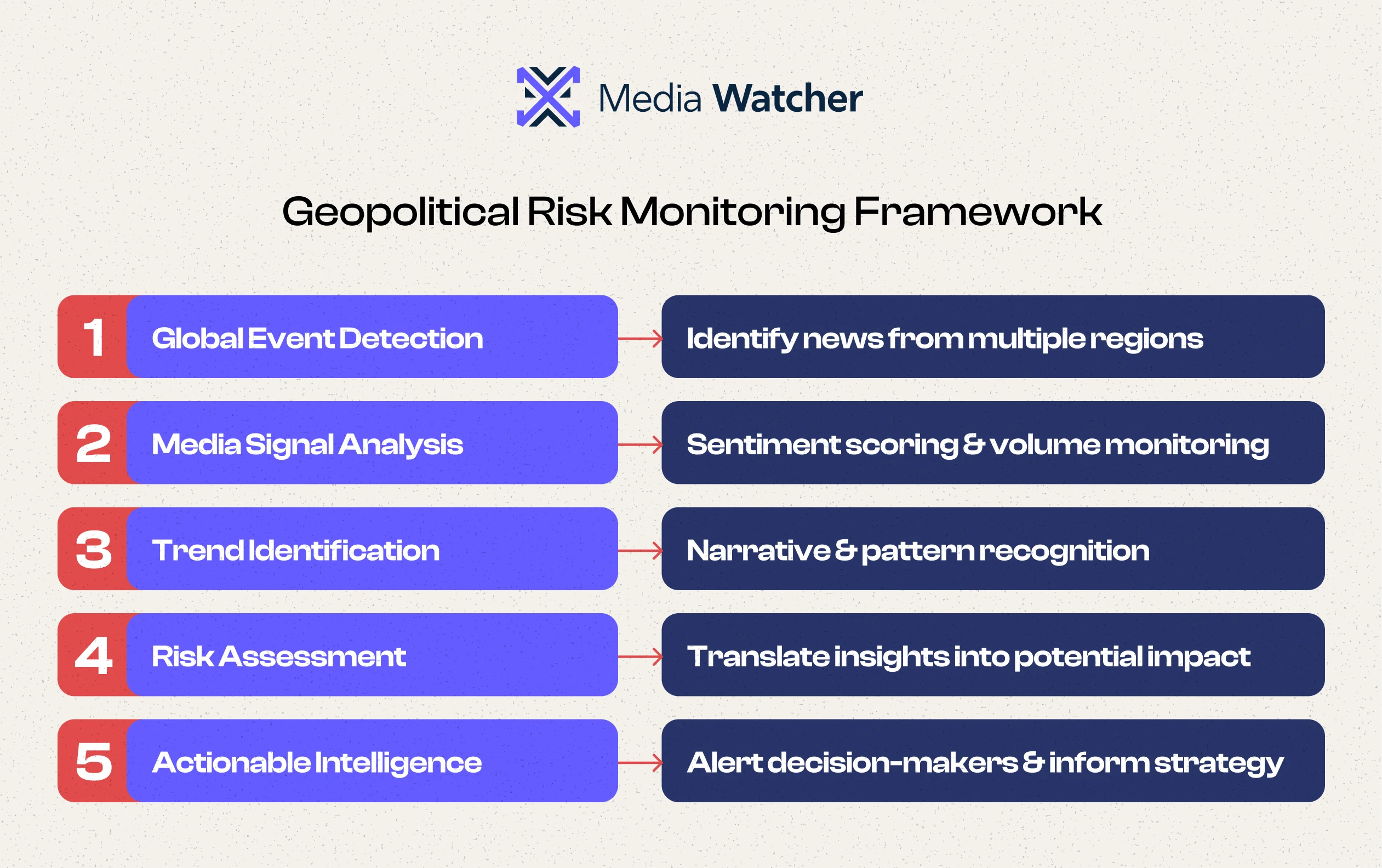
The initial necessity is global news tracking in real time. Changes do not occur in one area at a time, and the use of one set of sources may result in partial analysis. The observation of various international media, such as regional publications, will give a more precise view of current events.
Intimately related to this is sentiment analysis across markets. Not all news updates are of equal weight. The manner in which an event is perceived is often indicated by the tone of coverage, whether negative, cautious, or optimistic. The change in mood may indicate future volatility before any financial effect is felt.
Narrative and trend identification are other important components. Geopolitical risk is not usually the result of one event. Rather, they are formed by repetitive media coverage. Recent trends, like the emerging issue with regulatory adjustments or the rising level of attention to regional conflicts, can be used to predict the escalation of risks within organizations.
Finally, prioritization and data filtering make sure that the information does not overwhelm decision-makers. The abundance of global news can be noisy, and it is hard to find substantial information. Good geopolitical risk analysis tools aim at isolating pertinent signals against background noise.
Indicatively, a global company tracking its activities across different parts of the world can observe that the Asian press is more guarded and the European media is more consistent. This regional distinction gives a warning of local risk in advance, enabling proactive adaptation instead of reactionary action.
Challenges in Geopolitical Risk Monitoring and How Technology Solves Them
There are a number of challenges associated with geopolitical risk monitoring that can be restrictive to its performance when not dealt with effectively. The excessive amount of information is one of the acute problems. As thousands of news articles are published every day, the task of finding something valuable to say is getting more difficult.
The other problem is in determining signal and noise. It is not all headlines that represent a real threat. There are changes that are only momentarily followed without lasting effect, and there are changes that happen quietly and then affect markets. It can be hard to separate these signals without the appropriate tools.
Another obstacle is language and regional prejudice. Significant developments can initially be introduced in local media before being publicized on a global scale. Their absence may postpone reaction and cut down on strategic edge.
One of the key solutions to these difficulties is technology. High-tech financial media monitoring systems rely on AI-based filtering to remove noise, enabling analysts to concentrate on meaningful developments. Real-time alert systems make sure that important updates are not overlooked, even under rapid developments.
Moreover, multilingual monitoring features allow organizations to monitor stories in various regions concurrently. This method gives a more balanced picture of world opinion instead of the one point of view.
As an example, a sudden rise in negative sentiment with a corresponding jump in the volume of media coverage can signal that there is a growing concern during the initial phases of a geopolitical event. By detecting these trends using geopolitical risk analysis tools, investors would be able to react more confidently and accurately.
Consequently, technology makes geopolitical monitoring more of a proactive strategy than a reactive process, allowing organizations to anticipate uncertainty.
How Media Watcher Strengthens Geopolitical Risk Monitoring
In a world where global transformation is a constant fact, timely insight is no longer a competitive advantage; it is a necessity. Lag in interpreting geopolitical shifts can result in missed opportunities or risk exposure. This is where Media Watcher comes into play.
The platform offers a cohesive and transparent overview of emerging risks by integrating real-time global media monitoring, sentiment analysis, and intelligent filtering. With the world starting to rewrite its narratives, the initial cues like sentiment shifts and increased media volume are soon spotted. Moreover, multilingual coverage will capture regional developments before they attract more attention.
Media Watcher, as an investment intelligence platform, assists in converting the overwhelming global data into targeted insights to make more confident decisions in a world that is increasingly uncertain.